


|
|
|
|
 |
 |
   |
interview Experiencing
the sensual A
word about letters
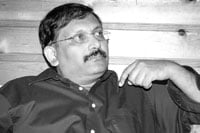
Amaresh Misra appears to be a young man, but he is actually over 200 years old--not quite, but talk to Misra about South Asian history and his scholarship would convince you that he has seen the events of the last 200 years through his own eyes. On the sesquicentennial anniversary of 1857, two noticeable books on that war were published. One came out from the land of the past major colonisers of South Asia, the other from the land of the past colony. Amaresh Misra is the author of the latter work titled "In War of Civilisations: India AD 1857." Misra is currently in the US, on a promotional tour of his book. This scribe talked to Misra at a private gathering and later interviewed him on the phone. At the dinner meeting with Misra a relevant Punjabi documentary film 'Taropa', produced by Lahore-based filmmaker Huma Safdar, was also screened. Taropa convinced the audience that, though fading with time, oral accounts of the 1857 war are still present in parts of South Asia, and invariably in places of low human mobility. The telephone interview with Misra is being produced below: By Ali Hasan Cemendtaur The News on Sunday: Why did you write this book? Amaresh Misra: Around 2003
I realised that the 150th anniversary of 1857 was approaching. On the 100th TNS: Were there many other books written on the sesquicentennial anniversary of 1857? AM: Yes, there were, but besides Dalrymple's and mine, no other book covers the entire event. TNS: What primary sources did you rely upon during your research of the 1857 war? AM: Primary sources were basically the immense amount of material preserved in the National Archive in New Delhi--also the state archives in Lucknow, Patna, Bhopal, Bombay, and Ahmadabad. Apart from that I also went to the old pre-British libraries: the Raza Library in Rampur, Shibli Numani Library in Azamgarh, Khuda Baksh Library in Patna, and also to the Deoband Library. Historians are inclined towards looking only at English sources. But I checked Urdu, Persian, and Arabic sources as well. And you have to do that because a lot of Indian perspective comes from material in Urdu, Persian, and Arabic; also in Hindi, Awadhi, and Marathi. Many primary sources that I looked at were actual narratives written by the actors in 1857--the reports that were compiled and sent. The gazetteers were very important sources. TNS: But these records have been around all this time. Why other historians did not bother to look at them as thoroughly as you have? AM: I am really surprised because no other Indian researcher has bothered to look at the gazetteers. The British published new gazetteers every fifteen or twenty years. I went to the oldest gazetteers, those published in 1858 and 1859. I think most historians are too structured. My background as a journalist helped. My training is to question structures, not to work in a structured way. This really helped in being eclectic in approach, reaching out to sources, and working on intuition. TNS: British declassify material after a few decades. So 1857 material was declassified a long time ago. Then what's new? AM: Yes, that material has been declassified for a long time. What recently got declassified was the material concerning British opinion about 1857, after 1947. It was under the MI6 files and others: how they perceived the memory of 1857 and how they perceived 1857 as still politically explosive, even in the 20th century. TNS: Who translated the regional language material for you? AM: I know Urdu so Urdu was easy, but still I needed an assistant who knew Persian and Urdu. So I contacted some friends in Allahabad and they were kind to translate Persian material. Most of the Arabic books written on 1857 had been translated in Urdu so it was easy for me to access those. The Bengali and Marathi literature was translated for me by friends and assistants, so the whole project was a team effort. TNS: In essence you found most of the material in India. Or did you go to the UK too? AM: No, I did not go to the UK. There was a plan but it did not work out. But I knew certain British families whose members had participated in 1857, and they had written family papers. And those papers were not even given to the British library. I was very lucky because some of the papers revealed, like say, uprising in the Madras Army which has totally been suppressed. You don't even hear about it. From the official British stand point there was no mutiny in the Madras Army. But I found this material from a family whose ancestor was posted in Madras and he was writing back. TNS: Which indigenous language had the most material available on the 1857 war? AM: Of course Urdu because in that era people wrote in Urdu. Also Persian, for example the court of administration established by the sepoys when they overthrew the British and put Bahadur Shah Zafar on the throne, had its proceedings in Persian and those proceedings are preserved in the National Archive in Delhi. TNS: So, after winning the war, the British did not destroy those local records? AM: No, they did. For example they suppressed this entire story of how many Indians were killed. They never let anyone tabulate the numbers. The figure I have brought up, that out of the population of 150 million, 10 million Indians were killed, that is seven percent of the entire population. That is the highest death toll figure in proportion to the overall population in modern history. British did destroy all records on the genocide. What they preserved was the story of the battles because the British had to report to their superiors. They had to present the real situation on the ground. A lot of letters went from the junior officers to senior officers, and seniors to juniors, giving instructions, so they give a lot of information. The figure of the genocide I reached, I tabulated from land, railway and labor survey reports. For example when a British officer is trying to build a road in a town in Awadh in 1870s he is finding there is not enough labor; he is trying to understand the cause and he understands that most of the men here were killed. And this is a general practice when you are trying to reach a figure for genocide--obviously records are not there. So you compare the labor records and operation records and you reach a figure. This indirect method of reaching a genocide figure is called the triangulated analysis. TNS: Many of the families that were instrumental in the 1857 war are presently not in India. Some are in Pakistan and others in Bangladesh. Did you also consult with those families to check their historical family records? AM: I sought the help of Sang-e-Meel Publications in Lahore. They were generous to supply me a whole list of gazetteers of districts of Punjab, Sind, and NWFP. Similarly I was able to get gazetteers from Bangladesh of Dhaka, Chittagong, and Fareed Pur. So, I did not talk to the families but I was able to dig up a lot about who sided with the British and who sided with Bahadur Shah Zafar, because British rewarded those families who sided with them after 1857. I have a rare book with me called "Princes of Punjab" and there are British records too in which they published lists of allottees and from there you can see the elite that emerged in what today is Pakistan and Bangladesh. TNS: Would you consider feudalism coming out of the event of 1857, or was it that the land that was given to the favorites of the old regime was taken from them and given to the new favorites? AM: It is too simplistic to say this. What British did in India is what I would call major socio-economic engineering which means that during the Mughal period land was held by peasant communities, and these communities paid revenue to the state. And in the European sense there was no private property in land. In Ain-e-Akbari everywhere Abu Fazal mentions that the state is not engaged with individuals, the state is engaged with the communities. When British came they overturn this whole structure and introduced the idea of private property in land. In Europe, feudalism was based on individual ownership of land. So British had no conceptual tool to analyze South Asian phenomenon. Also, this whole idea of communities holding lands went against their plan to squeeze the maximum land revenue and the maximum revenue could only be squeezed out if the land was held by private individuals. So land was taken from peasant communities and was given to individuals. In Bengal the land was given to a new generation of Brahmins. In UP it was given to the Banyas. This way the British were able to isolate themselves from the communities. The British invented feudalism in India and through this process killed the possibility of an indigenous industrial revolution and indigenous modernity which was evolving through the peasant communities. When the peasant communities had to pay in cash they were also into entrepreneurship, they were finding new ways to generate money. There was a lot of dynamism in those communities which came to an end once feudalism was re-invented. The peasant became a serf, in the European sense. And today this is a major cause of poverty in many parts of South Asia. In those times this change in land-holding structure resulted in severe famine, because the earlier food security and sovereignty of communities was shattered. TNS: Do you think reading your book the present warring South Asian communities would unite against a past enemy, the British colonisers? AM: Present day communities, seemed locked in communal conflict, are not the original peasant communities. The communities we see today are invented communities. For example, the pan-Indian identity was invented after 1857. The pan-Hindu identity was invented when a new middle class started emerging and started competing. And in competing it constructed its identity, which the British encouraged because they thought this kind of community formation would help them. So that is how modern communalism emerged in India. Communitarianism was an old phenomenon and was progressive, but communalism is regressive. In modern India, the whole idea of community was distorted by the British. The idea of a community based on soil, based on loyalty was replaced by a community based on vested interests. TNS: You say that the 1857 war was not confined to a few parts of South Asia, that it happened through the length and breadth of the region. In those days of limited means of communications how did the news of revolt reach from one place to another? AM: This is one question that even the British failed to answer at that time. My research tells me there was a whole network of spies and messengers that was created. Obviously there was a lot of planning. Indians were planning something like this since at least the annexation of Avadh, if not before that. So within ten days of Meerut, the news reached Andhra Pardesh. British had telegraph, but the Indians did no. This local network was based on old linkages of peasant communities. TNS: If the 1857 would have been won by the locals, how it would have changed the history of our region? AM: Entirely! First, there would have been no partition. The kind of political structure that the Mughal had in which there was a lot of regional autonomy would have evolved further. India would have taken its own peasant past towards the industrial revolution, towards modernity, instead of the half-baked European modernity that we now have, we would have genuine modernity. Had the 1857 revolt succeeded we would have seen a strain of South Asian Islam very different than what we see today.
Pal
bhar ka bahisht By Sarwat Ali Sarmad Sehbai started to
write poetry while in college and since then three of his books of poetry
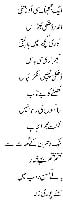
have been It may be a little difficult to place Sarmad Sehbai's works in the traditions of our poetry as they have evolved and developed in the last fifty odd years because of the uniqueness of his expression. In his latest poems, it seems that the objective world has receded further from his vision and he is more preoccupied with discovering the entire gamut of experience through the pixel of his sensual experiences. These sensual experiences, wrapped in the intensity of the erotic, point to his reversion to the quality of experience which derives its basis from the quality of its intensity. Like traditional poetry, he draws the parameters from the physical experience embodied in love, but unlike the traditional poets there is an awareness of the perils that lie in wake of essentialness being lost without appearing to be so. There is a certain freshness about his style, inexorably linked to the freshness of the experience. It appears that the various layers of experiential reality have become cloyed, almost trite, embedded in many folds of clichéd existence. This is an effort to release it from the accretions of received experience, to taste it anew and to celebrate its newly formed shape. And the rhythmic movement
is unique as the experience it expresses. The poet is breaking into imagery
that is not Sarmad Sehbai has vitalised the mainstream expression by drawing on what is not mainstream. The experience not worth recording has been elevated to the level of the standard expression; the commonplace imagery fresh in its newness has coexisted with standard metaphors.
The world has changed from
the ideological given-ness of reality and now calls for discovering new
ground to trace There are many echoes of his poetry from the past. The convoluted images piled upon each other then created the futility of experience because the experience needed to be revitalised by a bigger backdrop of change, but now it is the receptiveness of authenticity that is encased in flashes, in moments that do not last. It is the effort to capture the transient nature of that intensity that preoccupies him greatly. But from the past are his
intense descriptions of passion going to seed, the futility of love in the
time of cholera, the When Sarmad Sehabi started to write poetry there was the influence of the new poets who were attempting to change their expression, structure, rhythmic movements and metaphors according to their sensibility. Gilani Kamran and Iftikhar Jalib represented the two poles while Yousaf Zafar, more irreverently, debunked the values esteemed by the classical expression. Behind these poets was the tremendous lyricism of Akhter Shirani and then the immediacy of sensual experience embodied in Meera Ji. The latter in particular explored and changed the revered style, caressed and scratched the underbelly, the rawness of sensuality that often got lost in the much chiselled expression that has been handed down from previous ages. The erotic poetry in the
tradition of our poetry is only in its perverted form. "Wasookht"
is graphic in its treatment of the physical aspects of human relationship but
there have been other sources to tap into. The Hindi poetry is very rich in
its erotic elements, going back to the classics and the verses in their
rhythmic stresses and in Punjabi too the oral tradition intensifies and it
seems that he has drunk deep from those wells and doused it in the colour
that the local idiom yields. He had been weary of the staid poetic expression in the past as well. "Neeli Ke Sau Rung" too was a successful attempt at erasing the barriers between the high tradition of the ghazal and the more malleable Punjabi and Sindhi forms. There he was inspired by the lyricism of the Kaafi, with its embedded imagery that springs from the very roots of living in a land that afforded plenty, a diversity of religious beliefs, castes, colours and landscape all encased in the absolute ring of the feminine protagonist – it is the same ring of the feminine that finds a male counterpart in his erotic poetry. He has not been a very prolific poet -- three volume in more than thirty years and if quality of verse is the only litmus test then there is no cause for regret. It appears that the poem of love is still in the process of being written and we will not have to wait very long for his next publication. A
word about letters Sachal Literary Conference I spent four days of the past fortnight at Khairpur in Sindh to attend a national literary conference held in connection with the 187th annual Urs of Sufi saint and poet Sachal Sarmast who composed poetry in seven languages: Sindhi, Seraiki, Punjabi, Hindi, Urdu, Persian and Arabic. Organized by the Culture and tourism Department of the Sindh Government, the conference attracted a number of poets, writers and intellectuals from many parts of the country. Renowned scholar Nawaz Ali Shauq who is a former professor and head of the Karachi University's Sindhi department and is now serving as adviser to the Shah Abdul Latif Bhitai Chair at the university came from Karachi. Haider Sindhi, who recently retired as chairman of the Pakistan Studies at Quaid-e-Azam University, Islamabad, was also there and so was Abdul Jabar Junejo who is a former dean of the faculty of arts at Sindh University and chairman of the Sindhi Adabi Board. Hiadyan Prem, former chairman of the Sindh University's department of Sindhi literature, Taj Joyo of the Government College, Hyderabad, Bashir Ahmed Shad of Larkana as well as many senior teachers of Shah Abdul Latif Bhitai University including chairman of the Sindhi department Adel Soomro, Chairman of the Urdu department, were there. Yousuf Khushak and Altaf Asem of the Sachal Chair were prominent among the scholar who graced the conference. Those who came from Punjab included Shafqat Tanvir Mirza, who head of Punjab Adabi Board, Nabeela Omar of the Punjabi department of the Punjab University's Oriental College, Tahir Taunsvi, chairman of the newly-established Sargodha University's Urdu department, Rashid Mateen of the Higher Education Commission, Islamabad and Khizer Naushahi of Mandi Bahauddin. The conference was chaired by the speaker of the Sindh Assembly Nisar Ahmad Khuhro while the young and fiery Sindhi Minister of Culture and Tourism Sassi Palijo was the chief guest. In his welcome address the Director General of the Culture Department, Moonis Ayaz Sheikh, who till recently taught international relations at Khairpur University and is a columnist and a poet,highlighted the need of Sufism in the modern world. The great mystic poets and saint he said, gave the message of tolerance, universal love and respect for other and these the values that we need today to counter aggressive fundamentalism. It was also the central theme of almost all the papers presented a the conference. In his keynote address, Sakhi Qabool Mohammad, the custodian of the Sachal Sarmast Shrine and a notable scholar of Sufism, said that all the major religions of the world had nourished mystic traditions which played vital role in developing religious humanism. Many scholars pointed out that the poetry of Sachal Sarmast is based on the metaphysics of pantheism which breeds pluralism. His pantheism links him to the great sufi intellectuals and poets of the Indus Valley like Shah Hussain, Baba Bulleh Shah, Sultan Bahu, Rehman Baba, Khushkhal Khan Khatak, Jam Durak and Shah Abdul Latif Bhitai. Ms. Sassi Palijo said the present Sindh government will take all the necessary steps to preserve the cultural heritage of the province. Announcing the plan to construct a cultural complex at Sachal Sarmastís shrine, she also pledged to publish the complete works of the poet. The first session of the conference continued till 3ío clock in the morning and I was amazed to see that hundreds of people kept listening to the speakers with wonderful patience. The session was followed by a Sihdhi, Seraiki, Punjabi and Urdu mushaira. Prof Adel Soomro told me that about seventy poets who had gathered there from many parts of the country were to participate in it. Baba Sahiba Ashfaq Ahmad's best book has now hit the stands four years after his death. Published by the Sang-e-Meel Publication of Lahore under the title Baba Sahiba, it narrates the story of his lifelong search for spiritual gurus. The 668-page tome throws light on his intellectual and emotional development and also apprises us of his spiritual experiments. Ashfaq Ahmad had always been a seeker of truth but my observation is that his quest for truth had greatly intensified during the last year of his life. The book was not complete when he passed away in September 2004. Bano Qudsia, his widow and herself a noted novelist, gave final touches to its manuscript. I rate Baba Sahiba as Ashfaq Ahmadís best book because the beauty of his language is bewitching and power of his style is at its zenith in it.
|
 anniversary, in 1957, a lot of books had come out. I thought 2007 was a great
occasion to write an analysis of 1857 from an Indian perspective.
anniversary, in 1957, a lot of books had come out. I thought 2007 was a great
occasion to write an analysis of 1857 from an Indian perspective.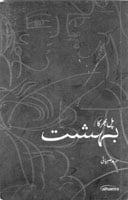 published. In the meantime, he also meandered into writing plays, almost
verse plays -- not entirely in verse but tending to explore the middle ground
between verse and prose --
published. In the meantime, he also meandered into writing plays, almost
verse plays -- not entirely in verse but tending to explore the middle ground
between verse and prose --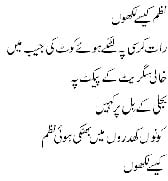 quite in the traditional mould of the mainstream expression. He has deviated
from the mainstream in search of something raw, something new, something that
is not trite and reclaims a quality that draws on various sources. These
sources are the folk and classical idiom from the various dialects and
accents that have been sacrificed in the great drive for standardisation.
quite in the traditional mould of the mainstream expression. He has deviated
from the mainstream in search of something raw, something new, something that
is not trite and reclaims a quality that draws on various sources. These
sources are the folk and classical idiom from the various dialects and
accents that have been sacrificed in the great drive for standardisation.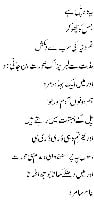 Many
a time he writes in the "behar" or the verses of well-known poets
not as emulation but really as in contrast to clarify the difference that
exists; at other times he breaks into new territory to explore the
experiential reality not enshrined in standard poetic expression.
Many
a time he writes in the "behar" or the verses of well-known poets
not as emulation but really as in contrast to clarify the difference that
exists; at other times he breaks into new territory to explore the
experiential reality not enshrined in standard poetic expression.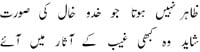 and map raw experiences. It is as if the poet is lapsing back to his gut
feeling to feel reality rather than the ideas and sensibility that a
well-wrought expression creates.
and map raw experiences. It is as if the poet is lapsing back to his gut
feeling to feel reality rather than the ideas and sensibility that a
well-wrought expression creates.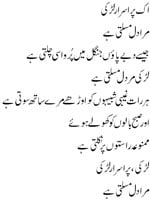 passion that runs around on barren soil. The desires and wishes of common
people which die even before they are born
passion that runs around on barren soil. The desires and wishes of common
people which die even before they are born