



|
|
|
|
 |
 |
   |
controversy United
state-ment on Pakistan Taal
Matol quake Follow
it up RIPPLE
EFFECT
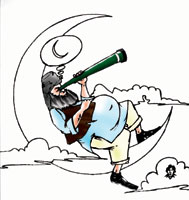
The more the merrier, except in the case of Eid By Waqar Gillani Moon sighting or moon
fighting? This is what mars the Eid ul Fitr celebrations every year. This
year The difference on moon sighting usually leads to two Eids -- in certain parts of NWFP and the rest of the country. Parts of NWFP are geographically so located that the new moon can be sighted immediately. This year, too, the provincial government of NWFP announced to celebrate Eid ul Fitr on Oct 1 after over a dozen of witnesses from different parts of the province claimed to have seen the new moon. The announcement came amid constant news reports on behalf of the Meteorological Department that indicated the unlikelihood of moon visibility on Sept 30. The RHC decided to defer the claims coming from NWFP, as per its procedure, witnesses should have directly contacted the RHC zonal committee members for authentication. It took three hours for the committee to announce a decision to celebrate Eid ul Fitr on Oct 1. Consequently, the eid was celebrated on two different days in Punjab. Many religiously divided segments of society in various districts of Punjab including Lahore, Gujranwala, Multan, Melsi, Faisalabad, Gujrat and Sialkot refused to accept the official declaration. They announced fasting on the officially declared Eid-day, believing the RHC decision was wrong as it was made under political pressures. But this was not the first time it happened. It has happened before also; two Eids were celebrated in Punjab in 1947, 1968 and 1979. Kiramat Ullah Khan, member provincial assembly NWFP, told TNS they wanted to end this monopoly of clerics. "RHC must attend to public witnesses and consider their accounts properly instead of making quick decisions." He added that Pakhtoons and ANP believe that the Government of Pakistan must follow Saudi Arabia -- the centre of Islam. Bashir Bilour, senior minister of ANP in the NWFP government, told the press that they wanted unanimous decisions on Eid and for the consensus it would be better to follow Saudi Arabia. Chairman Ruet-e-Hilal Committee, Mufti Muneebur Rehman, said talking to TNS that the committee had to confirm and authenticate the witnesses and this takes time "because witnesses are required to present themselves before the nearest zonal committee." To the question whether the issue can be resolved amicably and with consensus by changing policy procedure, he said, "I don't think this is possible in a country like Pakistan. Has the issue of Waziristan been resolved? Has the issue of judiciary been solved?" he asked, adding, "If we are incapable of resolving such issues how we can settle the issue of moon sighting." He claimed the RHC procedure was quite appropriate but people didn't have any patience, tolerance or respect for the committee. He said there was no solution to this issue yet Former federal minister of religious affairs Ejaz ul Haq, however, has a different point of view. "NWFP always prefers to celebrate Eid with Saudi Arabia as it happens in Afghanistan. This controversy cannot be resolved without bringing NWFP's people, especially those associated with Qasim Mosque, on board," he said, adding, "But the interesting thing is that the Qasim Mosque people do not want scientific experts on board. They have different hadiths which negates the present procedure. This way Eid is only possible when they approve it." "There are also psychological and political pressures on the committee too," he admitted, adding there were chances of indirect political pressures on the committee by the government. Ejaz ul Haq said the previous government had also formed a committee last year to settle the issue but there was no third meeting of the committee after difference of opinion of various clerics. "The issue cannot be solved," he nearly declared. Retired chief meteorologist of Met office Shaukat Awan told TNS that according to astronomical calculations, there was no chance of moon sighting because of its short duration, low angle above the horizon and size. Scientifically, he said, the technical parameters are internationally calculated with the help of two books named Nautical Almanac and Air Almanac. The books are annually published after the United States and United Kingdom agencies determine the position of the stars, sun and moon throughout the year. Then this calendar is followed internationally. "NWFP has an edge because of its geography and the latitude of moon in that area, especially in Charsadda," he said. However, Awan was of the view that the final declaration of the moon's visibility must not go beyond 9pm in Pakistan. "In Saudi Arabia the committee announces Eid and if there is any doubt after seeing the next day's moon's shape and size, they announce Qaza Roza." "People think that there was political pressure on the committee, which is wrong," said chief meteorologist of Meteorology Department, Hazrat Mir. "The Met Office had already predicted that the time duration of the moon's visibility was very little this year. However, we had also set up 80 observatories across Pakistan to not lose any chance of moon visibility, if possible." Sahibzada Hamid Saeed Kazmi, advisor on religious affairs to the prime minister, said, "The fact of the matter is that the committee had been trying to authenticate the witnesses presented by the NWFP government that took so much time." "The people doubted the decision of RHC because of the late announcement. At the same time, the NWFP government is not happy either because the committee did not immediately agree upon the witnesses," he said adding the procedure of the committee was correct and based on Islamic principles. "However, if people have objections on the procedure or have a different point of view, they must propose positive suggestions to the committee or the government." Historically
speaking Just how did Ruet-e-Hilal Committee come about and how it works... "The central Ruet-e-Hilal Committee was formed through a resolution of the National Assembly in 1974," according to sitting chairman Mufti Muneebur Rehman. Previously, there was no central procedure for the crescent moon sighting in Pakistan. Different governments in the past tried to set up various committees, including one formed in Ayub Khan's era. The objective of the RHC was to verify the witnesses of moon sighting across Pakistan. The committee further set up zonal committees in all districts of the country. According to the procedure of the committee, as told to TNS by Mufti Rehman, all district committees and central committees hold their meetings and try to sight the moon on the end of every Islamic month. The district committees inform the central committee after the authentication of any witness. Then the central committee makes the final decision. The central committee comprises 10 to 12 noted clerics from different schools of thought. Experts from SPARCO, Met Office, and the Government of Pakistan also join the meeting at the end of every month. Mufti Rehman further added that a witness is technically confirmed by the members of the committee(s). If someone sees the crescent moon, he or she should talk to central or zonal committee members who are available to the public on that day and then appear before the zonal comittee in person. The committee then asks the witness about the location, size of the moon etc. before making the final declaration. -- Waqar Gillani
The signs that US policy towards Pakistan is hardening are being emitted every day from Washington By Arif Azad Following the Sept 3 US
Navy Seal incursions inside Pakistan, there is a gathering consensus within As President Zardari's visit to the US came on the heels of the Marriot bombing, there was considerable criticism of the visit undertaken at a time when the grieving nation needed its leaders to be close at hand. The visit, however, was justified on the premise that it was planned long ago as part of the UN General Assembly session. The UN session would provide Pakistan the opportunity, it was argued, to showcase its new political leadership alongside interacting with world dignitaries assembled for the UN general assembly session. Another allied, and foremost purpose, was to engage US top leadership to understand Pakistani sensitivities on the issue of border incursion by US troops. The US government for its part underlined seriousness of the visit before President Zardari took off from Islamabad. On reaching the US, President Zardari went to great lengths to underline Pakistan's seriousness in fighting the War on Terror while struggling to preserve its political and geographical sovereignty. The next day meeting with George Bush, the US president, looked more of a routine affair, with Bush making customary lip-service reference to the issue of sovereignty. The official hard-line dropped from the lips of Robert Gates , the US defence secretary, who bluntly told the US Congress committee that US was well within its rights to strike deep into the Pakistan territory. He further rebutted President Zardari's statement that striking within Pakistan territory constituted a violation of the UN charter. The same line was toed in the presidential debate where both McCain and Barak Obama agreed on the eventuality of attacking militant hideouts inside Pakistani territory Though much of the newspaper comment sought to find some comfort in McCain's slightly nuanced approach on the issue, there was no doubt in any mind that US would adopt a bipartisan policy of attacking Pakistan in pursuit of militants if the situation so demanded. President Zardari also cited the formation of Friends of Pakistan -- a consortium of Pakistan friendly countries -- who are well disposed towards pulling Pakistan out of its economic straits (After the Marriot bombing, Pakistan has already been declared a non-family station for the staff working in the UN and other international organisations). The absence of Saudi Arabia -- involved in many bailouts in recent years -- from the consortium meeting does not augur well for the Friends of Pakistan initiative. Though UK did lend verbal support to the idea, it indicated preference to work through existing financial institutions. The group's next meeting is to be hosted in Dubai. President Zardari has put Pakistan's immediate financial needs at more than 10 billion dollars. Whether this need is urgently addressed by the group remains to be seen in the coming days. At the root of it all, perhaps, is Pakistan's sullied brand, damaged by Pakistan's half-hearted and fitful attempts to fight terrorism. President Zardari would be well advised to make sparing use of Benazir's anti-terrorism credentials unless substantial verifiable progress in containing Taliban and ensuring law and order on the ground is made. Because more is going to asked of us in future as the US is leaning towards beefing up its troops in Afghanistan. The signs that US policy is hardening are being emitted every day from Washington. Further proof of this came a few days after President Zardari left the US. Both Joe Bidden, democratic vice presidential candidate and Sarah Palin, republican vice presidential candidate, launched a frontal assault on the current policy and fully endorsed the notion that Pakistan and Iran are the most dangerous countries in the regions. Lumping Pakistan with Iran in the US demonology is something which should send shudders down our collective national spine. All of this seems part of a radical policy change on Pakistan-Afghanistan signed off by George Bush in July and has been dutifully echoed by every official since. This has put Pakistan in a tight spot and finding a way out requires statesmanship of first order backed up by public and institutional support. What can the government do in this scenario? By adopting the following policy options, the long term peace and security of Pakistan can be enhanced. First and foremost, the political and military elite need to redefine the problem of terrorism in terms of a purely law and order problem. There is no point in justifying the killing of civilians as a reaction to the US strikes in Pakistan (that needs to stop as well and condemned outrightly). We need to secure peace and security within our boundaries first and then look for excuses of current mayhem elsewhere or seeking millenarian adventures elsewhere. After all, the foremost test of any credible government is ensuring the safety of life and limb of its citizens. Second, the government needs to take ownership of the political direction of the policy. In this, there should be no parallel policy operated by intelligence agencies. The new policy should also enjoy the confidence of the people. On any showing, the doctrine of strategic depth has proved a colossal failure, with Pakistan providing strategic depth to religious fundamentalism -- exactly the opposite of what was flaunted as the geo-strategic masterstroke of the century Third, the new government should adopt a more rational policy towards India. By overwhelmingly making India a fixation of our existence, we have taken our eyes off the pressing needs of development and institution building. The policy of anchoring religion in foreign policy --in Kashmir and Afghanistan -- has boomeranged on us in terms of inverted extremism too. This can only be corrected by returning the making of foreign policy to where it belongs -- the parliament. With pressure building upon us on a daily basis we need to be alert to the enormity of the task facing us. By Shoaib Hashmi There is the ancient story
of this man who had a truly dumb son, so that when the son grew up they They decided to start by printing a ten-rupee note. They worked hard and when the note was ready they noticed they had made a slight mistake. They didn't think anyone would notice but their professional pride was hurt. It seems instead of a ten-rupee note they had made a fifteen- rupee note! The man took it to the next village where maybe no one would suspect him, and here he came upon an old woman, half blind and totally deaf minding her little kiosk. He asked her if she would give him change for a fifteen-rupee note. The lady cackled in his face and asked him if he thought she was dumb, or what. But then she relented, seeing he was a stranger and said she would give him change, but not the full fifteen. She would give him fourteen rupees! The man couldn't believe his ears, he thanked her and gave her the note which she looked at closely and felt it, then folded it and put it away, and then she went off home, rummaged about in her stuff, and came back -- with two seven-rupee notes! I am reminded of this because it has come home that for a couple of years someone at our Central Bank has been having a ball. Mainly they have redesigned and issued new versions of all our notes and coins, in some cases more than once. There are new versions of the one, two and five-rupee coins -- only all are the same design, and practically the same shape and size so no one can tell them apart. Now they have gone back to the five-rupee note. They have printed a few million and are issuing them, wads of a hundred notes at the bank -- and they have all disappeared and are selling in the black market at eight hundred rupees per wad! You can't actually buy anything for five rupees, see, and mostly they were used for handing out Eidi, the Eid present, or for making garlands of notes for bridegrooms. With the note gone people found either kids were sneering at a coin for Eid or they had to switch to garlands of ten-rupee notes and weddings were costing a fortune. Now it is the Eid season, and the wedding season is hard at the heels, and someone has had the good sense to reprint the five-rupee note, which, as I say, you can buy for eight rupees! I have a suggestion. Why don't we simply strike a fifteen-rupee note and put everyone out of their misery! People hit by the earhquake on Oct 8 are still far from satisfied with the speed of the reconstruction and rehabilitation efforts By Nadeem Iqbal "Last winter, 76 year
old Shahji from our area waited all night outside the bank so that he could
be in These are the words of a man, left unnamed for obvious reasons, from one of the 45 case studies that Omer Asghar Khan Development Foundation (OAKDF) has carried out in its report Surviving on the Faultline launched on the eve of third anniversary of the Oct 8 earthquake. The OAKDF research is based on 37 village rehabilitation action plans and a questionnaire survey that were prepared by local people in 37 villages of 15 union councils of district Battagram, Mansehra and Abbottabad. The findings are about the affectees of the over 250 union councils, who are far from satisfied with the speed of the government agencies in materialising their promises of reconstruction and rehabilitation. The main area of concern is housing for the people. An estimated 600,000 houses were destroyed as the earthquake affected an area and a population equal to that of Switzerland. Quoting ERRA (Earthquake Reconstruction and Rehabilitation Authority), the OAKDF report says that ERRA states that construction has been completed on 409,613 houses, 118,406 are under construction while no work has yet started on 35,972 houses. It becomes clear that 462,900 persons have received only the first tranche of housing support and that 244,583 (52.84 percent) people have not yet been able to access the last tranche. As per ERRA policy, the owners of completely destroyed houses are to get Rs 1,75,000 in subsidy while the owners of damaged houses are to get 75,000 each. The subsidy is to be released in three stages of construction after inspection to see if the construction is complying with a earthquake resistant model. The report quoted a widow of Union Council Bakot claiming that the official inspectors inspected the plinth of the house and then demanded a bribe that she could not pay, therefore they did not complete her form and her house remains partially built todate. Rashida Dohad of OAKDF told TNS that the cost of accessing subsidy has been often quite substantial that includes expenditure incurred on transport and documentation. It has often also included bribes and other forms of rent-seeking. More blatant bribes of up to Rs 25,000 were paid to assessment teams on different stages, while the condition of remote areas is worse, where rent seeking rate is higher and the cost of follow-up cases is greater. Ali Asghar Khan, executive director OAKDF, told TNS that these delays have increased the cost of construction manifold." A one room structure of 400 square feet in 2006 would have cost Rs 250,000 in a village with reasonable access. Today the very structure costs Rs 400,000. Therefore the buying power of the subsidy had been reduced practically to a half." Chairman ERRA Altaf Saleem (who resigned in December but was asked to continue till the new chairman came) had his own story to tell. He said that ERRA's mandate of reconstruction and rehabilitation is spread over five years between 2006 and 2011 and only two years have passed. He said the $2.9 billion consumed during relief and early recovery was not spent by ERRA but by other national and international agencies, while only $3.7 billion are left for reconstruction and rehabilitation which is far less from the estimated cost of around $5 billion to be incurred on these activities. This gap is to be filled by the government of Pakistan. Altaf said that the money has come to the government in the form of loans that will be repaid. Altaf Saleem added that 27 percent of the budget for reconstruction has been spent on reconstruction of houses and the task will be completed by December this year. As regards schools, he said that there are 1300 schools undergoing construction that will be completed in the next 6-8 months. While in the health sector, "hospitals cannot be built quickly and would take a few years." He admitted that the main reason for the delay was ERRA's 'built-back-better' strategy which requires quality reconstruction and this would take some time. A highly placed officer in ERRA, on condition of anonymity, told TNS that the mandate that was given to ERRA by the then President Pervez Musharraf in 2006, was massive but it had been relatively slow. But, the officer said, "Although in other sectors ERRA maybe struggling, in water and sanitation it has done well." The officer admitted that ERRA receives a lot of complaints in housing reconstruction and release of installments. "This activity is not carried out by ERRA, but by local army formations, to which ERRA had outsourced the contract for an amount of $6.1 million. However from Oct 31, the UN-Habitat will be carrying out a similar activity for a similar amount of money till the end of this year." As for urban housing, the officer added, at least four cities of Muzaffarabad, Rawalakot, Bagh and Balakot are falling in the red zones and will be relocated. For the temporary phase, over 5-6,000 temporary shelters have been secured with the donations of friendly countries. "The fact is that one transition house has cost around 5 lac rupees, which is much higher as compared to the 175,000 rupees that ERRA is paying as subsidy for the reconstruction of a whole house." The officer also said that external loans came with a conditionality which ERRA is bound to follow, but only ERRA is held responsible if something goes wrong. As regards the capacity of the ERRA officials in undertaking the mammoth task, the officer said that most of the officials coming on deputation have had on-the-job training but many are dismayed because a special allowance that was approved by the finance minister is not given to them. "These officers are getting $500 per month, while consultants hired by some multilateral donor agencies and assigned to ERRA are getting around $5-6 thousand per month." Some of the government officials have managed to first go on deputation to a multilateral donor agency and from there they have been assigned to work with ERRA on higher salaries.
October -- the month observed the world over to raise awareness about breast cancer. A case study of a hospital in Lahore By Saadia Salahuddin "Every kind of lump in
the breast should go for biopsy to get an expert opinion of a pathologist.
Only All the doctors lay emphasis on early diagnosis. "Screening is important, which means having a medical check-up every year," adds Chaudhry. He observes that 90 percent of women who are diagnosed with breast cancer are poor. "There are women who fear their husbands will leave them if they find out about their disease. Most imagine disfigurement as devastating for their relationship. So apart from physical health, you have to attend to their psychological problems as well. NGOs need to work closely with such families," he goes on to say. "Women who survive are those who work. Poor women mostly leave the treatment half-way even when they are diagnosed with malignancy." "It is very unfortunate that patients don't come for follow-ups. 30 percent recovery is from surgery while 70 percent is from chemotherapy and follow-up. Those who follow through the treatment recover completely after mastectomy, radiotherapy and chemotherapy," says Dr Farhat Ali, the doctor on duty at the clinic. "Early detection is very important because cancer spreads fast. It can reach the other breast, to the auxiliary lymph node, to the lungs and to the spine," says Dr Tahira Tabassum, additional principal medical officer at the Breast Clinic at Ganga Ram Hospital, Lahore. She asks women to immediately see a doctor on finding a lump and follow the doctor's advice. The 'Well Women Breast Clinic' at Ganga Ram Hospital Lahore operates on a daily basis except for Sundays and gazetted holidays. "Over 50 percent of the women who came to Out Patients Department (OPD) of this hospital, had breast problems. That is how the clinic came into existence," TNS learnt this from the additional principal medical officer at this Breast Clinic. Now five thousand patients come here every year out of which 1-1.5 thousand are new patients. "At least 30 percent of the patients the breast clinic Ganga Ram Hospital receives are diagnosed with malignancy and that too at advanced stage. Cancer is painless, that is why patients come after much delay," says Dr Farhat Ali at the hospital's Breast Clinic. So it's very important to have an early diagnosis. Sakina, a patient in her 50s, detected a lump in her breast one and a half years back and saw a doctor who advised mammography and told her she should get the lump removed. Then she went to many quacks. In one and a half year, her breast developed a bad wound with blood and pus oozing out. Now she has reached a government hospital but it's too late. "They don't operate upon me and don't tell me anything," she says tearfully. "We can't operate upon the patient when the cancer has reached an advanced stage," says the doctor on duty. The number of breast clinics in Pakistan has increased over time. The Pakistan Atomic Energy Commission has a breast clinic in all its nuclear medicine centres in five different cities of the country. Self-check is the best way of breast examination. Doctors advise women to check their breasts for lump once a month after menstrual period. "Women can do so when they take a bath -- palpate their breasts to check for any lump or hardness there. Any abnormality should be reported immediately to the doctor," says Dr. Muhammad Chaudhry, Head of the department, Clinical Oncology, Sir Ganga Ram Hospital, Lahore. Dr Farhat at the clinic says, "a lump does not go with medicine. It should be checked every month. If it is mobile, then most likely it is not dangerous." Breast and colon cancer history in the family are a warning, doctors say. Another important dimension of the problem is that there are more male surgeons and technicians than females, so more women need to come in this field to encourage women to come for breast check-up. Some of the suggestions that came from doctors and patients at the breast clinics are setting up of camps in rural areas to check breast health. A breast clinic in every DHQ hospital plus free tests can do wonders. This is all for the government to see. Likely
cases Pakistan has the highest rate of breast cancer in Asia Pakistan has the highest rate of breast cancer among all the Asian countries. Every year 90,000 women are diagnosed and 40,000 women are killed by this disease. Approximately, 1 out of 9 women in Pakistan are likely to suffer from breast cancer at some point in their lives. It is the most common cancer observed in women, representing more than one third of female cancers and about one fourth of all malignancies. Every fifth woman in Pakistan develops a lump after the age of 40. About 77 percent of invasive breast cancers occur in women over 50 years of age. Average age at diagnosis is 64. Out of the reported cases, advanced breast cancer accounts for 43.7 percent of cases. There is no concept of annual screening or Mammogram for women aging 40 or above. The available human resource in health sector in Pakistan is dismally low as it shows a ratio of 1,254 people per doctor, 2,671 per nurse, 6,235 per midwife and 18,318 per Lady Health Visitor. With Early detection the chances of surviving breast cancer are more than 90 percent. Not having children or late motherhood tend to increase the possibility of breast cancer. Women who have their first child after the age of 30 or who have never had children run a slightly higher risk for contracting breast cancer than do women who give birth before reaching 30. Increased body weight and weight gain during adulthood are linked with a higher risk of breast cancer after menopause. An increase in divorce rate amongst women who are diagnosed with breast cancer has also been seen. In recognition of the struggle done by the Pink Ribbon Campaign Pakistan in promoting awareness against breast cancer, the Federal Government has planned to establish breast screening centres in five major public hospitals in the country to provide free mammography and screening services to women. The hospitals include: Pakistan Institute of Medical Sciences (PIMS),Islamabad, Jinnah Post Graduate Medical Centre (JPMC), Karachi, Sheikh Zayed Medical Complex (SZMC), Lahore, Sheikh Khalifa Bin Zayed Federal Hospital, Quetta and Federal Government Medical Centre, Peshawar. Hope it starts soon but there is no directive to the hospitals in this respect as yet. The Pink Ribbon Campaign was brought to Pakistan in 2004, when Women's Empowerment Group (WEG) observed the astonishingly high breast cancer prevalence in Pakistan. -- courtesyPink Ribbon RIPPLE
EFFECT By Omar R. Quraishi In response to my last column, a friend, who also happens to be a foreign diplomat recently posted to Islamabad in a sensitive post, said that in his few weeks in Pakistan he had to yet come across any of the so-called 'normal' people of Pakistan. He wrote that most, if not all, of the Pakistanis that he had met so far were warm, friendly and courteous. His position is such that he can hardly venture out of the premises where he works or lives, thanks to the security clampdown in Islamabad following the Marriott tragedy. However, he and some other longer-term residents of the federal capital are right in wondering whether there is any method to the security cover imposed on Islamabad. The road closures seem to be haphazard and no advance warning is given to motorists and/or commuters on what roads are to remain out of bounds and what alternate routes may be used. A good example of this happened the other day as I was leaving for work. An errand required that I first take a detour towards Seaview and one ended up taking the road that goes past Abdullah Shah Ghazi's mazar -- normally known to local residents as 26th street. On the way back and heading to my office -- and this was at 11am -- I ran into a massive traffic jam just before the mazar. It turned out that some Sindh minister -- must have been the information one because the person speaking had an annoying female voice -- decided to 'commemorate' the third anniversary of the Oct 8 earthquake by blocking one side of a busy road and make a rousing speech. As I and my car tried to wriggle through the traffic, I saw dozens of policemen standing around -- including several traffic cops -- watching the minister speak and probably trying to get their headshot in any one of the several TV cameras present on the scene. Somebody should have asked the minister that what good was this doing -- surely this show could have been done in a ground or some such public space without causing inconvenience to hundreds of motorists and road users. Also, couldn't the traffic police have done their bit to divert the traffic coming from the blocked side or perhaps the police could have placed a notice or a board (or something!) a few hundred yards, or before the last major intersection where the function was taking place, to warn motorists and advised them to take an alternate route. But as the attitude is in Pakistan with government officials and the state machinery, to hell with the people. The only thing that matters is that we should please our bosses, because they have the power to transfer us, demote us and sack us. Back to what my diplomat friend had told me -- about how he was finding Pakistan so far -- one can only wonder why is it that when a foreigner comes to this country, he finds a reality that is very different from what he or she has read or seen in his/her own media. On the face of it, this seems to be a dream for official spin doctors -- ISPR, PID, the ministry of information, PTV, APP and so on -- but a look (as a journalist) at what they -- particularly PID, APP and PTV -- do, or try to do, and one feels like pulling out one's hair in frustration and exasperation. For instance PID should realise by now that having paid 'hacks' (they are not professional journalists or writers by any stretch of the imagination) who sing (write) praises of the president/prime minister and wax eloquent on how great their last foreign visit was -- when clearly the reality, as usually happens to be the case, was a mixture of both good and bad -- is not going to fool readers. If anything, it ends up damaging the credibility of either the government -- since most readers can tell that such articles are pro-government for a reason -- or the publication itself since it should know better than to publish articles which present a picture quite in opposition to the facts on the ground. In this, PID and surely the ministry of information (which is PID's parent ministry) will argue that the government view should also be given a fair hearing and that is fine -- but when someone writes on behalf of the government, he or she should make their affiliation or association public and not pose as an independent writer. A newspaper should have no problem in publishing a strong counter-article written by a minister of the government in response to an earlier piece, by say, an opposition politician. The problem arises when people writing on behalf of the government but not stating this and posing as readers or freelance writers are pushed forward and a claim is made that they be given space. This is something that happens in all governments -- whether it is one led by a military dictator or one led by a civilian with a heavy popular mandate. This happens also in the way letters to the editor are compiled, collated and published. A good editor should be able to tell that a letter or an article is -- as the industry term happens to be -- 'planted', which is difficult since some letters these days come complete with emails, postal addresses and phone numbers -- suggesting that the individual who wrote them is in all likelihood a real person. However, that doesn't preclude the very distinct possibility that these real persons may well be writing on behalf of a government ministry and/or department. This is why there shouldn't even be a ministry of information in this country. Developed countries don't have such ministries, which is not to say at all that their governments don't try to -- and do -- influence the media but they employ far more sophisticated ways than the usual trite personal attacks and/or conspiracy theories peddled as information coming from 'informed ' or 'reliable' sources, as happens usually in the case of Pakistan. The writer is Editorial Pages Editor of The News. Email: omarq@cyber.net.pk
|
|
 was no different; though this time the Ruet-e-Hilal Committee (RHC) made the
moon sighting announcement as late as 11pm at night.
was no different; though this time the Ruet-e-Hilal Committee (RHC) made the
moon sighting announcement as late as 11pm at night.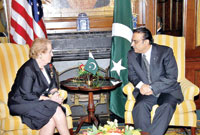 the United States that it must put its foot on the ground on the Pakistani
soil in pursuit of militants. This unified resolve was on full display during
President Zardari's visit to the US. From the White House officials to the
bipartisan political establishment, everyone spoke with one voice when it
came to the US direct intervention in Pakistani soil to target the militants
hidden there. Both vice presidential contenders, Joe Biden and Sarah Palin,
agree on the issue of declaring Pakistan as the most dangerous country along
with Iran.
the United States that it must put its foot on the ground on the Pakistani
soil in pursuit of militants. This unified resolve was on full display during
President Zardari's visit to the US. From the White House officials to the
bipartisan political establishment, everyone spoke with one voice when it
came to the US direct intervention in Pakistani soil to target the militants
hidden there. Both vice presidential contenders, Joe Biden and Sarah Palin,
agree on the issue of declaring Pakistan as the most dangerous country along
with Iran. were in trouble because no one in the village would give him a job, or even
take him on as a farm hand. There was nothing to do but set up in business
for themselves. Which is when the son had a brilliant idea. Why should they
kill themselves working? They should start printing their own money!
were in trouble because no one in the village would give him a job, or even
take him on as a farm hand. There was nothing to do but set up in business
for themselves. Which is when the son had a brilliant idea. Why should they
kill themselves working? They should start printing their own money!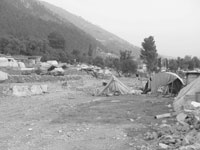 the front in the queue the next morning. He caught pneumonia and died the
following day in a local hospital. There was also another 70 year old Gul
Badshah, who sustained injuries during the police's lathi charge outside the
bank. He fell down from the steps of the bank and was killed."
the front in the queue the next morning. He caught pneumonia and died the
following day in a local hospital. There was also another 70 year old Gul
Badshah, who sustained injuries during the police's lathi charge outside the
bank. He fell down from the steps of the bank and was killed." a needle goes in to take the sample," says Dr. Muhammad Chaudhry, Head
of the Department, Clinical Oncology, Sir Ganga Ram Hospital, Lahore.
a needle goes in to take the sample," says Dr. Muhammad Chaudhry, Head
of the Department, Clinical Oncology, Sir Ganga Ram Hospital, Lahore.