


|
|
|
|
|
 |
 |
   |
analysis firstperson Putting
our hands up for democracy history Left
alone! militancy
Need
for a big push
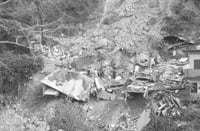
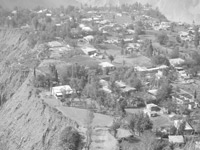
Against people's will Efforts to inculcate better safety measures for reconstruction in the earthquake-affected areas are doomed By Beenish Kulsoom In the aftermath of disasters, human relocation and
resettlement present a major challenge to the government, as well as
relief and humanitarian agencies. Since relocation is a highly emotional
experience for most people, they resist the idea of being moved
forcefully, involuntarily or under coercion. The reconstruction and
rehabilitation efforts of the government, as well as relief and
humanitarian agencies, in the earthquake-affected areas reflect on the
dilemma they are faced with. Should relocation be imposed or made
voluntary, considering people's resolve to challenge the state's actions
when they feel that they are not in their interest? With the establishment of Earthquake Reconstruction and Rehabilitation Authority (ERRA), an effort was made to inculcate better safety measures for reconstruction in the earthquake-affected areas. The overarching strategy of 'Build Back Better' is an integral component of all the 12 service sectors supported by ERRA. These service sectors have cross-cutting themes and each complements other interventions. For example, 'Social Protection Intervention' is one of the most important intermediary sectors, focussing on marginalised groups by linking their rehabilitation with other key sectors, such as housing, education, health, etc.
Social Protection Intervention This was devised as one of the components of the Social Protection Strategy in January 2007 with its focus on vulnerable groups, identified as widows and female-headed households; children without parental care; people with disabilities; elderly; and landless. ERRA designed specific interventions for each of these identified groups and programmes for their rehabilitation were launched accordingly. Rehabilitation of the 'landless' group emerges as the most problematic, since it involves redress for relocation and resettlement of vulnerable groups. Moreover, the Landless Programme has been interlinked with the housing reconstruction programme, which is being implemented simultaneously and is itself plagued with policy contradictions. The Landless Programme has two phases: Rural Landless
Programme and Virtual Landless Programme. The former was launched in
January 2007 by ERRA with support of partners, including the United States
Agency for International Development (USAID), Department for International
Development (DFID) and UN-Habitat. Under the programme, 'landless'
families who have lost their land completely were paid Rs250,000 each
(inclusive of Rs175,000 subsidy for earthquake-resistant house
construction). About 1,750 families of Azad Jammu and Kashmir (AJK) and
the North-West Frontier Province (NWFP) benefitted from the programme. During implementation of the Rural Landless Programme, ERRA devised a plan for relocation of the population living in hazardous locations. The Virtual Landless Policy issued by ERRA elaborated on the need for encouraging people to live in locations that were not, or were less, susceptible to hazards, such as landslides, rock falls and rock slides. The objective of the programme was to relocate people from hazardous locations to safer locations, by not forcing but encouraging them to do so. The geological mapping demarcated surveyed affected areas into three categories: a) Highly Hazard Zone -- whose residents have no option but to relocate; b) Moderate Hazard Zone -- Village / area that could be secured; and c) Low Hazard Zone -- where the adoption of nominal housing reinforcement techniques would make houses safe. To implement the programme, multiple stakeholders were engaged. On the technical, side the geological mapping was conducted by the Geological Survey of Pakistan (GSP) and facilitated by the local administration. On the implementation side, the UN-Habitat extended the mobilisation services with the financial assistance of DFID.
Reflections from the field Reports from the field suggest that the people in need of money submitted false land-holding documents that were duly approved by the local patwari. Maqbool Abbasi, a resident of the Dhani Mai Sahiba village, says: "Many counterfeit agreements were presented by the people in cahoots with the revenue department to receive the additional Rs75,000." He, however, adds: "I have also applied for the grant, but I do have authentic legal documents of the land possessed by me in Naluchi." On the contrary, Majeed Abbasi, another resident of the same village, says: "I did not apply for the grant after getting information about the process. When I found that the government has set only Rs75,000 as our price, I also urged others not to apply." He was bold enough to admit that his father applied for the grant and has also received it on submission of fake land records. Misconceptions about the policy have emerged as another problem area. The policymakers are confident of relocation, while the people are adamant that such an action cannot be forced through a written agreement, because it would only create chaos and social unrest. Maqbool-ur-Rehman, a lawyer from the Dhani Mai Sahiba village, showed a letter to The News on Sunday that states: "The GSP has found location of applicant to be most unsafe and highly hazardous. Therefore, applicant is considered landless, since the area s/he lives in is highly hazardous zone and not suitable for residence." This simple letter fulfils the 'condition' for applying for the grant, informs Rehman, who along with another villager, Sadiq Abbasi, facilitated the cases of his fellow villagers. When questioned about the fulfilment of the strange 'condition' in the letter, Sadiq Abbasi asserted confidently: "There is no such policy that after signing this paper and submission of a land-holding document in the presence of a judge, the population of 254 households will be considered for resettlement. We have our farmland in this village and its produce is our major source of livelihood." A UN-Habitat staff member partly agrees with Sadiq and says: "The grant provisions are only for residential shift; hence they do not cover costs of shifting farmland." Observations from the field confirm poor integration with other projects, since the Landless Policy was launched two years after the Housing Reconstruction Programme in August 2007. As a result, any linkage between the two could not be established, Chaudhry Muhammad Rasheed, a member of the AJK Legislative Assembly, says: "The policy is a farce. What does ERRA have to offer to people who have already built houses in hazardous locations? They are now being told to purchase land in the so-called safer location, but there is no provision for any grant or subsidy to build houses there." He also criticised the role of housing monitoring teams and held them responsible for misguiding the people. "The army monitoring team created chaos among the people and urged them to hurriedly complete construction, even in highly hazardous locations," Rasheed alleges. Relocation and resettlement have proved to be major challenge for government authorities engaged in reconstruction and rehabilitation programmes. Though the people have voluntarily or involuntarily, forcefully or willingly, signed the applications, at the same time they are sceptical of the government's relocation policy. Their scepticism can be attributed to variety of factors, such as misconceptions about relocation, over reliance on local informants and submission of fake land records. Surprisingly, none of the stakeholders has the tenacity to admit mistakes. The government and humanitarian agencies are clear about their role, yet that too is not in sync with the people's social vulnerabilities. The people of the earthquake-affected areas, on the other hand, are adamant that applying for a 'grant' is their rightful and just claim, since they have a right on the grants the government and humanitarian agencies have received in their names. However, the fact of the matter remains that the people would have to shift, move, relocate or resettle in locations other than the highly hazardous areas within a year. The time, when it comes, could raise further questions on the efficacy of the policy and its implications. We have seen in the case of housing reconstruction that fixation with earthquake resistance designs discounted local needs and resulted in the people's discontent. Had context-specific policies been designed, this problem could have been overcome. (The writer works with Rural Development Policy Institute, Islamabad. Email: beenish.k@rdpi.org.pk)
firstperson All for 'peace' The NWFP should be renamed as Pukhtoonkhwa at the earliest to better represent our identity By Delawar Jan Maulana Sufi Muhammad, a cleric hailing from Kumbar in
the Lower Dir district bordering the troubled Bajaur Agency in the
southwest and the war-torn Afghanistan in the northwest, started his
political career as an activist of the Jamaat-e-Islami. He ended his long
association with the Jamaat-e-Islami after doubting the party's sincerity
to enforce the Shariah and formed his own organisation, named
Tehreek-e-Nifaz-e-Shariat-e-Muhammadi (TNSM), on June 28, 1989, for the
same purpose. Sufi Muhammad, however, restricted activities of the TNSM to
the Malakand division (comprising the districts of Upper and Lower Dir,
Chitral, Malakand, Swat, Buner and Shangla), the Kohistan district and
Bajaur Agency. After garnering support for the movement, he demanded the
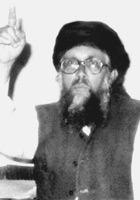
enforcement of the Shariah in these areas. In November 1994, Sufi Muhammad, along with thousands of his followers, launched an armed campaign for this purpose, and took control of many government buildings and installations in the Swat district. The campaign hit headlines across the world, because 40 people, including security forces' personnel, were killed in the fighting that continued for over a week. Though the situation was finally put under control, the campaign forced the then PPP-led government to promulgate the Shariah Regulation 1994. Not satisfied with this legislation, Sufi Muhammad continued to hold demonstrations between 1994 and 2001. Subsequently, another regulation in 1999 recommended that the Shariah Regulation 1994 should be amended to accommodate the demands of the TNSM, so that the ongoing violence in the valley could be brought to an end. Sufi Muhammad again made headlines when he led a group of 10,000 poorly-equipped volunteers to fight against US forces, which had launched an attack on Afghanistan to topple the Taliban regime in the aftermath of 9/11. Most of these fighters were either killed or arrested in Afghanistan; however, Sufi Muhammad managed to return to Pakistan along with some of his followers. Thereafter, the TNSM, along with four other organisations, was banned on January 12, 2002. Sufi Muhammad remained in jail for more than six years. He was released on April 21 only after an agreement had been reached between the ANP-led NWFP government and the TNSM. However, on October 9, the undeterred cleric once again set up a 'peace camp' in Timergara, the district headquarters of Lower Dir. The News on Sunday interviewed Sufi Muhammad last week at this camp. Excerpts follow. The News on Sunday: Why have you rejected the draft of the Sharai Nizam-e-Adl Regulation framed by the ANP-led NWFP government despite the fact that the enforcement of the Shariah has been your longstanding demand? Maulana Sufi Muhammad: We have carefully read the draft of the Sharai Nizam-e-Adl Regulation, but it does not have anything to do with the enforcement of the Shariah. Only name does not make a regulation or a law in line with the Shariah. TNS: The government claims to have consulted you and your organisation before preparing the draft of the regulation. Is this true? If yes, then what is the justification for rejecting it? MSM: Yes, the government did consult us, but it did not incorporate our recommendations into the draft. So how can we agree to it? TNS: Did you propose a draft to the NWFP government? MSM: No, we have neither framed any Shariah draft nor handed over anything in written to the provincial government. TNS: When you do not any Shariah draft to share with the government for implementation, then which document would do suggest for this purpose? MSM: Former president Farooq Ahmad Khan Leghari approved the Sharai Judicial System under Article 247 of the Constitution in 1994 and enforced it through then-NWFP Governor Khurshid Ali Khan. Then-NWFP Chief Minister Aftab Ahmad Khan Sherpao also signed an agreement on Shariah with the TNSM. Later, then-NWFP Chief Minister Mehtab Ahamd Khan ratified the Sharai Judicial System on January 16, 1999. Moreover, the NWFP Assembly unanimously approved a resolution for the enforcement of the Sharai Judicial System on September 23, 1999. Finally, then-NWFP Governor Muhammad Shafiq approved the same in 2000. So, the Sharai Judicial System is an agreed upon document prepared after thorough deliberations between the government and the TNSM over a period of time. Since the Sharai Judicial System is a consensus document that has also been endorsed by successive governments, we want it to be implemented in letter and spirit. We request the federal government to enforce it in Pukhtoonkhwa to end militancy and to create an atmosphere of peace in the province. In fact, there is no other way to restore peace in the Swat valley. TNS: Since you have used 'Pukhtoonkhwa', the name that the ANP advocates for the province, instead of the 'NWFP', would you like to share your stance on the issue with us? MSM: I think that the NWFP should be renamed as Pukhtoonkhwa at the earliest to better represent our identity. Some people, who are against the name of Pukhtoonkhwa, argue that because Pukhtoons also live on other side of the border in Afghanistan, this could jeopardise the integrity of Pakistan. However, Punjabis also live on other side of the border in India, but the name of the province represents the identity of its largest ethnic group. The case of Balochistan is also similar. If these provinces can be named after their largest ethnic groups, why the same cannot be allowed to Pukhtoons? TNS: In an agreement reached on April 21, you made a promise to the NWFP government that you will remain peaceful and will also help the government in restoring its writ in the Malakand division in general and the troubled Swat valley in particular, but you have set up a protest camp here. Why? MSM: I have not violated that agreement and am still peaceful. This camp has been established to demand the enforcement of the Shariah in a peaceful manner. I have directed all my followers to remain non-violent. However, I would like to make it clear that this camp would remain in operation until the enforcement of the Shariah as promised by the government. As far as ending militancy in the troubled Swat valley is concerned, this objective cannot be achieved until the enforcement of the Shariah in the region. Therefore, the government should immediately announce the enforcement of the Shariah to restore peace in the Swat valley. TNS: Do you think that Maulana Fazlullah is fighting for the enforcement of the Shariah in the Malakand division? MSM: I cannot answer this question and can say only this much that he will not be able to fight against the government after the enforcement of the Shariah, because then he would have no excuse to do so. TNS: Do you have a plan to put an end to the violence in the Swat valley? If yes, what role can you play? MSM: If the government announces through television, radio and newspapers that all un-Islamic laws have been declared null and void in the Malakand division and the Kohistan district, I can bring insurgency to an end within no time. As soon as the government incorporates Shariat-e-Muhammadi into the judicial system of the Malakand division and implements it in true spirit, I would dash to the restive Swat valley to tell the people there that the Shariah has been enforced as per their demand. I would also ask those fighting against the security forces to lay down arms, though they are not my followers or supporters. Even if they refused, I would defeat them through force. Similarly, I would ask the security forces to return home, because they would not be needed any more. I would proclaim that the trouble-makers are 'rebels from Islam' and would take up arms after declaring jihad against them. I am sure that my followers will be able to defeat them. However, let me make it clear that I will not accept anything against the Shariah. For example, the Qazis in the Shariah courts should be completely independent and not controlled by sessions judges, because God's laws cannot be subservient to man-made laws. They should not be controlled by the superior judiciary. I mean that they should not be under the control of the Peshawar High Court or the Supreme Court of Pakistan. Only the divisional Darul Quza (the apex court in the Malakand division), and not a Peshawar High Court divisional bench, should have the authority to hear an appeal against the decision of a Qazi. TNS: Do you have the power to fight against the resourceful and powerful militants in the Swat valley who also have suicide bombers at their disposal? MSM: They may have the material power, but are deprived of the divine help that enables one to win a battle. Since we do not have any ill designs, and want the supremacy of Islam and the stability of the country, I am sure that God will help us. TNS: Did you try to convince Fazlullah to stop fighting against the security forces? MSM: When I was in jail and Fazlullah, who also happens to be my son-in-law, decided to fight against the government, I sent him four letters asking him not to challenge the writ of the government and remain peaceful. Despite my repeated calls, he launched an armed uprising. Since then, I have cut off all relations with him. TNS: Did you not talk to him after your release to convince him to lay down arms? MSM: I told you that I have severed all relations with him. So how can I talk to him now? TNS: But you had formed a committee to negotiate a peaceful settlement of the Swat problem. It did visit Fazlullah and also held talks with the NWFP chief minister. Why did you give up the effort? MSM: You are right. I had formed a committee for finding a peaceful solution to the lingering problem of militancy in the region. We asked both Fazlullah and the government to authorise the committee to make decisions that would be binding on them. Fazlullah replied in the affirmative, but the government did not respond after seeking more time for consultation. This compelled us to shelve our peace initiative. TNS: These days it has become a fashion for the clerics demanding the enforcement of the Shariah to hold a Kalashnikov. Unlike them, you do not have one. Why? MSM: I do not need a Kalashnikov or any other weapon. My movement has been a peaceful one and will continue to remain non-violent. When I do not have any plans of confronting the government for the enforcement of the Shariah, I do not need weapons. I am all for peace and also ask those fighting against the security forces to lay down arms and adopt a peaceful approach. Guns are picked up against an enemy, but the Pakistan Army is our own institution and the people serving in it are our own. I will not fight against them, but would rather fight along with them if some other country attacks our homeland. I would only pick up arms in this case.
The distinct impatience with an elected government that has become part and parcel of the national psyche is a character flaw that must be corrected By Aasim Sajjad Akhtar As we approach the one year mark of the November 3
emergency, it is worth reflecting on how far we have come (or not come)
during the course of these incredibly turbulent 12 months. It would not be
wrong to suggest that the almost euphoric expectations that accompanied
the mobilisations against the emergency all the way up to the historic
Long March in June have given way to disappointment and disillusionment.
Therefore, it is worth reflecting on exactly what precipitated this
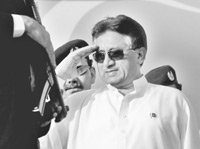
sea-change in attitudes. At least some of those at the frontlines of the movement against the Musharraf regime did not expect revolutionary upheaval when the generals were finally forced to relinquish absolute power. Those who study their history (not only Pakistan's, but also of other praetorian states) know that the end of direct military rule never means a complete transfer of power to civilian leadership. And in any case, the existing civilian leadership is not committed to revolutionary upheaval. It was thus that these same wise observers warned against expecting too much from the elected regime, and instead advised that democracy should be thought about as a process rather than judged by parameters that emphasise immediate results. This is not to suggest that the elected regime should not be subject to public scrutiny or that the right to dissent and protest should not be guaranteed under democratic dispensations, but only to point out the reality that the political process cannot guarantee quick-fix solutions. As I have pointed out many times before on these very pages, I am as frustrated as anyone with the elected government's unwillingness to take steps that I think are necessary for the benefit of the majority of this country's people. And I do think that the Pakistan People's Party (PPP) and Awami National Party (ANP) in particular hurt their own cause by not taking some of these steps, because only in taking such steps can they retain a minimum level of public support that must be their primary source of legitimacy. However, even if the parties in government do not take these steps, they are entitled to continue ruling under the logic of the parliamentary system. Unless we can muster up some kind of revolutionary mass movement to overhaul the state and embark on an entirely new experiment in popular democracy, the parliamentary system is what we have to accept. If the elected government is boxed in on all sides to the point that muffled demands for change become vociferous calls for the government's deposal, then it becomes the responsibility of all those who fought for democracy to protect what they have managed to secure. This is unpalatable for many, because, as I have already pointed out, there seems to be nominal difference on most policy fronts between the PPP-ANP government and the Musharraf junta that preceded it. But to express dissatisfaction -- even disgust -- with the elected government should not become an excuse to inadvertently support the machinations of the security establishment, which was forced to retreat from its complete domination of state affairs due to a popular movement but has not reconciled with the notion of an elected government exercising effective power. I am not suggesting that there is any immediate plot being hatched to sack the elected government, but at the same time it is clear that its position is becoming more and more onerous. Should the downward spiral continue, the chances of direct military intervention will increase! It is another matter altogether that the military is currently content to pull the strings from behind the scenes and rehabilitate its image. It should be noted, for example, that only about five months ago ordinary Pakistanis on the streets were hurling abuse at the behemoth that is the military empire, but history has quickly been rewritten so that the period between October 1999 and August 2008 is described as 'one-man rule' rather than the rule of the military institution. So, to reiterate, the point is not that the military is about to wipe the slate clean again, so to speak, but only that the distinct impatience with an elected government that has become part and parcel of the national psyche is a character flaw that must be corrected, because it reinforces the binary of 'guardian of the nation military vs bloody civilians'. Surely a level-headed appraisal will reveal that the Musharraf regime only became subject to widespread public censure many years after it had come into power, and that too illegitimately, whereas the legitimately elected regime is now the target of as much, if not more, public abuse after only a few months. Besides it is worth thinking about whether the elected regime actually enjoys as much power as the magnitude of the abuse suggests it does. I have already pointed out on these pages that the civilian authority is conspicuous by its absence in the NWFP and FATA, and whatever policy is being framed in the so-called 'war on terror' has little to do with the parliament and more to do with GHQ and the Pentagon. Then there is the question of economic policy space for the new government, the lack of which, as I pointed out last week, is partially a function of the PPP's lack of courage and vision, but also a function of the prevailing policy paradigm that was fashioned by the military regime in cahoots with the international financial institutions (IFIs) and western governments. Perhaps most importantly, the security establishment retains complete control over the 'ideological frontiers' of the state. Pakistan, 61 years after its creation, remains a highly fractured society in which the Punjabi heartland remains committed to the vague idea of the ideological state. This vision is manifest in educational curricula, popular media depictions, the direct statements of the military and, most unfortunately, the civilian leadership as well. In the final analysis, the PPP and ANP do retain responsibility for putting themselves into an untenable position. But democracy is bigger than the parties that are its major protagonists, and it is up to those of us who have fought for real democratisation over the past two years to bear this in mind in the battles that we wage in the coming years.
Painting a 'rosy' picture Perhaps the Muslim rule in India was not as 'Islamic' as it is made to be By Ammar Ali Jan In Pakistan, there is nostalgia for the Muslim past in
India. In this imagined past, there were truly 'Islamic' leaders who
united India, led it towards progress and, subsequently, proved the
superiority of Islamic rule over other forms of government. Within this
particular narrative, the degeneration of the personal character of
Muslims -- such as indulging in drinking, womanising, listening to music,
etc -- is cited as the main reason for the decline of the Muslim rule in
India. Of course, Hindu and western 'secular' influences are blamed for
'corrupting' the Muslim soul. Needless to say, a rejection of such
influences is the only way for Muslims to regain their 'glorious' past. Aijaz Ahmad, a political analyst from India, has extensively studied the reverence religious leaders pay to their past. For example, the leaders of the Hindutva movement claim that under the Ram Raj there existed complete peace and equality in India; however, the Muslim invaders disturbed this wonderful balance through their barbaric acts. Ahmad criticises the Hindutva movement by demonstrating how India had always been divided into theocratic fiefdoms and the Indian society was heavily plagued by the rigid caste system, shattering all illusions of equality under the Ram Raj. He writes a line for the Hindutva movement that aptly describes the Muslim revivalist movement in Pakistan: "The communal leaders praise the Hindutva past and urge their followers to revert back to those glorious times. The only problem is that this 'glorious' past never actually existed." Before showing how our 'historians' have given history a twist to create a puritan, monolith identity for Muslims, it is important to show why we must counter such history. The Muslim revivalist movements, including the Jamaat-e-Islami, continue to repeat this puritan version of history to present it as the eternal truth to the general public. There are three major problems with this narrative. First, in its attempt to formulate a monolith identity for Muslims, it completely ignores the diverse, progressive and secular history of Muslims in the Indian subcontinent. Second, it gives fodder for Hindu reactionaries to criticise the otherwise secular Muslim rule. In this way, both these revivalist movements re-enforce each other's power. Third, and most important, the religious leaders are using this version of history to prove that only a puritan form of Islam has the answers to our problems. To begin with, the assertion that the successful Muslim governments in India were religious in nature is not backed any historical evidence. As I have stated in this space before, Mehmood of Ghazni invaded India many a time, but never made any attempt to establish his rule over India or to convert followers of other religions to Islam. The Mughal rule is accepted by most historians, with the exception of religious extremists on both sides, as secular in nature. The Mughal rulers appointed Hindu advisors, gave autonomy to Hindu maharajas and married Hindu women. What is more important is that there was no mass attempt by any Mughal ruler, with the exception of Aurangzeb Alamgir, to spread Islam in India. It was this secular nature of the Mughals that earned them respect among followers of other religions. The Mughal rulers did not regulate the personal lives of their subjects, which is why drinking was never banned during their period. Akbar's wife, Jodha Bai, was a Hindu and never converted to Islam, nor was she ever pressed to do so by Akbar. Akbar also encouraged interfaith dialogue among his subjects, for which he made the residency of Dharampura in Lahore. He even presented a new faith, Din-e-Ilahi, with the intention of bridging the gap between Hindus and Muslims. Moreover, the Mughals maintained large harems and this was done in the open by them. The mullas who are still in shock over Zardari's flirtatious comments to Sarah Palin would surely get a heart attack if they ever read what the 'Islamic' governments in India had sanctioned under their watchful eyes. Within the religious tradition, the Sufis played a very important role in popularising Islam among the people of the subcontinent. Sufi teachings of love and tolerance ran contrary to the narrow-minded interpretation of Islam advocated by the clergy. The Mughals always remained close to the Sufi version of Islam, with Dara Shikoh (Aurangzeb's brother) making important contributions to the Sufi literature. It would be wrong to lump together all Sufis as a monolith, but generally speaking most of them tend to be more relaxed in their approach towards religion. Their rituals involve music, poetry, dance and many other elements from the local culture. Most of the poetry by Sufi saints, such as Baba Farid and Bulleh Shah, is extremely bold and takes to task many of the prevalent norms within the religious establishment of the time. It is because of their message of love and tolerance that they were able to spread the message of Islam in India without shedding any blood. However, today if someone dares to truly follow the tradition of these Sufis by rejecting the imposition of a puritan interpretation of Islam by the state, s/he will not survive the blasphemy laws, proving once again that we have degenerated from a progressive into an intolerant society. The widely held belief that any expression of love (the same goes for music and poetry) is a 'western' influence is another big hoax, and does great injustice to the rich tradition of fine arts in the Indian subcontinent. Folk tales, such as Heer Ranjha and Sassi Punno, are common in every city, town and village across Pakistan. The likes of Amir Khusro, Mirza Ghalib and Mir Taqi Mir have had a profound impact on the people of the Indian subcontinent. To suggest that they do not represent Muslim culture or, worst still, represent western or Hindu culture is not just an insult to these great people, it is an insult to the diverse cultural history of Muslims and an attempt to re-write it to meet the requirements of a narrow-minded ideology. Finally, there began a movement by the Muslim revivalists asserting that the Muslims in the Indian subcontinent had only one language, namely Urdu. This is the easiest thesis to rebut. Muslims, contrary to what the revivalists claim, never had one language. For example, a Baloch would speak Balochi no matter s/he was Hindu or Muslim. Similarly, a Punjabi would speak Punjabi whether s/he was a Hindu, Muslim or Sikh. The same goes for the entire Indian subcontinent. Even today, after massive state patronage for the Urdu language, only eight percent of Pakistanis speak Urdu as their first language. Records show that the numbers were far less at the time of the partition. The state's imposition of Urdu on its subjects has resulted in mass resentment among nationalist forces, and this was also one of the main reasons why Bengalis became disillusioned from the Pakistani state. What the revivalists fail to understand is that languages do not have a religion, which is why Munshi Premchand, a Hindu, became the father of the genre of short story in Urdu. However, such examples do not fit into the scheme of things of the puritans who want to give an ideological account of everything without taking into account its repercussions. The Muslim revivalists, as well as the Pakistani state, have consistently tried to change the past, in order to silence all narratives that could show the presence of progressive and secular thought among Muslims of the Indian subcontinent. The distortion of the Muslim rule in India is done deliberately to cement a puritan religious identity around chauvinistic Muslim nationalism. Today, the hegemony of this histiography has meant that the liberals have abandoned attempts to challenge this master narrative, which is now taken by many as the eternal truth. Here lies the main problem. The increasing violence in the subcontinent is linked with the creation of this false past from which only communal outfits benefit. Knowing all the harm this communal politics has done, it is extremely important for us to reclaim our history from the mullas. Our history is not full of moral tirades by the self-proclaimed champions of morality; on the contrary, it is filled with unprecedented tolerance for other's beliefs. It is not just a tale of jihad between Muslims and Hindus; it is more about the message of compassion and love our Sufis were able to bring to this part of the world. It is not about condemning all forms of art as un-Islamic; it is in fact about Muslims making the most profound contributions to art, music, poetry, literature, science, etc. It is not about being in confrontation with all those who differ with us, but about coexisting with them despite our differences. It is this history that we must unearth and reclaim. We can no longer allow another generation to be fed a narrow-minded, hawkish view of Muslim history. Much like our friends on the other side of the border who are fighting against the absurdities of the Hindutva movement, we need to challenge the discourse of the religious right on the histiography of our country if we want to prevent further bigotry in our society. Extremists in both India and Pakistan, by spreading hatred, mutually re-enforce each other. This is why the response by the progressive-minded people on both sides has to be a united one. For this, we need not import any western secular ideology; we simply need to find the roots of secularism within our history to challenge the monopoly of the right. This remains a challenge for all those who want to see the end to religious divisions and who want to build a society where everyone's right to differ is respected. (Email: aa_jan@hotmail.com)
Pakistan is looking in all directions for financial help, but no one seems to be forthcoming
By Syed Nadir El-Edroos The world is currently experiencing an economic crisis of great proportion. For Pakistan, in particular, there seems to be very little light at the end of the tunnel. Faced with political somersaults, suicide bombings and an all-time high inflation, the people of Pakistan, however, have no time to look at the larger picture: how other countries are bracing to meet the economic challenges of the future. With the credit crunch bringing consumerism to a halt,
the reality has finally sunk in that this much-idolised view of the West
is little more than a fantasy. With the decline in consumption and
investment, governments have emerged as the only actors capable of
increasing spending to keep the economy going. Because of debt-fuelled
consumerism in the developed countries, especially in the United States
and United Kingdom, the debt-to-income ratio of their citizens has
exceeded 3 to 1. Considering this, we can expect many years of economic
'adjustment', the results of which most people of the world will have to
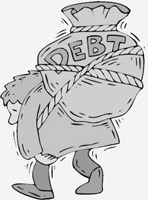
bear. Debt-fuelled growth, based primarily in the tertiary sector, has come under heavy criticism in the recent past. Since the 16-year period of uninterrupted growth has ended, the people of the developed countries -- such as the UK, which relies disproportionately on a small part of London ('The City') for its overall national income -- are questioning the wisdom of such policies that have brought them to this situation. It is important to note that, though not promoted as such, governments of the developed countries are expanding their roles in the national economy -- which, in simple terms, means nationalisation -- since the beginning of the global economic crisis. However, Pakistan does not enjoy such a luxury. The government has little or no resources to intervene effectively in the economy. Hopes of foreign aid and grants to boost the economy in these troubled times are also far from materialising. Therefore, regardless of what President Asif Ali Zardari says, Pakistan faces default. The current government alone cannot be held accountable for this, though it may be criticised for not learning anything in terms of economic policymaking from the eight-year Musharraf regime. Moreover, little effort has so far been made to assess the impact of the global economic crisis on Pakistan. The country's economic managers have projected that Pakistan immediately needs $3.5-$4.5 billion in funds to see through these hard times. The International Monetary Fund (IMF), however, has projected that Pakistan requires $7 billion to meet only its foreign liabilities for the ongoing financial year. Importantly, very little is being said about what would happen beyond this supposed transitory phase. The global economy is unlikely to rebound until late 2010 and even then, Pakistan is not likely to benefit immediately. Placing faith in foreign 'benefactors' to bail us out and prop up our economy is fraught with its own dangers. Moreover, Pakistan's major 'benefactors', in particular the US, are currently facing economic problems too and have turned off the pipe on aid. The strategy that the government has adopted to pursue aggressively the so-called 'war on terror', whether right or wrong, will remain a hotbed of debate; however, in return Pakistan is unlikely to receive the same level of support from the US as before. The reason is simple: the US economy. Over the past few weeks, as Wall Street collapsed, the 'war on terror', al-Qaeda, the Taliban, Osama bin Laden, etc, have all seemingly lost their prominence in the US presidential elections campaign. In fact, in the final debate between the two presidential candidates, John McCain (Republican) and Barrack Obama (Democrat), foreign policy issues hardly came up. In short, the US is far from bailing Pakistan out when it is engaged in a massive bailout of its own economy. An economic slowdown in the West also affects Pakistan's other 'benefactors', such as the oil-rich Middle Eastern countries. As the global economy slows and demand falters, oil prices tumble (on October 16, they were recorded at as low as $67 a barrel). Facing rampant inflation themselves, these countries have other pressing issues to address rather than bail out Pakistan. Moreover, the IMF wants the commodity-producing countries that currently have balance of payments (BoP) surpluses to use their reserves for injecting liquidity in the global market. Pakistan is unlikely to feature prominently in this arrangement. In this scenario, Pakistan's last hope is China. As Zardari left for China, he mentioned that he was going to strengthen economic ties with the country that had been neglected in the past. This remark was uncalled for by all standards. We should remember that a country that aims to become the global superpower does not dole out cash for unfeasible economic investments. China knows very well that by offering strategic support, it has already won our loyalty. Moreover, in terms of economic benefits, Pakistan has very little to offer back to China. The time has come to question the populist talk and measures that offer little in terms of sustainability. As Pakistan looks for foreign inflows, this money, if it ever comes, will do little to improve the economy. Far from it, much like in the West, the money will be used for bailing out financial institutions and forcing the masses to foot the bill in the form of interest. Therefore, Pakistan's attempts to increase its foreign exchange reserves will only be tantamount to adding to its already high debt burden. In other words, the majority of the country's people will be paying the price for the luxury goods imported for a tiny minority of the population intoxicated by consumption. As governments around the world tighten their belts, perhaps for the first time since the mid-1980s when neo-classical economics brought in a wave of liberalisation, low taxes and privatisation, are we able to revaluate our policies. Today we should be drawn towards massive investments in human capital, education and health, besides the development of infrastructure and economy on a tangible footing. (Email: nadirnwo@gmail.com)
militancy A befitting reply The government's latest strategy of forming tribal lashkars to defeat the militants is proving to be successful By Tahir Ali The insurgency-hit Federally Administered Tribal Areas
(FATA), frontier regions and several settled districts in the NWFP have
witnessed a new development of late: the formation of tribal lashkars
(armed wings) and peace committees to fight against the militants and
flush them out from these areas. This development is being projected as
the biggest success of the multi-pronged strategy -- referred to as 3-D:
'Dialogue', 'Development' and 'Deterrence' -- adopted by the government to
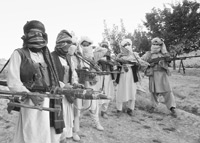
tackle the issue of terrorism. The involvement of local people against the militants, according to experts, is vital to defeating terrorism. Before the mobilisation of these volunteers, there was a widely held belief that the tribal people support the militants. Many others believed that the militants had planted themselves among the locals and had obtained forceful allegiance from them. It is welcome news that the myth of alleged public support to the militants has finally been demolished. It is also being said that the reason for the formation of the tribal lashkars is that the people of the violence-hit areas want to save themselves from the ongoing military operations. This may be partially true. While the instinct for survival may be one of the factors behind the decision to form the tribal lashkars, the fact is that many other factors are also involved. For example, tribesmen in various areas have been forced to form volunteer armies after witnessing the destruction caused by militancy. Coupled with the military operation that followed it, the militancy has deprived many people of their relatives and belongings. In the militancy-hit areas, hundreds of educational institutions have been razed to the ground. Similarly, health, power and communication infrastructures have been ravaged. Moreover, the NWFP's tourism industry, the main source of income for millions of people in the province, has been virtually destroyed. Internal displacement of hundreds of thousands of people, who are still living in miserable conditions in makeshifts camps across the province, has also drawn the tribesman to this phenomenon, much to the joy of the government and to the dismay of the militants. The militants have gradually lost public sympathy and support, because they are executing 'spies' and slaughtering security forces' personnel. Moreover, their attacks against security forces almost always cause civilian causalities. The families of the deceased, as a result, get alienated from the militants. In short, the militants' policy of killing civilians has distanced them from the people. "The people supported the militants in the past thinking that they were victims of repression, but now they are identified with mercilessness and cruelty," a displaced person from Charmang, Bajaur Agency, tells The News on Sunday on condition of anonymity. Knowing fully well that the tribal lashkars would destroy whatever bleak chances they have of success against the security forces, the militants have started attacking the people involved in the process. In Darra Adamkhel, a peace jirga was attacked. In the insurgency-hit tribal and settled areas, the people involved in the jirga process were abducted and beheaded. The brutal suicide attack at a jirga of the Ali Khel tribe in Orakzai Agency, which was convened to raise a tribal lashkar and in which 133 people were killed, seems to suggest that the militants are loosing patience and are scared of the new phenomenon. The militants know fully well that their local rivals are in knowledge of their hideouts and passages. They, in turn, want to spread so much terror that the people think twice before joining the tribal lashkars. Whether they would succeed in terrorising the people is still unclear, but one thing is certain: such attacks will further harden public opinion against the militants. Should the insurgents persist with their attacks against the tribal lashkars, the outcome may be a more revengeful counterattack against them! Anti-Pakistan foreign elements have also taken advantage of this situation and have infiltrated the ranks of the Taliban. The parliamentarians were told during the in-camera briefing a few days ago that 340 of the 744 militants killed by the security forces in Bajaur were foreigners. Former federal communication minister and the father of the NWFP chief minister, Azam Khan Hoti, also recently told journalists that Russia, India and Israel were abetting and funding the militants. The locals of the insurgency-hit areas are, in particular, annoyed with the infiltrators. Many criminals have also joined the ranks of the militants and they follow their own agendas independent of the Taliban. People are being abducted for ransom, only to be released on payment of the desired amount. Even if they have to be released for one reason or the other, their luggage is confiscated. Incidents of bribery, nepotism and corruption are also being reported by the displaced people. "That is why the people of Koza Banday in Swat have changed their loyalties. While only two months ago, all the people in the area came out to repulse the attack by the security forces, they now want the government to come to their rescue and have decided to support it," says a person hailing from the area on condition of anonymity. He further says that the locals initially considered security forces as their enemies, but now they think that the Taliban are responsible for all their miseries. "After all, it were the Taliban who fired the first shots and took law into their hands. The government showed extreme patience to avoid human losses, but the Taliban took it wrongly, believing that it was afraid of them. Therefore, the government had to take action. After all, what is a government for if it does not improve the law and order situation?" The formation of the tribal 'lashkars' is being both lauded and criticised by different individuals and parties according to their perception, interests and stakes involved in the issue. Some of them think that it is a positive development and the only hope for peace in the region. They contend that this approach also worked in Iraq and Afghanistan, and opine that the support of locals is imperative for the security forces in their ongoing operation against the militants. They also believe that the security forces have remained on the receiving end so far only because the militants had the local support. Now the people have taken up arms against the militants and they will be eliminated shortly. Certain others have come down hard on the formation of the tribal lashkars. Qazi Hussain Ahmad, who heads the Jamaat-e-Islami (JI), dubs them as a conspiracy to incite civil war in the country. He also believes that the United States is sponsoring these lashkars. "With the formation of the tribal lashkars, the country has once again been pushed to an East Pakistan-like situation," the JI head said recently. It would not be out of place to mention here that the JI had itself formed lashkars named al-Badar and al-Shams in the former East Pakistan, and had supported the Pakistan Army despite the opposition of almost the entire Bengali population. Now when tribesmen have formed lashkars and the majority of population has decided to flush out the militants from their areas, he is opposing the move. Interestingly, the same JI has joined hands with other parties in Upper and Lower Dir and Buner -- the areas where it is most powerful -- to block the entry of the militants, perhaps to maintain its control in these areas. Qazi says all acts of terrorism are being committed in reaction to the government's support to the US. Amazingly, in the same vein, he states that India and the US are perpetrating acts of terrorism in Pakistan. He also holds the government responsible for the Orakzai blast. Some analysts also fear that the tribal lashkars may not work for long. They fear that the mechanism may produce new Masoods, Dostums and Osamas. A recent BBC documentary on the issue highlighted many important factors, such as the relative difference between the training and weaponry of the militants and the tribal lashkars. This documentary also pointed to the possibility of the tribal lashkars becoming yet another nuisance in the times to come. Again, the insurgents come from nowhere and follow the hit-and-run policy, while the volunteers would be living in their homes. Also, the communication infrastructure is not that good in the insurgency-hit tribal areas to enable the security forces to come to their rescue quickly. And more than anything, the rampant poverty and illiteracy may also impede the process sooner rather than later. Fears and problems notwithstanding, dialogue, development and use of force should continue to bring the badly needed peace to the tribal areas. The tribal lashkars and peace committees must be given a chance to prove their worth. But along with it, the door for dialogue with the elements that are ready to lay down arms must be kept open. Of course, necessary safeguards must be taken to ensure that the mechanism works properly.
Investors will never flock a country where there is no security of life or property By Huzaima Bukhari and Dr Ikramul Haq The fiscal policy should serve as a catalyst for industrial expansion and economic growth. In Pakistan, ill-directed, illogical, regressive and unfair tax regulations are causing a dampening effect on the industrial and business growth. The sole stress on meeting revenue targets, without evaluating its impact on the economy, has crippled our trade and industry during the last few years, especially since we have started submitting completely before the dictates of the foreign donors. Had the successive governments concentrated on economic growth and industrial expansion, there would have been consequential substantial rise in taxes today. It is impossible to enhance revenues with stagnation in economy and over-taxing the existing taxpayers, without expanding the tax net. The priority of our rulers, military and civil alike,
on revenue targets, fixed ambitiously every year in This is a vicious circle in which our policymakers are now trapped. They will have to find ways and means to come out of this tangle to make Pakistan a competitive place where investors find satisfactory conditions to invest. In a country where there is no security of life or property, notwithstanding the availability of host of tax benefits and other incentives, investors will never come forward. The Federal Board of Revenue (FBR), the apex administrative revenue authority, has been single-handedly destroying Pakistan's trade and industry by withholding undisputed refunds payable to the taxpayers, making excessive tax demands, and resorting to all kinds of negative tactics and high-handedness to meet its budgetary targets. There is an urgent need for paradigm shifts at structural and operation levels to ensure not only more tax revenue for the state but also social equity and fairness, so that honest taxpayers are not disillusioned by the benefits the FBR has been extending to the rich and mighty. The most crucial problem faced by Pakistan in its fiscal reform programme is that of devising astute and stringent measures to curb tax evasion, so that we can distribute the burden of taxes fairly and justly between different people in the same or similar occupations. The honest taxpayers have to be safeguarded, because with each passing day they are being disillusioned by the fact that tax evaders are not paying anything with the connivance of their friends and mentors in tax machinery. Every now and then, the state announces a tax amnesty scheme that favours tax evaders, smugglers, corrupt, extortionists, drug barons and criminals. Such schemes are a spank for the honest taxpayers (proving them the most foolish for paying the taxes). An extortionist in Karachi can decriminalise his ill-gotten money through such a scheme, but the poor businesspeople who paid it cannot claim it even as an expense in his or her tax return! The situation needs to be corrected. The facilitation should be for genuine businesspeople to bring untaxed money back into the disclosed, formal sector by paying some percentage as tax, and not for the corrupt and unscrupulous as is being given under the prevalent Tax Investment Scheme 2008. The government must announce Compulsory Public Disclosure of Assets Scheme requiring the following to make their assets and liabilities public: head of state and all high ranking civil and military officials; all MNAs and MPAs; judges of the superior courts; and businesspeople / directors of all the companies who availed loans exceeding Rs50 million from any financial institution. The abovementioned privileged classes of society shall act as an example for others. Their declarations will inspire the common people to pay their taxes honestly. The state needs to wage an allout war against the burgeoning black economy, money power and corrupt politico-administrative structures. This war must start from the mighty classes as suggested above. The people of Pakistan have a right to know how these mighty sections of society amassed immense wealth without paying taxes. There is a national consensus that existing tax policy needs to be reformulated to provide an equitable, pragmatic, investment-oriented and business-friendly tax system, integrating good tax administration with simplified tax laws that are easy to understand and are hassle-free from the implementation perspective. The recent efforts of the government to reform the tax system through so-called foreign experts on the dictates of the International Monetary Fund (IMF) and World Bank will not yield any positive results or acceptability from the taxpayers. It is a closed-door, bureaucratic exercise with no meaningful dialogue between the people and tax administrators. In the absence of a well-designed tax policy, the agenda of tax reform will remain lopsided. The government should not make any legislative and administrative changes until a transparent tax policy is announced and support of all those who are affected by it is secured. Our tax potential is not less than Rs3-4 trillion, provided the tax base is not only widened but also made equitable; tax machinery is completely overhauled; and exemptions and concessions available to the privileged sections of society are withdrawn. The determination of a tax base capable of measuring an individual's ability-to-pay is a major problem of our tax system. This rule is incorporated in the form of progressive rate schedule for personal income tax, estate duty and property tax worldwide. In Pakistan, we have moved from this policy to unequal sacrifice rule where the mighty civil and military bureaucrats (now they are part of the landed aristocracy by getting state lands as awards and rewards), rich industrialists and greedy businesspeople are paying meagre personal taxes and the poor are compelled to pay general sales tax (GST) of 16 percent (21 percent in certain cases), and ever rising costs of public utilities and POL products. The taxes should be for the welfare and benefit of public at large, and for making the state invincible, and not for the luxuries of the rulers and state functionaries. Our successive governments have failed to convince the people that payment of taxes is their collective responsibility. The civil and military governments alike have been engaged in wasteful expenditure. They never bothered to live within their means and failed to protect even the life and property of the people, not to talk of providing them basic needs of life, such as health and educational facilities. The tax policy should be used as a tool of distributive justice. The government should launch programmes, financed mainly through taxes, to solve the twin problems of unemployment and poverty. These welfare-oriented schemes may also include subsidised / free medical and educational facilities, low-cost housing, safe drinking water facilities, land improvement projects, and employment generation programmes. Once people see the tangible benefits of the taxes paid, there will be better response to tax compliance. Taxes cannot be collected through harsh measures and irrational policies. The rulers and tax bureaucrats have to demonstrate through their actions a clear inspirational model for the taxpayers to believe them, and to pay taxes honestly and diligently. (The writers are visiting professors at the Lahore University of Management Sciences. Email: ikram@huzaimaikram.com)
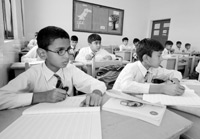
The roots of the ongoing violence can be traced to the flawed educational system By Jamil Nasir Achieving universal primary education by 2015 is an
important Millennium Development Goal (MDG), which requires concerted
efforts on the part of both the government and the society. Bringing the
poor children into schools is still a daunting challenge in Pakistan and
unless these sections of society are not made part of the mainstream
through targeted interventions, we will be failing in achievement of other
development goals as well. The ability to read and write deepens
understanding of the world affairs, and makes people aware of their rights
and duties. They can secure better employment and enhance their
productivity and pleasure through interaction with new technologies. It is, however, pathetic to note that the educational system adopted in our country was inherently non-egalitarian and tailor-made in favour of the urban elite. The people on the street, especially those living in the hinterland of the country, never remained a serious focus of the educational system. The lack of broad uniformity in major contours of the educational system has been a flaw of fundamental nature, which has shaped different paradigms, mostly in contradiction with one another, about life, world and the universe. The roots of the ongoing violence, extremism and terrorism can also be traced to the flawed educational system. Education enables people to overcome deep-rooted inequalities due to various factors. In this way, education becomes a catalyst for social change. However, the educational system adopted in Pakistan has only acted to deepen the existing schisms in the society along various lines. Moreover, there are language-based distinctions and rural-urban divide in the shape of Urdu- and English-medium schools. Besides these divides, discrimination based on the financial status of students is present in its worst form. The outcome of this great divide in education has been a nation composed of people having discordant views and perspectives on the world. It also results in people falling victims to interminable ideological conflicts, due to disharmony emerging from the misplaced educational priorities. This divide has also proved to be a big obstacle to the nation-building process in Pakistan. Moreover, an analysis of the impact of education on the distribution of income and the elimination of poverty shows that the system has acted to increase, rather than decrease, income inequalities. There are manifold but interrelated reasons for this phenomenon. First, equal access to services like education is missing in the system due to acute stratification in the society and the deep economic disparities among different classes. Second, there is no connection between skills imparted through education and those required by different employment sectors and job markets. Education imparted in the rural areas of Pakistan is a pertinent example of this mismatch. The dominant perception among the rural people is that the educated youth is rendered useless for agricultural activities. The mismatch between the quality of labour supplied and quality of labour demanded has resulted in massive unemployment among the educated youth. Third, students of poor families have less chances of completing any given educational cycle than relatively rich students due to the non-egalitarian educational system. Speaking in economic jargon, the private cost of education, especially the opportunity cost of a child's labour to poor families, is higher for the poor students than the rich ones. Moreover, the expected benefits of education are lower for the poor than their rich counterparts. The high opportunity cost and lower expected benefits are primarily responsible for the high dropout rates among the poor students. The policy implication is that merely free education at the primary and middle level will not work unless perceived benefits accruing from the education are higher than its opportunity cost for the poor families. Put in simple words, we cannot achieve the target of universal education unless people feel that sending their children to schools is economically more beneficial than staying at home. Ramshackle schools, large-sized classes, a complex curriculum structure divorced from real-life issues and unmotivated teachers are the main factors responsible for low quality of education in Pakistan. Thus, there is a need for a big push in the education sector, which not only requires more budget allocations, especially for basic primary and technical education, but also an overhaul of the system with a focus on quality and its relevance to the labour market. (Email: jamil_nasir@hotmail.com) |
|

 utter disregard of how economy will behave, is the main problem. Fixing
revenue targets in isolation, and not making necessary efforts to improve
productivity and economic growth, have put Pakistan in a dilemma, where
neither it can afford to give any tax relief package to the trade and
industry (due to the growing fiscal deficit) nor can it achieve a
satisfactory level of economic growth (due to retrogressive tax measures).
utter disregard of how economy will behave, is the main problem. Fixing
revenue targets in isolation, and not making necessary efforts to improve
productivity and economic growth, have put Pakistan in a dilemma, where
neither it can afford to give any tax relief package to the trade and
industry (due to the growing fiscal deficit) nor can it achieve a
satisfactory level of economic growth (due to retrogressive tax measures).