


|
|
|
|
 |
 |


|
Our weakest link Sports and the emotional quotient
CLT20: Where are all the champions?
Putting hockey on right track
interview-II
The long wait for turfs
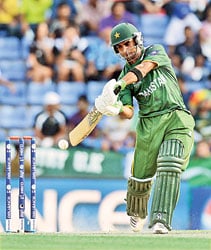
Our weakest link The biggest villain for Pakistan is the man who pushed Imran Nazir in the touring party and then made sure that the misfiring opener played in each and every match of the World Twenty20 By Khalid Hussain The dust seems
to have settled on Pakistan’s semifinal exit from the World Twenty20
Championship in Sri Lanka. As usual, instead of carrying out a through
postmortem of what I believe was a below-par showing from the national
team, Pakistan’s cricket chiefs have moved on as if everything went
according to the plan in the emerald island. Skipper Mohammad
Hafeez expressed his satisfaction on the team’s performance in the
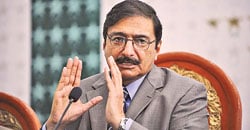
tournament and his views were later echoed by Pakistan Cricket Board
(PCB) chairman Zaka Ashraf, who stressed that winning and losing are
part of the game. He is partly right.
Winning and losing are part of the game but it’s the way Pakistan lost
their semifinal against Sri Lanka that should have forced PCB chiefs to
rethink their strategy. In the crunch match against Sri Lanka and in
what was the most eagerly-awaited game of the tournament —
Pakistan’s Super Eights clash against old foes India — Hafeez and
his boys surrendered meekly. The losses provided conspiracy theorists
with enough ammunition to point the finger of suspicion at the national
team for the two defeats especially the one against India. Experts, too, were
baffled at the way Pakistan crashed against their Asian rivals — India
and Sri Lanka. “It was a pathetic performance,” Mohsin Khan, the
former Pakistan Test opener told me. “It seemed as if we didn’t
believe we could win those two games,” added Mohsin, also a former
national coach. There were many
villains for Pakistan at the World Twenty20 — a tournament that
Pakistan should have won. Many would point the finger at Shahid Afridi,
the former captain, and rightly so. Others would blame the selectors for
picking a less than balanced squad for such an important assignment.
Some would find fault with the strategy of team management led by our
foreign coach Dav Whatmore. Several critics underlined poor captaincy by
Mohammad Hafeez in the games against India and Sri Lanka as one of the
major reasons for poor results. All of them do share
responsibility. But personally I believe the biggest villain for
Pakistan was the man who pushed Imran Nazir in the touring party and
then made sure that the misfiring opener played in each and every match
of the tournament. Some believe it was Ashraf while others suspect
Hafeez. Whoever he was, that person should be held accountable for
Pakistan’s World Twenty20 defeat. I have nothing against
Imran. He is a good stroke-maker who has the ability to play delightful
shots, on his day. But the problem with him is that nine out of ten
times it’s not his day, at least not in international cricket. The man
who rooted for Imran perhaps wasn’t aware that there is a world of a
difference between second and third-tier competitions like the
Bangladesh Premier League or Hong Kong Sixes and international cricket.
Imran may be a success story in such leagues and exhibition events but
when it comes to international cricket he is nothing more than an
uncalculated risk. His supporters would argue that Imran was one of
Pakistan’s leading scorers in the World Twenty20. He scored 153 runs
from six outings at 25.50. His tally included a fifty against
Bangladesh. The figures don’t sound bad but the fact of the matter is
that the only big knock Imran played in Sri Lanka was in a low-pressure
game against minnows Bangladesh. Even in that match he was dropped on 1.
Against India, he was completely out of sorts and even against Sri Lanka
his performance was below-par. But it wasn’t
actually his fault. Imran tried to do what he does best. He went out
there and tried to just whack the cricket ball out of the park.
Sometimes he succeeded but mostly he didn’t. It’s an open secret
that on the eve of the semifinal against Sri Lanka in Colombo, several
of the team’s senior players urged the management to drop Imran Nazir
and bring in the experienced Abdul Razzaq. They thought Pakistan can
take the field for the big game with a more balanced line-up if they
opened with Nasir Jamshed instead of Imran Nazir with Razzaq bolstering
the lower order. But their request fell on deaf ears. Pakistan lost the
semifinal while chasing a modest victory target and with the game they
squandered their best chance of winning a world title. Because, let’s
be frank. I don’t think we have the resources to win the 50-over World
Cup or be the winners of the inaugural World Test Championship whenever
it’s launched. Most of our top performers of the last 5-10 years are
now over the hill. You can’t expect players like Shahid Afridi, Younis
Khan, Misbah-ul-Haq and even Umar Gul to last very long — a few years,
maybe. Our younger stars like Umar Akmal are hardly reliable. The
upcoming ones like Nasir Jamshed have shown promise but they still have
a long way to go. There are batsmen like Asad Shafiq and Azhar Ali, who
are more technically sound, but even their true mettle could be judged
once they take the crease in more challenging conditions like South
Africa, where Pakistan would be playing their next full series. It’s quite evident.
Speaking on the basis of Pakistan’s current lot, our best chance of
winning a world title was in Sri Lanka earlier this month and we blew
it. And the worst part is that PCB is trying to give the impression that
everything is hunky dory. It’s not. Pakistan got it all
wrong with the line-up that they picked for World Twenty20. They opted
for too many stroke-makers without realising that they also needed
orthodox and reliable batters, who could anchor their innings and bring
in much-needed balance to the line-up. And the one specialist
middle-order batsman whom they did select was unfortunately confined to
the dug-out for the entire tournament. Asad Shafiq could have added the
one ingredient that was terribly missing from Pakistan’s batting
equation: reliability. But who cares. After all we did reach the
semi-final and that’s what matters, at least to our cricket chiefs.
PCB’s top boss is happy so is our Twenty20 captain. It doesn’t
matter to them that for a much smaller cricketing nation like Sri Lanka,
even losing the final were so embarrassing that Mahela Jayawardene
resigned from Twenty20 captaincy. But our cricketers and officials
don’t believe in taking responsibility for poor results. That’s the
prime reason why we are not world champions. Khalid Hussain is
Editor Sports of The News, Karachi khalidhraj@gmail.com
Sports
and the emotional quotient Religious
extremism that took birth in Afghanistan and the neighbouring no-go
areas of Pakistan was in its adolescence when the statue of Buddha was
blown by the Taliban. These extremist tendencies nurtured by the hidden
hands to facilitate the Great Game in the region has matured to an
extent that neither individuals nor their properties have remained safe
in the country. The recent Malala
episode and burning of banks, cinemas, toll plazas, petrol pumps and
looting of shops in Karachi, Lahore and Islamabad on the pretext of a
blasphemous film made in the US are testimony to our poor psychological
and emotional state of mind. Isn’t it strange that a nation that
stands fourth in the world IQ ranking is nowhere in the Emotional
Quotient (EQ) ranking? These incidents
exposed our complete radio silence in the area of leadership and an
absolute whitewash of life skills and poor EQ amongst masses in general
and youth in particular. Conflicts in the past
used to serve as powerful impetus for innovation in the presence of able
leadership. Machiavelli once said, “Never waste the opportunities
offered by good crises.” All great leaders of
modern times, including Coubertin, Chairman Mao, and Nelson Mandela used
the tool of sport in the face of crises to shape the destiny of their
nations. But unfortunately our leadership has never been able to
replicate this. Ghazi Salahuddin wrote
in an article after the incidents that “what happened on the
(un-fateful) Friday did not come from nowhere. We had seen it coming.”
Indeed it has been
brewing in our culture for decades, but the question that arises is that
what we have done to stop this. It seems that our society has now been
de-synthesised to a great extent. We point fingers in every direction,
but are unable to understand the plain fact that no one but we,
ourselves, are responsible for our own destruction. Sport has a universal
appeal and our leadership knows it better than any one else. But how to
use it in the best interest of people is a conundrum beyond the scope of
those who lead us. Or perhaps they don’t want to empower the masses in
real terms through any means. We seriously need to
understand and apply the powerful tool of sports from at least two
different perspectives. The first and foremost
is its competitive and professional angle, where sport is played within
its unique dimensions of time and space in which quest for record and
entertainment is of high significance. POA, PSB and federal,
provincial and district sports bodies are primarily responsible for the
development of sports in the country so that national teams of different
sports can be selected, trained and formed to represent Pakistan. This aspect requires
prioritization and support from government, trained human resource in
sport sciences and management to run the affairs smoothly. The second angle is
more important and complex but extremely neglected. This perspective is
of using sport for developing the Emotional Quotient amongst the youth. EQ is not just the
ability to accurately perceive our own emotions, but it is also our
ability to accurately judge the emotions of other people and understand
what is really going on. This often means understanding what other
people are thinking and feeling even if we don’t feel the same way. It is indeed easy said
than done, because development of this understanding requires quality
education, intrinsic motivation, self improvement and constant training
in the area of sport for development (SFD). It is not about
rote-learning and attending a few sessions to acquire higher grades in
exams, but to develop analytical thinking and emotional sensitivity
towards fellow human beings and tackle ethical issues with prudence and
sagacity in a creative environment. The United Nations,
after years of thorough studies and trials in different developing and
least developed countries, now propagate the use of sport as one of the
basic tools of achieving life skills, MDGs and settling of conflicts in
fragmented societies, including ours. The United Nations
Office on Sport for Development and Peace in its annual report of 2011
stated that sport has become a world language, a common denominator that
breaks down all the walls, all the barriers. It is a worldwide industry
whose practices can have a widespread impact. In continuation to this
vision a number of projects are being organised worldwide to develop
life skills in societies hurt by conflicts. An Italian NGO Uisp
recently opened a boxing centre for young people in Shatila, Beirut
where people are still living in the memory of a 1982 massacre during
the Lebanese civil war. Unlike our boxing
federation, many countries in the world are using boxing and other
combat sports for venting out the youth aggression, creating role models
and even empowering women and challenging gender stereotypes. Box-girls
International runs programmes in Berlin, Nairobi and Cape Town, which
aim to improve confidence, team work, strength and resilience among
women and for this very reason women boxing was included in London
Olympics 2012 for the first time. While the rest of the
world and its education specialists are focusing on new equipment,
techniques and concepts in sports for development, children and youth in
our society are adopting dangerous trends and tendencies in the absence
of playing opportunities in schools, colleges and organised clubs. The children instead
of buying sports goods are seen buying toy guns with their pocket money
on festivals like Eid which depicts a dangerous trend in our social
preferences. This is an eye opener
for our educationists and policy makers. The solutions to our
deep-rooted social and cultural issues are not very simple, but use of
all possible tools, including sports, with utmost sincerity may help in
bringing a much needed social turnaround in the country, which can help
our intelligent nation become more emotionally stable and globally
acceptable. If we yet fail to
recognise our priorities and continue to live through ad-hocism and
military wisdom then we shall be repeating the events like September 21
time and again. And education system devoid of sport culture will only
produce chirping parrots with high academic grades and low EQ and our
dreams of producing sport icons capable of having positive impact in the
society will be eluded for ever. sdfsports@gmail.com
CLT20:
Where are all the champions? At present
there is a lull in international cricket as Australia is gearing up for
a series against South Africa while West Indies is set to take on
minnows Bangladesh in a bilateral series. There are some mouth-watering
clashes in store in the coming months with England’s tour of India a
must-watch for cricket fans. But hang on there is
apparently a top-class T20 tournament taking place in South Africa! The
best talent in the crash, bang and wallop format is at display in
Centurion, Johannesburg and Cape Town, and if you are not lucky enough
to be there to witness action at the grounds you can see live coverage
almost anywhere in the world. The concept is the
brainchild of the present day masters of the game — the Board of
Control for Cricket in India BCCI. The event was designed to cash in on
the success of the Indian Premier League and from a distance seems like
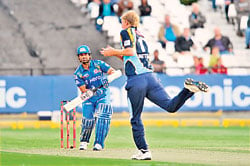
a rendition of the same event. The extravaganza named
the ‘Champions League T20’ features four leading teams from India,
two each from Australia and two from South Africa and if this wasn’t
enough two teams also qualified for the main round after a qualifying
round that featured champions from Pakistan, West Indies, New Zealand
and Sri Lanka. England the once
masters of the game were rewarded for introducing the game and had the
luxury of fielding their T20 runners-up besides the champions of the
national tournament (albeit in the qualifying round). The readers must be
confused but trust me so am I. I’ve tried to decode the formula behind
this farce where one nation is allowed to field its national T20
champion, runner-up, third and fourth best teams! While the other two
major stakeholders have both their champions and runner-up competing.
The rest rather less fortunate cricket boards are forced into a
qualifying crass. The message is loud
and clear and doesn’t reflect well at all on the gentlemen’s game
— the tournament is simply an exercise to fill in the coffers of the
stakeholders who have the biggest share in the pie and any left over is
for the poorer boards to revel in. As the tournament
wears on one gets great pleasure in seeing India’s champion, second,
third and fourth best teams receive a thrashing from a team like
Auckland Aces belonging to the historically docile New Zealand Cricket
Board. By the time this goes in print at least one of the mighty Indian
teams would have packed their bags and drifted away. Like most cricket
enthusiasts some of the big names associated with the game are also busy
deciphering what exactly is the league all about. Former Pakistan
captain and chief selector Aamir Sohail thinks that the league is not
the right advertisement for the game where the champions have assembled
and the governing body of cricket needs to address the glaring issues at
hand. “ICC should address
the concerns on the format of the tournament; if the event has to carry
the nomenclature ‘Champions League’ it should simply have champion
teams in the fray. The best possible solution is to have one champion
team from each of the ten Test-playing nations; this will truly make it
the league of champions.” Aamir also thinks that
BCCI needs to re-invest some of the money earned through the league in
promotion of the oft neglected 50-over format. “BCCI is set to earn
big money out of the Champions’ League; now as per the global practice
of leading corporations they need to re-invest the money in projects
which have been out of the mainstream off late. I think that the need of
the hour is an ODI league which will re-ignite interest in the format
that has been neglected due to the mushrooming of T20 leagues.” At the same time one
hopes that Pakistan Cricket Board steps up to the plate and demands a
fairer treatment. The lone representative from the country — Sialkot
Stallions — was forced to play the qualifiers despite having an
extremely impressive record in T20 cricket. Even in the qualifiers
they made a decent impact, winning one and losing one of the two ties
allocated to them in conditions which were alien for the players. The
stallions did not have the luxury of fielding any international star as
no foreign cricketer is yet to represent any team in our national T20
competition. Perhaps the English
Cricket Board and the Marylebone Cricket Club — the self acclaimed
custodians of the game — decide to raise their hands and call for
better sense to prevail. At present though the
league is anything but stuff made of or for champions, it is more of a
sham and one thinks that if this madness is to continue for the next
season the title given should be ‘The league of the mighty’ or
‘BCCI aur humaray pasandeeda doston ke league’. emmadhameed@hotmail.com
Putting
hockey on right track More than
three months after the national team crashed to a disappointing
seventh-place finish, Pakistan’s hockey chiefs would assemble in
Lahore next Wednesday to discuss ways and means to avoid such debacles
in the future. Qasim Zia, the
Pakistan Hockey Federation (PHF) president, has hinted at sweeping
changes in the national team management and selection committee. Senior
PHF officials are also set to work out a strategy for future tournaments
including the Junior World Cup, World Cup 2014 and the next Olympic
Games to be held in Rio de Janeiro in 2016. All of that would come
under discussion at the PHF Executive Board’s meeting that would be
chaired by Zia, a former Olympian. It’s quite clear
that after what happened in London this summer, Pakistan hockey
certainly needs an overhaul. PHF officials tried to give the impression
that Pakistan’s failure to finish among the top-six at the Olympics
wasn’t a huge disappointment but that’s a poor approach. How can a
team that has won four World Cup titles and three Olympic gold medals be
satisfied with a seventh position? It was hardly
surprising when several former stalwarts revived their campaign to
enforce sweeping changes within the PHF set-up soon after the Olympic
debacle. But let’s leave the
issue of the former Olympians aside for now and just focus on PHF’s
plans to overhaul the team management and national selection committee. PHF bosses seem to
have made up their mind about replacing the coaches but surprisingly
they are unwilling to axe Akhtar Rasool, who was Pakistan’s manager
and head coach for London 2012. PHF officials say that Akhtar was roped
in just a few months before the Olympics which is why he can’t be held
responsible for the below-par showing in London. The thing is if Akhtar
stays then you can’t say that there would be sweeping changes in the
team management because the top man would still be there. If Akhtar stays, which
seems quite likely, then one can assume that Khawaja Junaid would be
removed from his position as Pakistan’s coach. There are indications
that Tahir Zaman, also a former Olympian, might replace Junaid as new
coach. Till a few weeks back Tahir was regarded as a staunch critic of
PHF but he has changed his course and has joined the PHF. Some experts
believe that Tahir would be rewarded for his U-turn by giving him an
important job in the national hockey set-up. It won’t be a bad move
because Tahir has loads of experience. He is easily one of the most
qualified hockey coaches in Pakistan. But whether he would be able to
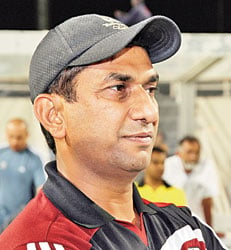
develop a winning combination with Akhtar Rasool remains to be seen. Hanif Khan is also
likely to lose his job as chief selector. It is expected that the PHF
would dismantle the entire national selection committee and bring in a
new group of former Olympians and internationals to form a new one. All such measures
would only work if they are taken after doing proper homework because by
just changing faces the PHF won’t be able to bring any improvement in
the performance graph of the national team. What Pakistan hockey
needs at the moment is meticulous plans followed by their implementation
with dedication and commitment. Over the years, one
has seen PHF take one step after the other without achieving the desired
results. One hopes that things are different this time. bilalsports86@yahoo.com caption Tahir Zaman... will he
be Pakistan's next hockey coach?
interview-II Gogi Alauddin
refuses to speak much about his style and technique. “About my style
of play, only others can describe.” This is what the
legendary Geoff Hunt says about his contemporary, “I played Gogi
numerous times over a number of years and when he was playing well he
was difficult to beat. His style of play differed from most because he
used a lot of slower paced shots like drop shots and lobs to
systematically open up the court and beat his opponents. “He was very
accurate with great touch never giving you an easy shot to play.
Combining that with his on-court agility and great ability to read where
the ball was going made him a formidable opponent. “Perhaps the main
thing that stopped him winning more tournaments was that he was not a
powerful hitter. Therefore, unlike some of other top players his attack
relied entirely on his placement. As good as that was it still meant his
opponents had more of a chance to retrieve his drive shots because of
their slower pace. I remember playing a match against Gogi where one
rally went for 10 minutes and was over 400 hits. This shows you what he
was like when he put his mind to it.” Gogi said Pakistan squash’s
revival in the ‘70s owed a lot to Air Marshal Nur Khan, the then
chairman of Pakistan International Airlines. “He initiated the PIA
Colts scheme. Young promising boys were spotted and given a monthly
stipend. We were coached and sent to participate in international
tournaments with PIA footing the travel. Whosoever performed well on the
international circuit was given permanent employment in PIA. The
incentives didn’t end there. If any of us achieved some major success
in prime events, he was rewarded with a departmental promotion; I was
moved to group six on reaching the final of the British Open. That
provided us with the security so badly needed as squash in our times
didn’t bring much money — winning the British Open brought only 500
pounds.” Gogi said it had
always been his desire to give something back to the game that had given
him everything. “I was sent by PIA for a two-month coaching stint in
Malaysia. In 1985, I went to Kuwait and spent five years with a high
profile club, coaching members of the royal family among others but had
to flee the country when Saddam Hussain’s troops entered, losing some
valuables. “In 2003, an
Egyptian firm approached me to coach in USA for four months but I
couldn’t go because of my mother’s illness.” He said the most
unfortunate moment of his squash life was Torsam Khan’s death. “I
was sitting in the front row when he died in action on the squash court
during the 1979 Australian Open. We were also sharing the same hotel
room. It was simply unbelievable. “Torsam Khan, elder
brother of legendary Jahangir Khan, was ranked unlucky 13 in the world
at the time of his death.” He said it was
surprising that no real star emerged from Lahore after him. “I had no
one to look to but after my successes, I think Lahore had a role model.
My own nephew Sohail Qaiser was the next hope. He began his
international career in a storming fashion: winning the world junior
championships in 1982, breaking into the world top 10 and also winning
the British open under 23. I think his fitness regime was not
professional. A tendon injury, when he was still in his early 20s, ended
his progress.” He said his favourite
player was no one but the great Geoff Hunt. “Apart from the technical
excellence, he was also physically very fit and mentally strong. There
were so many of us Pakistanis breathing down his neck. For a long time
in the ‘70s, the Pakistanis occupied rankings from no 2 to no 5. We
always discussed among ourselves how to bring Geoff down but he was too
intelligent for our plans. “But more than
anything else what impressed me the most was his gentlemanly behaviour.
If he felt the umpire had given a wrong call in his favour, he used to
stroke the ball out of play. I have seen Hunt doing this even in the
British Open final against Barrington.” He said it was painful
for him to see the decline of Pakistan squash. “I put the blame on the
players. They are not dedicated. As compared to our times, Pakistani
youngsters today are very much blessed in terms of facilities. There are
so many modern courts. National federation provides them with very good
coaches from a very early age. There are a number of tournaments in the
country. Yet, they are complaining all the time. The boys are not
prepared to work hard and the hunger for success is missing. “I am trying to do
my bit. Presently I work as the head coach of the Punjab Squash Rackets
where I train top four boys in each of the four categories: under 13,
15, 17 and 19. The boys have the talent but, as said earlier, lack the
will.” The rags-to-riches
story of Gogi Alauddin should be an inspiration to all. How a person
overcame lack of finances, facilities and competition. Through sheer
determination and hard work, he defied all the odds and reached great
heights. ijaz62@hotmail.com caption Gogi Alauddin
The
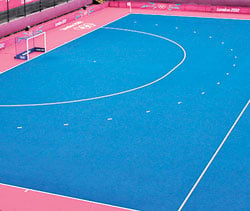
long wait for turfs If we go by
performance, the year 2012 could be declared a nightmare for Pakistan
hockey, but as far as development projects are concerned it is a year
when a mini revolution began. At least seven synthetic turf projects
have been launched in various parts of the country this year. Five of
them are to be blue turfs. One has already been put into operation and
it is expected that at least one more would be installed by the end of
the year, officials of Punjab and Sindh sports Departments and Pakistan
Hockey Federation told ‘The News on Sunday’. None of the five blue
turf projects is expected to be completed before the national hockey
team departs for the 36th Champions’ Trophy, to be held in December in
Australia this year. Fazal-e-Mateen, chief
executive of TS Builders, the contractor of the blue turf project at
National Hockey Stadium (NHS) in Lahore, claims that development work is
being carried out at NHS at a fast pace, and that the blue turf will be
ready by the end of November. “Then it will be up to the PHF to give
the Green-shirts practice here,” he says. The blue turf project
was initiated at NHS in Lahore earlier this year in order to give the
Green-shirts some practice before the London Olympics 2012, but this
attempt failed because the Sports Board Punjab (SBP) cancelled the
contract of Swallow Internationals, which could not complete the task by
the deadline of June 2012. TS Builders, the
second lowest bidder, was given the contract. PHF sources said they also
expected the project to be completed this year. Mateen’s company has
already installed a green synthetic Deso turf at Johar Hockey Stadium in
Johar Town, Lahore, and it is likely to be inaugurated by Chief Minister
Shahbaz Sharif by October 25. It is the only synthetic turf project in
the country which has been completed in the due given time. Both these projects
discussed above have been funded by the Punjab government. The absence of blue
turf in the country and Pakistanis’ lack of experience with it were
the reasons for the defeat at the London Olympics this summer. Most major
international hockey championships are now to be held on blue turfs,
according to the FIH directives. In Sindh, five
synthetic turfs, including four blue, are to be installed during the
ongoing year, but not one has yet been installed. The progress on
synthetic turf projects in Sindh is far from satisfactory. Progress is
currently being made on only one project, the North Nazimabad Gymkhana
hockey ground in Block N. It is also delayed, but the work on base of
the turf is near completion. When this project
would be completed depends on the release of funds, sources in the Sindh
government said. Sources said that
whatever development work is being carried out in the blue turf projects
in Sindh is because of the efforts of provincial sports minister Dr
Muhammad Ali Shah, who has made a lot of efforts to arrange at least
five turfs in the province, including in Mirpurkhas and Larkana. But bureaucratic
hurdles have delayed all the projects. Therefore, not a single synthetic
turf could be installed here during 2012. Four of the five
synthetic turfs will be blue. The green one will be laid at Khoro hockey
ground in Larkana. Funds for the one in
Larkana are being provided by the federal government’s Pakistan Sports
Board (PSB). The project has been delayed for the past two years.
Sources say that the synthetic turf has been brought in the country, but
it could not be installed due to lack of funds. Most of the projects
are being delayed because of the laziness of officials of provincial
sports department. More than 70 percent
development work has been completed at North Nazimabad Block N project,
but due to lack of funds the turf could not be installed. Dr Shah has said that
it would be installed soon. According to the contractor if funds are
released during the next two months, its installation will be completed.
Three of the five
turfs are to be laid in Karachi, including one at the Hockey Club of
Pakistan (HCP). The administrator of
Hockey Club of Pakistan (HCP) Olympian Iftikhar Syed said that last week
officials of provincial sports department had held a meeting with him
and visited the HCP to review the development process. Iftikar said that the
PC 1 of HCP blue turf project was being prepared and it was difficult to
give the exact date of its installation as it depended on the Sindh
government. One synthetic blue turf will be laid in Mirpurkhas at
Shaheed Zulfiqar Ali Bhutto Hockey Ground. Sources said the
installation of synthetic turf at Khalid Bin Waleed Hockey Ground in
PECHS has been jeopardised because of the objection of a resident of the
area, who says the ground was likely to be used for commercial purposes.
He fears serious environmental losses to the area because of the
project. The resident has filed
a writ petition in the Sindh High Court and development work has been
stopped till further orders. Sources in the hockey
circles said that this project was going fast until the court stopped
work. Olympian Qamar Ibrahim,
who is supervising the project, told ‘The News on Sunday’ that a
group of country’s hockey heroes is considering approaching the Sindh
High Court and become a party in the case. It is learnt that
approximately Rs60 million had been approved in the Annual Development
Plan for the Khalid Bin Waleed ground project and development work for
the base of the turf had been started. The ground is
considered a hockey paradise in the history of the country. It produced
a number of international hockey players and Olympians in its history of
more than 50 years. A group of
international hockey players asked how the place could be used for
commercial purpose and what loss of environment there could be when tree
plantation and gardening was part of the project. The construction of
base for the synthetic turf, sprinkle system, drainage system and
boundary wall was about to begin. A walking track for
the residents of the area and seating arrangements for spectators were
the part of the project, said the contractor. Pakistan has won only
three Olympic gold medals in its 64-year history and all came through
hockey. The country can win more but it all depends on how we invest on
the betterment of the game. intikhab3@gmail.com
|
|