



|
|
|
|
|
 |
 |
  |
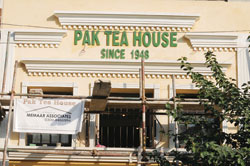
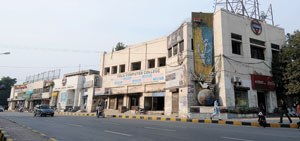
issue Slippery legal ground The recent sealing of YMCA Hall and its reversal was directly linked to the Punjab Government’s decision to reopen Pak Tea House By Waqar Gillani On Friday, October 19, the city district environment officer suddenly realised that the more than a century old historical building of Young Men Christian Association (YMCA) in the town did not fulfill “certain requirements”.Hence, the office of the Lahore chapter of this globally spread nongovernment organisation was sealed. According to the organisation, it was sealed on the directives of District Coordination Officer Noorul Ameen Mengal, following a sudden raid by the environment officerwithout any prior notice about these ‘violations’. Mood
street Town Talk atms Defenceless
in Defence Magical images
issue Slippery legal ground The recent sealing of YMCA Hall and its reversal was directly linked to the Punjab Government’s decision to reopen Pak Tea House By Waqar Gillani On Friday, October 19,
the city district environment officer suddenly realised that the more than
a century old historical building of Young Men Christian Association
(YMCA) in the town did not fulfill “certain requirements”. Hence, the office of the
Lahore chapter of this globally spread nongovernment organisation was
sealed. According to the organisation, it was sealed on the directives of
District Coordination Officer Noorul Ameen Mengal, following a sudden raid
by the environment officerwithout any prior notice about these
‘violations’. Surprisingly, the
incident occurred a couple of days before the city district government
squad raided a tyre shop adjacent to the under-renovation Pak-Tea House,
forcing the occupant Nasrullah Khan to vacate the shop for expanding the
Pak Tea House. The Punjab Government, which has promised to restore Pak
Tea House, also announced more than eight million rupees for its
renovation and re-opening soon. Meanwhile, an
investigation into the legal status of the Pak Tea House and adjacent
shops and Punjab Government’s claims reveals that the latter stands on
slippery ground. Both the shop that
housed Pak Tea House and the tyre-shop pay rent to the YMCA. Soon after
the incident, the YMCA building was sealed on the pretext of being
“environmental hazardous”. As per on-the-spot-issued notice, “the
building had no proper parking space and environmental approval for
discharging sewage.” However, after some pressures, the authorities
de-sealed the building on October 21, Sunday, without telling anything
further to the YMCA administration. The decision has been welcomed by the
YMCA administration and the local Christian community. It is important to note
that all three parties — the owner of the shop that was Pak Tea House,
the owner of the tyre shop next door, and the YMCA management — have
moved the court at various points to stop this high handedness of forcibly
opening the Pak Tea House shop, asking to vacate the adjacent tyre shop
and sealing the building without any reason, respectively. “Not even a single
vehicle was ever allowed to park on The Mall in front of the building.
Moreover, not even a single building on The Mall had any parking space and
the DCO only issued directions to seal the building owned by YMCA, a
minority community,” says Samuel Pervez, general secretary YMCA. Nasrullah Khan, owner of
the tyre shop, feels aggrieved. “This is very strange. We have got stay
order from court but despite that, last Sunday, the city government
machinery was sent to bulldoze my shop. Later, the traders associations
intervened and managed to stop them from this contempt of court.” Khan says his family has
been running this shop for three generations “and we are paying regular
rent to YMCA and according to land record this shop is the property of
YMCA so government has no right to forcibly remove us from here”. Zahid Islam, proprietor
of Pak Tea House, who has signed a rent lease of the part of building
where Pak Tea House is going to be re-reopened, also resents this
high-handedness of the government. “Last February, the government broke
the locks of my shop, threw the stuff away and told me it was re-reopening
the Pak Tea House. This whole act is unlawful,” he says, adding, “I
have already won two cases in the court under Article 4 and 18 of
Constitution of Pakistan which give me the right to justice and right of
free choice of business.” He alleges the
government is doing all this on the demand of certain influential writers
who are well-connected with the government. “This malicious act of
the government has given a bad name to this government and unfortunately
our country. The government should be made answerable for this suspicious,
mala fide act,” says Samuel. “The YMCA building was
sealed and later de-sealed on the directives of DCO,” Muhammad Younas,
deputy district officer environment departments says. “We don’t know
much about the issue.” YMCA is an international
organisation that started as a movement in 1844 in England. The historic
building is visited by a number of foreign delegates every year. The
former hostel, situated in the same building, has reportedly hosted former
American president Bill Clinton when he was a student in the 1960s as YMCA
member. Former Finland president and recipient of Nobel Peace prize in
2008 Martti Ahtisaari, and former Pakistani president Late Farooq Ahmed
Khan Leghari had also stayed in this hostel for some time. Zulfikar Ali Bhutto
announced his movement against Field Marshal Ayub Khan in a 1967 ceremony
in this building’s hall. Radio Pakistan started its broadcasting in this
building until the station moved to its present building at Empress Road.
During the partition, YMCA hosted a number of refugees for many weeks as
it was almost turned into a shelter camp. The history of Pak Tea
House in this building also goes back to 1944 when two Sikh brothers
opened two separate shops in this area. One brother opened India Tea House
in the YMCA-owned shop which was turned into Pakistan Tea House by its new
owner Sirajuddin Ahmed and father of the current occupant Zahid Islam,
after the Sikh brothers moved to India after partition. Reputed writers, poets
and intellectuals used to come to Pak Tea House till its formal closure in
2005 because of illness of Zahid Islam who later converted into a tyre
shop. However, there have been different demands and campaigns to re-open
this historic place. The sealing of YMCA hall was one way the Punjab
Government wanted to realise this demand. vaqargillani@gmail.com
Till a few years back, a
rickshaw was used for transporting people from one place to another. It is
no more confined to this service; thanks to the educated angry young
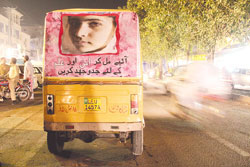
drivers who are now using their three-wheelers as advertising machines. We hardly see a rickshaw
without an advertisement for different goods and services such as cream,
herbal medicines, slimming centres, beauty parlours and academies. A risky conveyance, most
of the auto rickshaws have no indicators or rear lights, baffling other
motorists about which side it will turn. At night, it becomes so invisible
that a motorist following it has to apply brakes at the eleventh hour to
avoid collision. But if you are living and working in this city and
don’t have a car, rickshaw is quite a convenience. Other public transports
have too many stop-overs; thus people prefer rickshaws which are also
easily available. It’s the haggling for a reasonable fare that takes
some time, otherwise they come every minute. Sometime back, we would
rarely see educated people driving rickshaws. Now a good number of
degree-holding office-goers are seen driving rickshaws. In most cases,
these young men do this to avoid humiliation at the hands of their
employers for the meager sum of Rs10,000 or 15,000 as their salary. They
seem a lot more satisfied with self-employment and better income. You pick up a
conversation with these educated young, often angry, drivers and this is
what you hear “There is no tension to get up early and reach the office
in time. Certainly, I earn far more than I used to from office job which
would take all my time.” Sometimes we see funny,
catchy and thought-provoking sentences at the rear of rickshaws such as
‘I am back because the hell was full’, ‘Har dard ki dawa murshid ki
bargah’, ‘Maan ki badua jaa baita ricksha chala’, ‘Noorani noor
hey har bala door hai’, ‘Mil gayee rozee tu na mila tu roza’ and so
many others. Whether we agree with
these messages or not, they all have a rhyme and rhythm which is not the
work of an ordinary man. These sentences may seem insignificant but they
depict their world-view and may have a cathartic value. Let me give you some
useful information in case you don’t know it already. If you are looking
for a particular address in your city, ask this from rickshaw drivers
because they are the only people who can guide properly. I always find
them patient and considerate while telling me the address. Today’s rickshaw is
more of a mobile advertising vehicle; it’s a cheap source of
advertisement which is very effective because no one living in this city
can miss the rear of a rickshaw. Advertisements for selling goods and
services are okay but using them for spreading religious hatred is both
sad and unacceptable. Sometimes one becomes
curious as to how does it happen that an entire lot of rickshaws comes on
the roads carrying one single message on its back. Again, dengue awareness
is alright as are prayers for Malala Yousufzai but the anti-India and even
anti-Hindu advertisements come as a surprise. One wonders as to who
pays money to these rickshaw walas for spreading hatred in a society that
is already losing any semblance of sanity. One also wonders if the
educated rickshaw drivers will stay driven by the market forces or put
their foot down if the message is so anti-people and just do with the
sense of humour that was the hallmark of their vehicles. shafiqnizami@yahoo.com
* Exhibition at Ejaz
Galleries: Colours of Desert by Asad Faruki till Nov 05. * Class Room, a solo
exhibition of Ghulam Hussain Guddu at the Drawing Room Art Gallery till
Oct 31. * Exhibition titled
‘Daughters of Walled City’ at Nairang Art Gallery to open on Thursday,
Nov 1. Artists: Afshan Ejaz and Noshi Ejaz. * Collectors of stamps,
coins and bank notes gather on the first Sunday of every month at Alhamra,
the Mall. This time it will be on
Nov 4.
atms Ali, a marketing
executive in his mid 20s, rushed to the nearest ATM he could locate to
withdraw the cash he needed urgently. To his surprise there was no queue,
so he triumphantly walked into the cabin and inserted his ATM card in the
machine. Things went smoothly
till the entering of the Personal Identification Number (PIN). It was
exactly when he expected the machine to eject brisk and new currency
notes, the power failed. It got pitch dark. The power supply was restored
shortly and the machine got functional. But there was no update on the
transaction which he was in the process of making and neither the machine
ejected his ATM card. After waiting for a long
time and trembling with anger and frustration, he graciously accepted
defeat and walked out of the cabin. For a moment, he said, he had a
temptation to kick the machine with his pointed boots but he didn’t. The
presence of a tall and robust security guard, with moustaches touching his
earlobes, made him decide against what he was thinking. The next morning he
reached the concerned branch around 11 am. Ali was shocked to find the
branch officials had not retrieved the captured card and there were fears
it was with some one who could try to use it as a debit card. Without
wasting a moment he called at his bank’s helpline and got the card
blocked. With his cheque book already lost, there was no way he could
withdraw money from his account. Ali’s is just a case
in point. There are countless victims of the same faulty ATM networks,
many of them with unique experiences to share. For example, Mehboob, a
newspaper employee, recalls the experience he once had with an ATM
machines. Having followed all the procedures to withdraw Rs 20,000, he was
waiting for the cash to come out of the machine. It produced something but
it was only a receipt saying “Thank you for using *** ATM” and showing
the said amount deducted from the balance. Mehboob said he was
shell-shocked after going through this experience. He stood there helpless
thinking how he would manage the expenses to go outstation with the family
and attend a cousin’s wedding over the weekend. He called the helpline
but help, if any, came in the form of an advice to visit the bank branch
where he maintained his account, on the next working day. It took the bank
one and a half weeks to confirm the malfunction in the ATM and settle his
amount but the damage had been done. He had faked severe illness to skip
the wedding they all had been waiting for. Breakdowns, running out
of cash and being off-link due to various reasons including power failures
are the other most commonly faced problems related to ATMs. A large number
of banking customers have switched to use of cheque books which only
require a visit to the bank. They believe this is much better than running
from one ATM to another ATM at odd hours with disappointment awaiting them
at every step. An official at the zonal
head office of a leading Pakistani bank tells TNS, on conditions of
anonymity, things will not improve till the State Bank of Pakistan (SBP)
starts rating banks in terms of performance of their ATM networks and
punishing them for unsatisfactory performance. The central bank simply
issues instructions and guidelines which hardly yield results, he adds. Explaining his point,
the official says people always condemn the bank which owns the ATM which
is unable to pay cash. Sometimes, the host server of the bank where a
customer has an account is down and not connected to the shared One Link
ATM network. In this situation, it is hard to gauge the efficiency of
different banks. “It’s quite common
that many banks intentionally go offline on closing days of months to
record higher closing balances.” SBP spokesman Syed
Waseemuddin tells TNS the central bank’s Banking Services Corporation (SBP
BSC) has set up Customer Facilitation Centres at all its sixteen field
offices to ensure smooth and uninterrupted functioning of ATMs of
commercial banks throughout the country, especially during Eid-ul-Azha
holidays. Names of the contact personnel and their mobile numbers have
been shared with the public so that they can file their complaints
immediately. He also shares an SBP
document with TNS which instructs the banks on procedure and timelines for
‘automatic credit’ of suspense ATM Cash. It’s the amount debited
from one’s account without being disbursed during an incomplete
transaction. The time for account recharge varies from one day to seven
business days depending on various factors, but it has been observed that
it often takes much longer. The central bank warns
commercial banks of action as per rules of Banking Companies Ordinance (BCO),
1962, in case of non-compliance but general perception is that no one can
touch them. However, the district
consumer courts set in Punjab claim of listening and catering to
people’s problems related to ATMs. Lahore District Consumer Court
Registrar Asif Nazir tells TNS the banks are issued notices on grounds
that they promise to offer 24/7 services to their customers but fail to do
so. The court, he says, has received a large number of complaints about
wrong deduction of funds from people’s accounts, especially while using
ATMs. The court has called
bank officials quite often and helped people get their accounts settled.
“In one or two cases, the account holders were even paid for going
through mental anguish due to non-functioning of ATM networks.” It’s quite natural for
ATMs to run out of cash on Eid as people spend more during this festival,
says Amir Ali Rizvi, MCB Business Head (Central), adding there were around
120,000 cash transactions on the first day of Eid-ul Fitr this year.
“What’s more important is that ATMs are stuffed with cash as soon as
they run out of it.”
Defenceless
in Defence Affluent people choose to live in posh
areas not only to enjoy a luxurious life but also to live safe. Defence
Housing Authority (DHA) has one of the most posh and expensive residences
in big cities including Lahore. The DHA has its own security system with
ample manpower apart from the two police stations that are supposed to
guard the lives and properties of people living in DHA. However, street crimes, house robberies,
thefts, cars and bike lifting have become a routine matter here.
Housemaids and servants have become a big challenge for the residents, the
DHA administration and the police as they have been operating under
organised gangs. The DHA office bearers and police claim that servants are
involved in more than 90 per cent of these crimes. The housemaids and servants rob in three
ways. Some of them steal valuables and gold ornaments from the houses
where they serve in such a smooth and smart way that the landlord takes a
long time to calculate his loss. Others plot a burglary by intoxicating
people in the house with poisonous foods or by mixing intoxicants in tea
or drinks. They choose the time when men of the house go out on their
business. The women easily become victim of the criminal-minded housemaids
who successfully escape with valuables. The last modus operandi is a heinous one:
the housemaids, who have links with criminals/robbers, get themselves
appointed at different houses for a very short time, examine the house
minutely and plot house robberies. The story does not end here as the
dacoits are also busy looting the citizens in commercial markets and
streets. The history-sheeters have been patronising the new comers in
street crimes. Blaming a family for not verifying the
servants before giving jobs to them is easy but the sorry side of the tale
is that police and security system of DHA have badly failed to control
increasing crimes in a ‘well organised’ residential society. Many residents have complained about the
negligence of security guards. Most of the close circuit tv cameras (CCTVs)
installed in the locality are out of order while the same is rarely seen
in commercial markets/shops. The ones which are installed at different
places lack night vision when most of the crimes take place. The office
bearers of DHA are waiting for the approval of a tender floated for the
installation of CCTV cameras. It would also be worth mentioning here
that most of the DHA security guards are in their 40s and are not much
equipped to control crimes or keep a vigilant eye on criminals. Some
police officers also disclosed that a few security guards were also
apprehended while providing information about the residents to gangsters. The society is not completely walled and
the fear of some villagers breaking into the houses during the Eid
holidays and other festivals remains. Trespassing boundary walls of houses
in DHA is a very easy task as the walls are very low. Around 350 cases of heinous crimes were
reported in the two police stations of DHA during the first nine months
this year. Two persons were killed while more than 30 sustained injuries
on resisting robbers in this area. 117 house robberies were reported during
this period. A six-member gang of dacoits had looted around seven houses
spreading terror in the DHA. Around five cars were snatched while over 80
cars were lifted from houses and markets during the first nine months of
2012. Out of the total reported incidents in
DHA, around 85 bikes were also stolen 12 were cases of theft, one case of
kidnapping for ransom, 7 cases of murder, 7 cases of attempt to murder and
2 of bike snatching were also reported during the current year. The agony
and trauma of robbery victims is besides this. A senior police officer serving in DHA
says that the collective effort of DHA security personnel and policemen
could help in controlling crimes of all kind in a very effective and
speedy way. There is a need to organise the manpower of DHA, he says. Assistant Superintendent Police (ASP) DHA
area Farrukh Raza, talking to TNS, claimed that the crime rate, however,
was less in ratio as compared to last year. “We cannot eliminate crime
but reduce it,” he says, adding, “Prevention is the most important
thing in controlling crime and we are trying our best.” He views that
careless attitude of the landlords living in this posh vicinity of the
town is a major reason for crimes. “They, generally do not take care in
hiring servants,” he says, adding, “Many people do not even have
copies of identity cards of their servants and they don’t keep even a
snapshot of them to get help if a crime is committed.” There is need to
sensitise people living in DHA to be careful about such things which lead
to major crimes. A few years ago the registration process of servants in
DHA was started by the administration. However, it seems to have almost
stopped now.
Magical images If I may be presumptuous enough to speak
for other lensmen, then there is only one emotion they can feel upon
seeing the wor Trained in the fine art of photography in
Japan, Khawar honed his skill over the last two decades in the great
outdoors of Pakistan. He gave mountainscape photography a new meaning in
colour, rivalling the work of Shahid Zaidi, arguably the greatest mountain
photographer Pakistan has ever produced, who mostly worked in black and
white on large f Though he understands the use of light as
the quintessential element in producing a first-class, almost magical,
image, the key of Khawar’s photography is his eye for colour that
transforms even a mundane setting into a masterpiece. Coupled with that,
he keeps a sharp look out on lines and shapes that comes in handy in
photography buildings. The ongoing (un Nadeem Khawar is no snap-shooter. He
scouts for the perfect image. And so the khaki walls of Marot Fort in
Bahawalpur are enriched by the line of colourfully clad local women, water
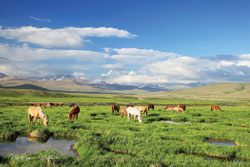
pots on their heads, making their way past it. Similarly, the herd of
horses grazing on the wide expanse of Deosai under a blue sky richly
overlaid with white cumulus becomes a sharp masterpiece by good timing and
a low sun. At the same time dust and a setting winter sun make his Punjabi
tent-peggers a faultless study in surrealism. Nadeem Khawar is a true artist with a
camera. Unfortunately, photography is still far from recognition as an art
form in Pakistan. Few people realise that it takes more than just a camera
to make unforgettable images, that it is simply not a game of point and
shoot. Years ago, America had its Alfred Stieglitz (1864-1946) whose fifty
years of labour with the camera made photography acceptable as an art
form. In Pakistan, it may well be the work of
Nadeem Khawar that will eventually lend photography the status it
deserves.
|
|

 k
of photographer Nadeem Khawar. And that is overpowering envy. If there is
ever a perfect image, it is taken by this man. If there is an artist with
a camera, it is Nadeem Khawar.
k
of photographer Nadeem Khawar. And that is overpowering envy. If there is
ever a perfect image, it is taken by this man. If there is an artist with
a camera, it is Nadeem Khawar.  ormat.
Yet, even as he was concentrating on the mountains, Khawar simultaneously
developed extraordinary skill in photographing people, built heritage and
wildlife. In this last category he excels in capturing birds.
ormat.
Yet, even as he was concentrating on the mountains, Khawar simultaneously
developed extraordinary skill in photographing people, built heritage and
wildlife. In this last category he excels in capturing birds. 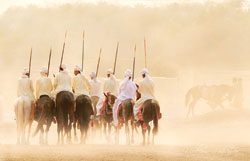 til
31 October) exhibition at Alhamra Arts Council comprising forty-six images
is an overview of Khawar’s work. It is a whirlwind tour across Pakistan
from the Chaukundi tombs of Sindh to K-2 in the extreme north. The artist
in the photographer is always evident whether it is the burka-clad woman
at the doorway of Sachal Sarmast’s tomb or the dancing malang somewhere
in Punjab. If the former is a complete study of colour, lines and shapes,
the latter is like an intense moment frozen in time ready to spring back
into motion.
til
31 October) exhibition at Alhamra Arts Council comprising forty-six images
is an overview of Khawar’s work. It is a whirlwind tour across Pakistan
from the Chaukundi tombs of Sindh to K-2 in the extreme north. The artist
in the photographer is always evident whether it is the burka-clad woman
at the doorway of Sachal Sarmast’s tomb or the dancing malang somewhere
in Punjab. If the former is a complete study of colour, lines and shapes,
the latter is like an intense moment frozen in time ready to spring back
into motion. 
