


|
|
|
|
|
 |
 |
 

|
review Pakistan is among the countries in South Asia which has shown east improvement on sanitation commitments By Aoun Sahi The fifth South Asian Conference on Sanitation (SACOSAN-V) concluded in Kathmandu on October 24, 2013, with the signing of the Kathmandu Declaration. Ministers and head of delegates from the eight participating nations of South Asia signed the Declaration, which contains nothing new. The declaration renews joint commitment to the Human Right to Sanitation adopted by the UN and endorsed by Saarc nations to work progressively to achieve an open defecation-free and hygienic South Asia. It also commits to further accelerate sanitation and hygiene behaviour change in South Asia to meet the Millennium Development targets and move towards implementing the UN Secretary General’s call to “Action on Sanitation”. borderless
interests visit Past
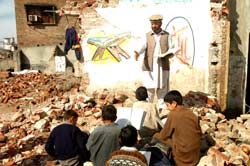
recast literacy KP’s Annual Statistical Report paints a bleak picture of schools in the province By Tahir Ali Experts agree that education requires a congenial atmosphere and the provision of certain facilities like water, electricity, washrooms, playgrounds and computer-labs within the school premises. But hundreds of schools in the Khyber Pakhtunkhwa still lack basic facilities, an official document reveals. It is mind-boggling to read that 20 per cent of the functional public schools still have no boundary walls, 30 per cent no water supply, 42 per cent no electricity and 16 per cent no toilets facilities.
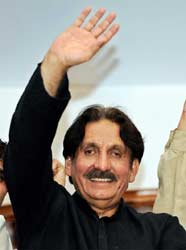
Pride and justice A reappraisal of the past five years and the Lawyers’ Movement as the day of Chief Justice of Pakistan’s retirement is fast approaching By Huzaima Bukhari & Dr. Ikramul Haq “Vanity and
pride are different things, though the words are often used synonymously.
A person may be proud without being vain. Pride relates more to our
opinion of ourselves, vanity to what we would have others think of us” — Jane Austen, Pride
and Prejudice As the day of retirement
of Chief Justice of Pakistan (CJP) is approaching fast, some serious
controversies are looming large — especially in the wake of a complaint
filed before Supreme Judicial Council by Lahore High Court Bar
Association. It reflects sadly on his journey from an admirable icon to a
controversial figure among the politically divided legal fraternity but
the more serious concern is the possibility of tarnishing the image of
higher judiciary in Pakistan in the eye of the common Pakistani who is
totally disillusioned about rule of law and dispensation of justice in the
country. At this critical
juncture, it is time for a reappraisal of the past five years.
Undoubtedly, the year 2007 will ever remain a dark patch in the judicial
history of Pakistan. On March 9, 2007, Pervez Musharraf summoned the Chief
Justice of Pakistan, Iftikhar Chaudhry, to the Army House and asked him to
submit his resignation in the presence of five army generals that also
included heads of intelligence services. Refusal to abide by the
orders of a President whose rise to power was through no legal means, led
to a series of vindictive actions against the CJP, who was not only
suspended from office but was also kept under house arrest and was
mistreated by inferior pawns of the administration. Such appalling
treatment of a public figure representing the highest echelon of judiciary
raised a severe furore that mobilised the masses to come out in the open
crying out for his restoration and rising like a formidable wall in
defence of prestige of Judiciary, an indispensable arm of the government.
The forerunner of these protests was the Lawyers’ Movement followed
closely and enthusiastically by members of the civil society as well as
all leading political parties. It was perhaps the first
time since 1947 that the nation stood up in complete solidarity against a
very despicable act committed by none other than a man in uniform and
so-called guardian of the country’s honour. After all, what was the most
motivating factor that led to such an uprising? Was it the persona of
the incumbent, Justice Iftikhar Chaudhry or the sanctity of the Chief
Justice’s office that compelled the legal fraternity, men, women and
children belonging to all social classes to come out onto the roads in
massive protests all over the country in general and more particularly in
the Punjab. Even those who did not actively participate sat glued to their
television sets as media covered moment to moment news about the
countrywide agitations along with topical talk shows. People were heard
saying that they were no longer interested in daily soaps or other
entertainment programmes but were keen on learning about developments on
the restoration of judiciary. The media also had a
significant role in creating hype and gauging the popularity of the
subject — every news channel was vying with each other in providing
breaking news. Many members of the legal fraternity, who were even not
very fond of Justice Iftikhar Chaudhry, laid aside their personal likes
and dislikes only to render their complete support for the restitution of
the office of CJP. In Pakistan’s peculiar
milieu, where people, despite “democracy”, are condemned to suffer at
the hands of politicians as Legislature, powerful military-civil complex
as Executive, the only source of hope remains the Judiciary that gives
them a sense of security and if that is threatened then obviously their
last resort would be by way of protest to safeguard their only sanctuary.
This is the reason why movements for deposed prime ministers could not
restore them whereas the Chief Justice regained his lost stature within
two years as on March 22, 2009. What a triumphant victory that was for the
people of Pakistan and the Judiciary! The people’s power was
overwhelming. It was all due to masses of Pakistan that the periods from
March 9, 2007 to July 20, 2007, from November 3, 2007 to March 16, 2009
and from March 9, 2009 to July 31, 2009 became a milestone for blocking
any future military takeover. The second restoration of the CJP on March
22, 2009 was not a triumph of an individual but a victory of democratic
forces. It paved way for revival of democracy and independence of
judiciary. The decision of July 31, 2009 consolidated it when a
categorical finding was given against unconstitutional acts of Musharraf
and action was taken against all judges who took oath under the
Provisional Constitutional Order (PCO) of November 3, 2007. As long as support for
Justice Iftikhar Chaudhry was pouring in from within and outside Pakistan
for his defiance against the mighty man in khaki it was commendable, but
when his unwise proponents started attributing victory to his persona, the
scenario turned into culture of sycophancy. It was as if, had the Chief
Justice been someone else, the movement would not have mustered the same
magnitude. Such flattery and misleading praises are sufficient to fan
anyone’s ego, turning pride into vanity. Even the expectation of people
was being transformed into believing that now the independent judiciary
would stand up for them with the same boldness as it did for its own
prestige. To what extent has this expectation been fulfilled can be
adjudged by the people from the subsequent decisions. On reminiscing the past,
one tends to think what would have been the position, had the Chief
Justice tendered his resignation the day he was fully restored? This
suggestion was fiercely countered by one of the leading advocates of this
country and right hand of the struggling Chief Justice and who has now
visibly distanced himself from him. One thing is definite that Justice
Iftikhar Muhammad Chaudhry would have become a much acclaimed national
hero had he opted to retire voluntarily after restitution. It could have
avoided many controversies — both political and personal, especially in
the wake of his son, Arsalan’s, alleged involvement in a high profile
case and the way it was handled souring the aspirations of the people of
Pakistan. Much has been written
about personal controversies and desire to be in the corridors of power
but the more important aspect has been ignored by all, i.e. rise and fall
of State institutions which are intrinsically linked with personalities.
The oft-repeated notion that institutions must rise above individuals is
more a cliché than reality. History shows that institutions rise because
of good individuals and not otherwise. One cannot divorce working of any
institution from the quality of human fabric. The best of the institutions
built over years are destroyed by even a single individual who is either
incompetent or becomes arbitrary in discharging his duties. People will never
respect an institution if its custodians fail to uphold its propriety and
sanctity. Institutions rise and fall with their custodians as leaders and
nations rise and fall together. The writers are Adjunct
Faculty at Lahore University of Management Sciences (LUMS)
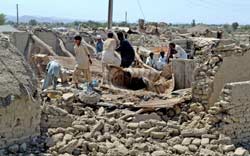
Scientists in Japan and elsewhere have developed earthquake early warning systems. Where do we stand? By Akseeb Jawed What does
preparedness for an earthquake actually mean? Can there be an effective
earthquake warning system? Before we look into the questions let us first
briefly see what is an earthquake and how does it come about? According to definition,
earthquakes are the result of shifting or movement of earth’s tectonic
plates. Earthquakes occur when the frictional stress of gliding plate
boundaries builds and causes rupture at a fault line. As a result, elastic
strain energy is released and waves radiate, shaking the ground. As we know, major
earthquakes affect large areas of population either by generating tsunamis
or leveling the entire cities. Comparatively speaking, minor earthquakes
can also be induced or caused by human activities like extraction of
minerals from the earth and the collapse of large buildings. Scientists can predict
where major earthquakes might happen in a general sense, but research does
not yet allow forecasts for specific locations or accurate predictions of
timing. Approximately,
two-thirds of the total area of Pakistan is on fault lines, putting the
lives and property of more than 170 million people at risk. Now and then,
experts have expressed concerns that neglecting the fault lines while
making big structures in cities might be the cause of massive destruction. Pakistan has been hit by
some forty earthquakes to this day, some of them deadly. Recently,
Pakistan was jolted by an intense earthquake of 7.7 magnitude. The
epicenter of the earthquake was 69km north of Awaran district in Quetta
and some 270km north of Karachi. The shocks were also felt in Turbat,
Panjgur, Chaghai, Khuzdar, Gwadar, Quetta, Hub, Kharan, Jhal Magsi, Qalat,
Sibi, Mastung, and Jafferabad, and even in Karachi. Four major tectonic
plates — Arabia, Eurasia, India, and Africa — and one smaller tectonic
block — Anatolia — are the cause for tectonic activities in the Middle
East and the adjacent regions. In geological terms, the
Aawran earthquake occurred due to oblique north-south to
northeast-southwest strike-slip type motion at shallow crustal depths that
is primarily accommodated on the Chaman faultline, with the earthquake
potentially occurring on one of the southern-most strands of this fault
system. The Chaman faultline
runs along Pakistan’s western frontier with Afghanistan from Kalat, in
the northern Makran range, past Quetta and then on to Kabul, Afghanistan.
A faultline also runs along the Makran coast and is believed to be of the
same nature as the west coast faultline along the coast of Maharashtra,
India. We cannot totally escape
from an earthquake but we can be a survivor if given a 60 seconds head
start before an impending earthquake due to an early-warning system. How
is it possible to issue a warning of the phenomenon that cannot even be
predicted? The statement of
seismologist, Richard Allen, director of the Seismological Laboratory at
the University of California, Berkeley, aptly resolves this paradox.
Generally, when people talk about prediction, they’re talking about when
an earthquake will occur — when rocks in a fault slip past each other.
Most seismologists say we won’t be able to predict this for the
foreseeable future. We’re predicting the shaking that comes from when
the earthquake ruptures. So, basically, an earthquake has already started.
People think of an
earthquake as being an instantaneous occurrence. It’s not. The energy
that radiates out from an earthquake is what causes the shaking that
people feel. P waves come first and S waves come next, as they carry most
of the energy so they do most of the damage. The intensity of the shaking
that’s carried by the S waves can be estimated, and that’s the basis
for an early warning. Basically, the warning provides an advantage of
sixty seconds which, in turn, also depends on the distance from the
epicenter. Earthquake early-warning
system is designed to detect the first strong pulse coming from an
earthquake, which carries information about its size. This shockwave
travels faster than the slower waves that do most of the shaking damage
during an earthquake. The farther you are from an earthquake’s
epicenter, the more warning you get. Therefore, the governments in some of
the earthquake-prone countries, like Japan, Mexico, and the State of
California, institute early warning systems to alert the public to expect
potentially hazardous shaking. In 2007, Japan launched
a comprehensive nationwide online earthquake early-warning system. It is
considered as one of the most advanced systems as yet. It detects tremors,
calculates an earthquake’s epicenter and sends out brief warnings from
its 1,000-plus seismographs scattered throughout the country via mobile
phones, radio, TV, and sirens. Area Mail Disaster Information Service
disseminates earthquake early warnings issued by Japan Meteorological
Agency. The subscribers of the
service receive the information via mobile phones either in the form of
pop-up display or special emergency tone. In California, the scientists
are in the early stages of developing the techniques and framework of
earthquake early-warning system. They are following the lead of Japan in
developing their warning system. Although the early
warning systems can only give warnings from seconds to one or two minutes
before the powerful S-waves hit and shaking gets serious, it can mean the
difference between life and death. It can be just enough time to take
cover, drive a car to the side of the road, step back from getting on an
elevator or stop medical surgery, turn off gas burners, or duck
preparedness, move away from windows, etc, to reduce the risk of injury
and minimize damage. Experts say most of the
major cities of Pakistan are located on the faultline, which also crosses
the centre of Margalla Hills. Therefore, Pakistan Meteorological
Department (PMD) should work on developing an effective earthquake warning
system. Moreover, PMD should enhance the potentiality of the existing
National Seismic and Tsunami Monitoring System that is responsible for
disseminating earthquake information. The writer is a
researcher based in Islamabad
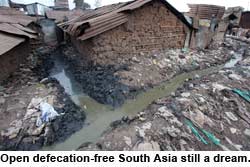
A dirty job Pakistan is among the countries in South Asia which has shown east improvement on sanitation commitments By Aoun Sahi The fifth South
Asian Conference on Sanitation (SACOSAN-V) concluded in Kathmandu on
October 24, 2013, with the signing of the Kathmandu Declaration. Ministers
and head of delegates from the eight participating nations of South Asia
signed the Declaration, which contains nothing new. The declaration renews
joint commitment to the Human Right to Sanitation adopted by the UN and
endorsed by Saarc nations to work progressively to achieve an open
defecation-free and hygienic South Asia. It also commits to further
accelerate sanitation and hygiene behaviour change in South Asia to meet
the Millennium Development targets and move towards implementing the UN
Secretary General’s call to “Action on Sanitation”. It recognises sanitation
as a matter of justice and equity, with a powerful multiplier effect that
unlocks measurable benefits in health, nutrition, education, poverty
eradication, economic growth and tourism while also reducing
discrimination and empowering communities, especially infants, children,
adolescent girls, women, the elderly and people with disabilities, in
rural and urban areas. The leadership of South
Asian countries also recognises in the declaration that the time for
sanitation is now and that they must capitalise on the strong political
will and local leadership and community ownership demonstrated throughout
South Asia to boost sanitation coverage and improve hygiene practices
substantially by 2015. The only agreement to which leaders has reached at
SACOSAN-V is to make an open defecation-free South Asia by 2023. The basic idea behind
SACOSAN initiative was to review progress on implementation of MDGs and
provision of basic sanitation to the population of South Asian countries,
and share latest development in the field of better sanitation. It is a
high-powered ministerial meeting. The first conference was held in 2003 in
Dhaka, second in 2006 in Islamabad, third in 2008 in New Delhi and fourth
in 2011 in Colombo. The Kathmandu
declaration is more or less similar to declarations of first four
conferences. In Dhaka declaration (2003), the leadership unanimously
agreed to eliminate open defecation. It seems over the years countries in
South Asia, especially Pakistan, lose interest in SACOSAN as sanitation is
not a priority subject in the country. The delegations of all other
countries in Kathmandu were either headed by relevant minister or the
relevant senior-most bureaucrats but Pakistan’s delegation was headed by
a member of National Assembly. Pakistan is also among the countries in
South Asia which has shown least improvement on SACOSA-IV commitments.
According to sanitation country paper of Pakistan presented at Kathmandu,
it is not on track even one of the 13 commitments it made in Colombo three
years ago. The on-ground situation
in Pakistan on sanitation front is not satisfactory at all. According to
Joint Monitoring Programme (JMP) of WHO and UNICEF, only 47 per cent
population in Pakistan is using improved sanitation depicting a wide
disparity among urban (72 per cent) and rural areas (34 per cent). Still
23 per cent of the population of Pakistan is practicing open defecation
and one out of every three persons in the rural areas of Pakistan defecate
in the fields. The people in rural areas spend over 60 per cent of their
household income to fight different water-borne diseases. At current rates
of progress, Pakistan would miss to achieve sanitation related MDGs by 13
years (2018). The Pakistan Social and
Living Standards Measurement (PSLM) survey of 2011-2012 also revealed
similar results. According to its finding only 24 per cent households of
Pakistan have access to underground and covered drains, 42 per cent have
access to open drains while 33 per cent live with no system. In rural
areas of the country, 49 per cent population has no system while 45 per
cent have open drains and only 6 per cent have access to underground and
covered drains. Moreover, 75 per cent households of Pakistan live without
any garbage collection system. The ratio reaches as high as 95 per cent
for rural areas. 38 per cent primary schools have no toilets in Pakistan. The collection of solid
waste and its treatment remains an issue in urban areas. It is true that
collection of solid waste has improved in the urban areas as over 60 per
cent of households in urban areas of Pakistan have access to garbage
disposal but nearly 95 per cent of the sewage is disposed of without any
treatment on nearby lands or into water bodies. This untreated solid waste
and sewage are creating a lot of problems especially when water and
sanitation infrastructure in the country is ageing and in bad shape. It is
resulting in mixing of sewage with drinking water supply lines which has
been posing serious health threats. It is one of the major challenges to
eradicate Polio virus from Pakistan. Dengue is another
product of this bad or no system for water and sanitation. But worst of
all is diarrhea and other waterborne diseases causing thousands of deaths
in Pakistan every year. WHO estimates that 97,900 people die every year
due to poor water and sanitation in Pakistan while, according to UNICEF,
54,000 children under the age of five die from diarrhea every year in
Pakistan caused by poor water and sanitation. The poor sanitation
situation has not only been causing health and social damages to Pakistan,
but also causing billions of damages in economic terms. According to a
report by Water and Sanitation Program (WSP) of World Bank in 2011, the
total economic cost of poor sanitation in Pakistan is estimated as Rs343.7
billion (USD5.7 billion) which is equivalent to 3.94 per cent of GDP in
Pakistan (which is six times higher than the national health budget and
three times higher than the education budget). Of this cost, Rs69.52
billion is the direct financial cost, which is equivalent to 0.8 per cent
of GDP. Health impacts accounted for 87.16 per cent of the total costs,
the equivalent of 3.43 per cent of GDP. Diarrhea alone accounts for 40.5
per cent or Rs 121.5 billion of the total health related economic impacts
resulting from poor sanitation in Pakistan. Pakistan has shown some
progress on spending on water and sanitation as share of expenditures made
on water and sanitation has increased from 0.16 per cent of GDP in
2010-2011 to 0.18 per cent of GDP in 2011-2012. Pakistan spent Rs36 billon
on water and sanitation in 2011-2012 compared to Rs22 billion in
2008-2009, showing an incremental growth of 20-25 per cent each year. It
seems a reasonable growth, but looking into needs, these expenditures are
peanuts. As per the Sector Status Report of 2012, Pakistan is in need of
Rs268 billions (USD2.68 billions) to achieve the target of 100 per cent
improved sanitation. The service delivery assessment report of Punjab 2013
showed that the province, which also has the highest number of population
with open defecation, needs Rs180 billion for only rural sanitation. Several officials in
Pakistan put blame on big natural disasters over the last few years,
especially 2010 super floods, for poor performance of the country on
sanitation front but it is not even half truth. The country was never on
track to achieve water and sanitation related MDGs even before 2010. Most
of the areas hit by these floods never had sanitation coverage. Very less
investment is made against the commitments in SACOSAN and there is no
gradual increase in it. Whatever allocations are made usually target urban
areas while people without services live in rural areas. The institutional setup
for sanitation sector is very complex as well. It was committed in SACOSAN
to have single focal institution for sanitation. However, in Pakistan
institutional roles still overlap among different departments and
ministries. Collaboration among them is not only need of the time but they
also need to involve civil society organisations working in the sector to
achieve maximum in sanitation. The health system in
Pakistan is also needed to go through drastic changes. It is needed to
shift it from curative to preventive services. Over 100,000 Lady Health
Workers should be involved in creating awareness about sanitation and its
benefits. Missing political will
is another major factor responsible for bad situation in sanitation sector
in Pakistan. Sanitation is a devolved function after the 18th Amendment
but none of the province in Pakistan has clear vision, strategy or plan
for sanitation. Under the 2001 Local Government Ordinance, municipal
services, including water supply and sanitation services, are the
responsibility of local governments but they are non-existence since 2009.
Pakistan has committed
through Kathmandu declaration to capitalise on the strong political will
and local leadership and community ownership to boost sanitation coverage
and it would only be possible by conducting local body elections, but our
political leadership is still reluctant to go for them. Experts believe Pakistan
needs a serious sanitation movement to mobilise necessary political will
and address the issue from the point of view of nation-building and
addressing major public health problem. “By 2015, every household in
Pakistan and public places should have toilets. The government should
demonstrate the leadership by providing policy environment, plans and
adequate resources to fund a right institutional mechanism to implement
the plan,” says Mustafa Talpur, an Islamabad based water and sanitation
expert.
Even as security
pickets on either side of the Line of Control (LoC) between India and
Pakistan stood glaring at each other in mid-October, a group of Pakistani
and Indian educationists and environmentalists was busy with fruitful
interactions in Mumbai and Bangalore. The group was discussing the
possibilities of how we, as separate nations bound by a common heritage
and socio-cultural matrices, could benefit by sharing information, best
practices and strategies for meaningful development. In a first-of-its-kind
initiative for bringing together NGOs (Non-Governmental Organisations) of
both the countries, this year-long project, initiated by the Centre for
Dialogue and Reconciliation (CDR) and the Lahore University of Management
Studies (LUMS) facilitated the visit to India, of a 21 member delegation
from Pakistan, to look at solutions for day-to-day problems that citizens
face in both countries. It was, as both Pakistani and Indian participants
in the roundtable discussions said, “an enriching experience”. Although the main focus
was on two infrastructural issues — education and environment — the
interactions covered a wider canvas. Agribusiness multinational Monsanto
has approached the Pakistani authorities regarding promotion of GM
(genetically modified) food grains. Indian activists have been waging a
spirited battle in recent years against Monsanto and multinational
appropriation of indigenous grain diversity, since their long term safety
is still being debated (the European Union forbids imports of GM foods
from the US). Pakistani NGOs concerned about people’s rights to safe
foods, sovereignty over local produce, and informed choice, can learn from
the Indian experience? Urban woes like
degradation of air and water resources due to “development” (with
industrialisation seen as synonymous with progress, disregarding the
socio-environmental costs) is another problem for both countries. How has
Bangalore city, which made international news last year, with its mounds
of uncleared garbage, tackled the issue? Why has the problem of increasing
waste generation caused by modern lifestyles, received scant attention? Indian activists briefed
the visiting Pakistanis about landfill issues (and the consequent health
problems that residents of places like Mavallipura on the outskirts of
Bangalore, suffer because of the dumping of thousands of tons of rubbish
brought from the city) while other activists shared information about
privatisation of water by French companies that seek to make profits from
the sale of a natural resource when the right to life encompasses the
right to access to water and clean air. What has the Indian judiciary
ruled, in the cases filed by activists and NGOs like Bangalore’s
Environment Support Group? Can these judicial perspectives provide ideas
to activists seeking to uphold basic human rights in other developing
countries of the region? Poverty is another
characteristic shared by India and Pakistan. Millions of deprived and
destitute tribals and rural populations depend on commons and grasslands,
for grazing, fuel and food. Appropriation of such lands for industrial
purposes and construction (or building highways) snatches these basic
rights from the poor, pushing them further beyond the margins, even while
GDP (Gross National Product) grows, as in India. China, as one participant
observed, has an impressive 10 per cent GDP growth but the horrendous
health costs that the people pay is not taken into account. Can we learn
something from these trends? Our common problem is
not political hostility across the border, but the wrong growth models
imposed by Western ‘experts’ and multilateral aid agencies that are
unfamiliar with the socio-cultural matrices that our economies have to
function within. So it makes sense to look at each other’s experience,
and see what works, what doesn’t, and avoid replicating mistakes. In
fact, the Western concept of “wastelands” is itself questionable —
land is never a waste, even ‘wastelands’ serve an
ecological-environmental purpose, but this realisation has come only
lately to the ‘developed’ countries, whereas Asian cultures have
always respected these interconnections that are vital for meaningful
development. As one participant from
Lahore put it, Pakistan has had prolonged periods without democracy, so
civil society activism has lagged behind that in India. But that is what
this project seeks to address, by bringing schools, academics, activists
and NGOs in four cities — Mumbai, Lahore, Karachi and Amritsar —
together, to explore shared concerns, challenges, and success stories.
Proof of the interest evinced by NGOs came in the form of sponsorship of
these dialogues in Mumbai and Bangalore, by groups like the Pakistan-India
Forum for Peace and Democracy (PIFFPD) and local educational organisations. There were also small
bonuses, for both sides — “I was pleasantly surprised that the
Pakistani delegation had more women than men,” said one Indian
participant, while the visitors from across the border expressed their
delight at the “similarities” they discovered, in India, and the
warmth they received everywhere. The bottom line is that there is a wealth
of goodwill between the two countries that could, and should, be
channelised for the betterment of both nations. The writer is a
Bangalore-based columnist, author, academic resource person and activist:
sakunara@gmail.com
visit A picture is
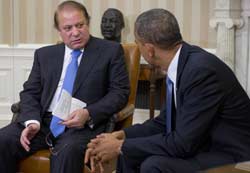
worth a thousand words. The official picture of the Obama-Sharif meeting
that the White House released suggests how the official working visit to
the United States by the Pakistani prime minister was regarded. It looks
like a picture of a defeated man being consoled. The prime minister kept
the same posture in his three speeches that he delivered here on three
different occasions. He kept returning to the fact, that everyone already
knew, how his government was sacked by a military dictator. His trip was not how it
appeared. The State Department guidelines say that there are different
types of visits to be accorded to a foreign government. An official
working visit is extended to a chief of state or head of government at the
invitation of the US president. The visit normally consists of a meeting
with the president at the White House, but without a luncheon, dinner or
an official state residence for the period of visit. It’s one of the
lowest rank in the list. Hence, on his arrival
the prime minister was received by the State Department officials led by
Ambassador Richard Olson. The red carpet and the honour guard was the
standard operating procedure. The prime minister was accompanied by
National Security and Foreign Affairs Advisor Sartaj Aziz, Special
Assistance on Foreign Affairs Tariq Fatimi, Finance Minister Ishaq Dar and
Foreign Secretary Jalil Abbas Jilani. There were others too, like Begum
Kulsoom Nawaz and Salman Shahbaz. Since the official visit
means sit down and work through problems or things that they need to talk
about, the prime minister and his four-member official team were invited
over a dinner at the State Department right away. The event was attended
by senior administration officials, including Defence Secretary Chuck
Hagel, National Security Advisor Susan Rice, Director CIA John Brennan and
SRAP James Dobbins. From that moment
broad-meaning terms were flaunted. Bilateral issues, substantial
dialogues, strengthening relationship, security assistance, revival of
economy, improvement of law and order etc.
The State Department
officials called this first summit level interaction, since the democratic
transition in Pakistan, as historic where every part of the relationship
was discussed while the tone remained respectful, warm and honest. This
tone and its honesty was, however, not shared with the media covering the
event. The first briefing took place on the third day where the foreign
secretary basically repeated the prime minister’s schedule. The whole range of
issues was discussed in these meetings. The United States said it wants to
listen to Pakistan, but basically it decided to stick to its position on
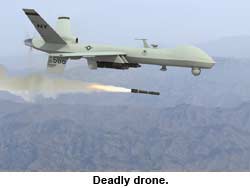
number of issues that include Kashmir, drone strikes and civil nuclear
agreement of any sorts, Dr Shakil Afridi, cross border infiltration, talks
with Afghan Taliban, Iran gas pipeline etc. There was a concern
about Pakistan’s falling economy, internal security and energy crisis.
The US officials said that it was the prime minister who linked the
security with the economy. They declared that any significant announcement
or signing of something huge was not expected. The most important meeting
the prime minister had was with the NSC advisor Susan Rice. There was one
scheduled, another unscheduled, and the third prolonged for over half an
hour. These were interesting in a sense that when the Finance Minister
visited Washington earlier this month to attend the IMF-WB annual
meetings, the country had already issued an Anti-Terrorism Amendment
Ordinance. Similarly, before the
meeting with President Obama, Pakistan introduced a new Protection of
Pakistan Ordinance 2013, with enhanced powers to security forces to take
action with a provision to detain suspects for three months at the
minimum, stringent punishments and special courts at the federal-level. The new Ordinance also
targets “millions of non-Pakistanis” living in the country “for any
reason including distressful conditions in their parent country,
especially those since 1979” and they “shall not be allowed to abuse
the temporary liberty to commit depredation”. This move was
significant and probably to satisfy US concerns to some extent. Prime
Minister Nawaz Sharif advocated that Pakistan has fixed itself. He said,
“We need to put our house in order first.” It was quite right, and the
statement was regarded as courageous. However, there was no
announcement what the new policy was and how it would be implemented.
Meanwhile, the US released two different amounts of funds that were
stopped or slowed down in the past couple of years. It also seemed that
there were obvious discrepancies. While the US insisted on using wind and
solar energy, Nawaz Sharif urged and insisted international investors to
support coal. The prime minister also had a meeting scheduled with the
House Foreign Affairs Committee. They have always been very critical of
Pakistan and thus the committee members grilled the Pakistani leader. They
pushed him to release Dr Shakil Afridi who helped the CIA in its Osama bin
Laden operation, and put an end to cross-border infiltration. Finally, Sharif’s
meeting with President Obama took place which lasted for two hours. It had
two sessions. It was full delegation in the beginning and the second part
of the meeting was restricted. The Oval Office, by then, had two leaders
from both sides. Prime Minister Nawaz Sharif had Tariq Fatimi with him,
while President Obama was assisted by his advisor Susan Rice. The general sense was
that Pakistan will play a constructive role facilitating peace in
Afghanistan ahead of the American withdrawal, which primarily means that
Pakistan has to facilitate a dialogue between the US and Afghan Taliban.
In return, the US administration will continue encouraging Pakistan’s
political and economic development. The US had just one concern: a
peaceful withdrawal from Afghanistan. The president acknowledged that
tension is likely to continue.
Past recast On October 25,
the anniversary of Thomas Babington Macaulay, historian, essayist, poet
and Whig politician of the 19th century England, was celebrated at
Loughborough University, UK. It is a place located adjacent to Rothley
Temple in Leicestershire, where he was born 213 years ago. Macaulay is generally
perceived by many as someone who made a difference in the fast changing
imperial polity of Great Britain. Born to highly
privileged parents — Zachary Macaulay, who had been appointed governor
in West Indies in 1793, and Selina M He could not make his
mark in the field of law but, as a parliamentarian, his oratory impressed
many. In the subsequent years,
he was destined to be someone influencing Indian populace in multiple
ways, which makes him a unique historical figure and warrants us to shed a
fresh light on his person and the impact he had on Indian subcontinent —
generally in the context of education. In the subcontinent,
Thomas Macaulay is known for his 1835 Minutes on Education, urging the
promotion of the English language in India and his support for
‘humanitarian intervention’, ostensibly to promote progress. His
attempt to create the Indian Penal Code also makes him relevant to the
historians of India and Pakistan. These are exactly the
reasons why Macaulay, though “hardly a romantic figure”, as Prof.
Christopher Bayly of Cambridge University contends, continues to receive
the close attention of scholars and biographers. No less than 10
biographies and historical works on him have appeared since the 1950s:
John Clive’s 1973 biography was a monument of detailed literary and
historical reconstruction; similarly, popular historian like Arthur Bryant
produced a book on Macaulay in 1979; and not very long ago, Robert E.
Sullivan’s ‘Macaulay: The Tragedy of Power’ received both praise and
opprobrium because of its portrayal of Macaulay as an aggressive,
‘liberal imperialist’. Catherine Hall’s ‘Macaulay and Son’
provides a detailed family history with an important section on the Indian
Penal Code. Hardly a few months ago,
Zareer Masani’s ‘Macaulay: Britain’s Liberal Imperialist’ got
published and attracted the attention of scholars. Strangely enough,
Macaulay is getting all this attention and acclaim when his style of
writing has long been antiquated. His Whiggish interpretation of British
history is deemed extinct and the Marxist, liberal and post-colonial prism
has provided an entirely different way of looking at History. We will try to make
sense of the dynamics of Macaulay’s aggressive support for the
introduction of English as a medium of instruction in the subcontinent,
leaving the penal code for some other occasion. Masani considers
Macaulay as a key source of Indian modernity, a ‘father of the
nation’, who promoted a language which, in the given circumstances,
could serve as the only possible link between India’s disparate regions.
Contrariwise, Mark Tully thought Macaulay as “the incubus which impeded
Indians from developing their own languages and helped encourage in
Indians a sense of the inadequacy of their own culture”. Similarly, such
post-colonialists working under the shadow of Derrida, notably Homi Bhabha,
have also commented on the manner in which Macauley’s Minutes promoted
‘fractured subjectivities’ or ‘sly hybridity’ and encouraged the
disempowerment of the subaltern by insinuating that knowledge could only
be imparted through a specific language and through a specific form of
civility. Here it seems pertinent
to invoke Christopher Bayly’s view on Macaulay’s ‘Minutes on
Education’. He categorically contests the oft-cited assertion that the
‘Minutes’ in any way disadvantaged Sanskrit, Persian or any of the
vernaculars in support of English. Nor did it, in itself, initiate a great
expansion of the use of English in the subcontinent which was well
underway before Macaulay set foot in Calcutta. Astoundingly, in Bengal the
commercial agents were using English for 50 or more years prior to 1835. In fact, Ram Mohan Roy,
the Bengali social reformer of the 19th century, was the first to
disparage the policy of those officials (the Orientalists) espousing
teaching of Persian, Arabic and Sanskrit. In 1822, he founded the
Anglo-Hindu School which taught partially in English. Roy urged the
Governor General, Lord Amherst to expand English education. In her study, Poonam
Upadhyaya asserts that Macaulay in fact appropriated Ram Mohan Roy’s
notion of the value of the diffusion of European learning which he had
presented in his ‘Remarks on settlement in Indian by Europeans’
appended to the 1832 Report of the Parliamentary Select Committee on East
Indian Affairs. She further says, “The Minutes as a whole is an
elaboration of [Ram Mohan’s] letter in Macaulayan rhetoric”. Thus, Upadhyaya seems to
have unwittingly substantiated Prof. Bayly’s point. Macaulay rather laid
stress on the vernacular and emphasised that Arabic ought to be taught at
Delhi Madrassah and Sanskrit at the Banaras College. He, however,
considered that introduction of English would revitalise the vernacular.
He believed quite strongly that most of education in India would have to
be in vernaculars. Despite saying all this,
one cannot deny Macaulay being an unequivocal supporter and advocate of
modernity — not only through language but combined with English liberty
and Norman justice. Macaulay left an
enduring legacy for people like Bholanath Chandra Ghose and R.C. Dutt in
Bengal, Syed Ahmad Khan in North Western Provinces (presently UP),
Dadabhai Naoroji, Western India’s leading ‘statistical liberal’ and
Macaulay’s most persistent spiritual interlocutor G.W. Leitner. All of them fomented
modernity but not at the expense of traditional methods of learning. All
of them tried to strike a synthesis between modernity and indigenous modes
of learning. Importantly, even the religious seminaries like Darul Uloom
Deoband and Darul Uloom Nadwatul Ulama too could not circumvent modernity
as Barbara Metcalf demonstrates in her seminal work ‘Islamic Revival in
British India: Deoband, 1867-1900’. Lord Macaulay in view of
what has been stated above ought to be scrutinised afresh. The writer is a noted
Pakistani historian, currently the Iqbal Fellow at the University of
Cambridge as professor in the Centre of South Asian Studies
Who will educate our children? The government seems content on relying on aid instead of taking steps towards a more self-sufficient model to enhance literacy By Naheed Memon An abysmal
education ranking (Pakistan ranks 189th in literacy), a lack of state
allocated resources, and a burgeoning interest in Pakistan’s social
fabric for varying and differed reasons has created a space for
international donor agencies such as USAID, DFID, The World Bank and
others to step into the country’s faltering education framework. Though there are
numerous initiatives and programmes being run by donor agencies in
collaboration with the provin Sustainability might be
a problem given the scant provincial budgets for education, and a growing
culture of dependency on international and local donors. According to
World Bank data listings, Pakistan’s allocation for education dropped
from 2.9 per cent of the annual GDP in 2008 to 2.4 per cent in 2011,
making the goal of Education for All (EFA) a very distant possibility. EFA
is the global UNESCO programme that focuses on providing access to primary
education for all children, male and female, and falls under the
Millennium Development Goals set out by the United Nations. Pakistan aims to spend
up to 7 per cent of its GDP on education by 2015, a claim that, given
historic trends, has to be taken with a grain of salt. UNESCO claims that
Pakistan has some of the worst education indicators ever seen. Pervasive
social inequality, gender divisions and an indebted government are just
some of the myriad problems at hand. Only 5 per cent of women from the
poorest strata of the country have gone to school compared to 70 per cent
from the upper-middle class. Of the total out of school children, 60 per
cent are girls. The state’s commitment
to social service delivery often loses out to gargantuan defense budgets,
and a large, cumbersome government bureaucracy. Post-9/11, there has been
a great emphasis on education by international donor agencies, but
criticism and insecurity within Pakistan stems from the unreliable pattern
of aid doled out over the years. The amount of aid and commitment pledged
is often seen as being tied to a shift in political climates and the ebb
and flow of interest in the region. Volatile fluctuations in
aid over four decades speak volumes about the often tense, on again-off
again nature of the US’ relationship with Pakistan. During the 90s, aid
was negligible and according to the Center for Global Development, USAID
was barely functioning in Pakistan. This was non-military aid, which
directly affects any and all projects underway or planned for in the
future. A huge spike was evident in all forms of aid after 9/11, when it
became socially imperative for the US and Pakistani governments to get
children out of the madrassas and into schools as a counter-terrorism
measure. According to USAID and
Congressional Research Service Reports, Pakistan was awarded $4.5 billion
for non-military assistance between 2002 and 2008, with $700 million of
that money being spent directly on facilitating education. The Obama
administration proposed spending $2 billion of the Enhanced Partnership
with Pakistan Act’s (2010) budget on education, health and humanitarian
sectors for the fiscal years, 2010-FY2014. USAID is currently
running a Pre-Service Teacher Education Program which focuses on teacher
training, and a Small Grants program that aims to strategically eliminate
problems within the education sector. To date, 16 schools in Balochistan
have been provided with clean, running water and the programme aims to
provide bilingual training to 2000 women in Gilgit-Baltistan. DFID is
running a similar programme aimed at reducing gender disparity in Punjab.
The initiative “Punjab Economic Opportunities Programme (PEOP)” is
poised to train more than 135,000 disadvantaged people, of which 40 per
cent are women, in vocational skills. The list of donor funded
programmes is almost endless, yet the criticism has not stemmed.
Allegations of inefficiency, corruption, and a fear of the
unpredictability and fickleness of International NGOs surround these
programmes. What happens once Pakistan isn’t the centre of the post-9/11
conflict? The US is planning its troop withdrawal from Afghanistan in 2014
which begs the question; once the money starts dwindling, will the
commitment to the social development of Pakistan remain? The dependence on
foreign aid can be detrimental to a country’s evolution, but it is also
difficult to criticise a donor agency, or even question its agenda when
the vacuum created by an absent state apparatus is so high. The Education
and Literacy Department of Sindh has estimated that more than 34,000
schools are operating without electricity, 12,000 schools are shelter
less, 23,000 of them don’t have bathroom facilities and 25,000 have no
access to clean drinking water. The abysmal situation in
Sindh led to a joint World Bank and European Union initiative called the
Sindh Education Reform Program (SERP) in 2009, which phased out in June,
2012. The quantifiable results showed an increase in primary net enrolment
by 450,000 children in Sindh, a rehabilitation of more than 1,500 schools
and the merit-based hiring of 13,000 new contract teachers. SERP-II was
signed into being by the World Bank to the tune of $400 million. If the state apparatus
took over this task, it would be easier to criticise the supposed agenda
of a donor agency; however that is not the case. It is a given fact that
the state is and should be responsible for not just providing access to
education, but making sure that all schools have the basic necessities of
water and electricity in place. That not being the ground reality, one is
hard pressed to point fingers at any organisation that is doing the work
the state should be doing. If the longevity of a
project is directly linked to the interest in the region, it is perhaps
the risk that Pakistan has to take and live with given the inability of
the state to fix the growing education epidemic. It is troubling that the
government seems content on relying on aid instead of taking steps towards
a more self-sufficient model for the country, that doesn’t hinge on
fleeting friendships. The writer is the CEO of Manzil Pakistan, a public policy think tank in Karachi. She is also a Visiting Faculty at IBA and a Director of a private conglomerate.
KP’s Annual Statistical Report paints a bleak picture of schools in the province By Tahir Ali Experts agree
that education requires a congenial atmosphere and the provision of
certain facilities like water, electricity, washrooms, playgrounds and
computer-labs within the school premises. But hundreds of schools in the
Khyber Pakhtunkhwa still lack basic facilities, an official document
reveals. It is mind-boggling to
read that 20 per cent of the functional public schools still have no
boundary walls, 30 per cent no water supply, 42 per cent no electricity
and 16 per cent no toilets facilities. According to the latest
Annual Statistical Report released by the KP Elementary and Secondary
Education (ES&E) Department, there are 28472 government schools in KP
of which 27975 are functional while 397 are non-functional/temporarily
closed and 100 are newly-constructed. Majority or 23073 (83 per cent) of
the schools are government primary schools (GPSs) while government middle
schools (GMSs), high schools (GHSs) and higher secondary schools (GHSSs)
make up 9, 7 and 1 per cent of all the schools respectively. Most of the
non-functional/temporary closed schools are girls’ schools with 288 of
them primary and 7 secondary schools. Of the total 44873 and
25364 rooms in male and female GPSs, 4563 and 2039 rooms need major
repairs, 11929 and 5504 minor repairs while another 3600 and 1416 room
need rehabilitation respectively. Similarly, amongst the
12644 rooms in GMSs, 784 need major repairs, 3048 minor repairs and 634
rooms are in need of rehabilitation. Again, off the total 15377 rooms in
GHSs, 2220, 5361 and 2343 rooms are in need of major and minor repairs and
rehabilitation respectively. And off the 8167 rooms in GHSSs in the
province, 648 rooms need major repairs, 1434 minor repairs and 647 rooms
need total rehabilitation. According to the report,
3.93 million students study in 27975 functional government schools with
2.84 million in GPSs, 0.76 million in GMSs, 0.29 million in GHSs and 0.041
million in GHSSs across the province. Over 1.51 million students also read
in 6743 non-government schools here. Most of the 119274 teachers in
government schools are male (78172), but female teachers in private
schools account for 44466 off 85325 teachers. The teacher-student
ratio in GPSs is 1:39 and secondary schools level is 1:23 but it is much
greater in some schools. The report shows that 1175 male and 1450 female
GPSs have only one teacher to teach all the classes and the
students-teachers ratio for these schools is 1:58 and 1:61 respectively.
344 male and 103 female primary schools have no rooms to shelter students.
10318 off the total primary schools have two rooms and two teachers,
obviously short of what is required. Though females account
for over 50 per cent of population
here, girls schools make up 36 per cent of all the schools, but their
share further comes down to 33 per cent at high and higher secondary
levels. According to a report in
The News in 2009, out of total of 4338 and 2609 rooms in all schools in
Mardan, as many as 713 rooms in boys’ schools and 399 in the female ones
needed major repairs. The recent report says 480 rooms in male schools and
211 rooms in women schools still await major repair. Overall Net Enrolment
Ratio at primary level is 48 per cent (52 and 44 per cent for male and
female schools) but it is at 28 per cent (33 and 21 per cent for boys and
girls) in all middle to higher schools of the province. While enrolment overall
increased by around 23.9 per cent in the last 10 years (2003 to 2012),
increase in teachers and functional schools was recorded at 15.7 per cent
and 7.7 per cent respectively. Girls’ enrolment grew by 3 times against
boys’. During 2011 and 2012,
the dropout rate for the stages from 5th to 9th grade has been recorded at
16, 9, 7, 14 and 16 per cent for boys. For the girls, it has been recorded
at 24, 9, 8, 21 and 8 per cent in that order. But dropout rate could
be higher if we analyse the data intently. The date reveals 0.519 million
students were admitted in the prep class in GPSs across the province in
2003-04. By 2008-09, when the students reached the 5th grade, their number
stood at 0.29 million which means around 50 per cent of them dropped out.
By 2012, only 0.16 million students of these are recorded in the 9th
grade. If not for the huge
dropout and the spread of private education networks, the existing number
of schools would hardly have accommodated all the students of the
preceding stages. Are these two phenomena blessings in disguise for the
planners? Though dropout in GHSSs
has not been ascertained in the report, it must have considerably
decreased as both total male and female enrolment has been recorded at
41000 in last year for both first and second year. The report further says
that 1101of the total 21972 parents-teachers councils (PTCs) in primary
schools are non-functional. Similarly, out of 4710 PTCs in middle and
secondary schools, 192 are non-functional. The PTCs, it should be
reminded, are meant for parents-teachers coordination. The report shows that
out of the sanctioned 133750 (86963 male and 46787 female) teachers,
119274 (78172 male and 41102 female) teachers work these days. It means a
deficit of over 14000 teachers. Another 6992 teachers (3185 Primary and
3807 Secondary Schools teachers) will retire during the next 5 years.
This, if not tackled soon, may expand teachers-students ratio and the
latter’s woes, especially at higher secondary levels. 572 posts of male
and 342 posts of female subject specialists, who teach students in grade
11 and 12 in the GHSSs, are still lying vacant, according to the report. There is no analysis as
to how many of the GHSSs in the province afford both medical and
engineering classes, but knowledgeable sources say most of them don’t
offer courses in science and most of the disciplines in arts for shortage
of the subject specialists and resources. The sector has had
received considerable amount in the provincial budget and has been
allocated Rs24 billion off the total ADP of Rs118 billion this year.
Experts say government schools have spacious buildings and plenty of
teachers but loose administration, poor monitoring mechanism, outdated
curriculum, flawed examination system, overcrowded classrooms, lack of
modern facilities, teachers absenteeism, outdated teaching techniques, and
political interference etc are the factors responsible for the poor
performance of the public sector schools vis-à-vis their private
counterparts.
|
|

 The
jargon permeated every gathering, minor or major. From the former
Secretary of State Madeline Albright to President Obama, in almost every
meeting the prime minister’s delegation boasted about its 4-E plan:
Energy, Economy, Extremism and Education.
The
jargon permeated every gathering, minor or major. From the former
Secretary of State Madeline Albright to President Obama, in almost every
meeting the prime minister’s delegation boasted about its 4-E plan:
Energy, Economy, Extremism and Education.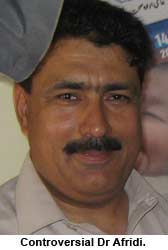
 ills
Thomas — he got an idyllic environment in Clapham, suburban London, to
grow into a precocious child with extremely retentive memory and immense
vocabulary as his principal assets. Later, he went to Trinity College,
University of Cambridge for higher education, then to Lincoln’s Inn and
was called to the bar.
ills
Thomas — he got an idyllic environment in Clapham, suburban London, to
grow into a precocious child with extremely retentive memory and immense
vocabulary as his principal assets. Later, he went to Trinity College,
University of Cambridge for higher education, then to Lincoln’s Inn and
was called to the bar. 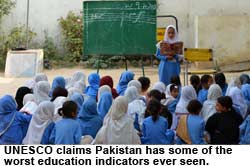 cial
governments, the future is fraught with uncertainty. Pervaiz Ahmed,
Special Secretary Education and Literacy Department, Sindh, spoke of the
importance of donor agency work but warned against the dangers of
complacency and dependence this can bring. “It is very important for the
Sindh (or any other provincial government) to be ready for the time when
international help is not sufficient. We need to be able to implement all
that we have learnt from the agencies in a future without them — these
policies and structures need to be sustainable.”
cial
governments, the future is fraught with uncertainty. Pervaiz Ahmed,
Special Secretary Education and Literacy Department, Sindh, spoke of the
importance of donor agency work but warned against the dangers of
complacency and dependence this can bring. “It is very important for the
Sindh (or any other provincial government) to be ready for the time when
international help is not sufficient. We need to be able to implement all
that we have learnt from the agencies in a future without them — these
policies and structures need to be sustainable.”