


|
|
|
|
 |
 |
  
|
history More than
just baths
history The hill stations of
British India, apart from providing pleasurable summer retreats for the
English Set in a dense pine forest the Kuldana cantonment is presently known as the Army School of Logistics. During the British era, infantry battalions were mainly based here. There is a long scroll of names of various regiments stationed in Kuldana in those times. Some of the well known amongst these were the Queen's Own Cameron Highlanders, Gordon Highlanders, 17th Regiment of Foot The Leicestershire, Irish Fusiliers, Queen's Royal Surreys, Devonshire and Bedfordshire Regiments, Kings Rifle Brigade and so on. Old maps of the cantonment
confirm the existence of infantry lines, barracks and a firing range. A
playground, two old cemeteries and a tiny chapel have survived in one form or
the other. An old rackets court built in 1897 (now a gymnasium) still stands.
Rackets was an older form of squash played in a larger court. Incidentally,
Majeed Khan of Nawekali, Peshawar who worked as a bearer at the Peshawar Club
won his first title in rackets at the turn of the last century in Murree
(possibly at this very club). A few other graceful 19th century buildings
have remained in their original state more or less and are still in use by
the military. Also a few family residences and an officers' and a sergeants'
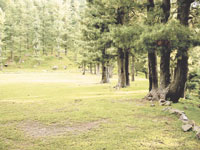
mess each were left intact until 1947, and still stand. Recently, while hiking in the woods around Kuldana, where I reside in summer, I came across a curious stone monument of the West Yorkshire Regiment. Bent on unravelling the actual story behind the memorial, on returning home I searched the Internet and came across a website of the Yorkshire Regiment Museum in United Kingdom and decided to drop them an e-mail. I wrote: "I am spending my holidays in Murree, a hill station in the Punjab province of Pakistan (formerly British India before 1947). While exploring the forests adjoining Kuldana I came across a large rock monument with a regimental crest and inscription of the 'Prince of Wales's Own (XIV) West Yorkshire Regt.' dated 1907-1910. The regimental insignia, the 'Nes Aspera Terrant' motto with an image of a horse and '1807-1831 India' with an image of a tiger are prominently visible. However the battalion's name '1st Bn' is now almost illegible. On top there is a faded inscription that appears to be 'the knaves mire'. Below it 'XIV' is inscribed in the centre. This imposing monument is located in a secluded area in the woods north of Kuldana in the Murree Hills. From a height the stone commands a fine view of the surroundings. There is a clearing in front of it with a raised platform a little further which appears to be the dais of a parade-ground or a playground from almost a hundred years ago. I have done a web search
for West Yorkshire Regiment and Murree but found no mention on the web, but
evidently it was stationed here between 1907-1910 before the Great War. Would
you have any further information about this monument? Moreover, I would be
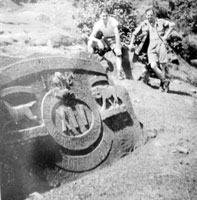
happy to send a photograph for your records if you wish." I concluded. It was not long before I received the following reply from the Yorkshire Regiment Museum: "Our records state that the 1st Battalion The West Yorkshire Regiment moved from Lahore to Rawalpindi in 1907 and remained in the (Murree) area until it returned to England in 1911. We were not aware of it and cannot be sure what the memorial stone in Murree commemorates. It may be in memory of the men who died there, or maybe it was simply carved to record the Battalion's three years in the area. Thank you for your interest in it, and we would be delighted to receive a photograph of it (for our museum and newsletter) if this can be arranged." The museum also e-mailed the battalion's 'Service Digest' dated 1907-1911. The several-paged document gave details of its general activities in Murree Hills. According to its history, the 1st Battalion (XIV) West Yorkshire Regiment was originally raised in 1685 by Sir Edward Hale. It was formerly known as the 14th Regiment of Foot and also as the Bedfordshire Regiment of Foot and later as the 14th Buckinghamshire. In 1759, when stationed at Windsor, it was granted royal permission to wear the White Horse of Hanover. From 1807 to 1831 it served in India and subsequently was granted the badge of the Royal Tiger superscribed with 'India'. In 1876, the Prince of Wales, later Edward VII, presented new Colours to the 1st Battalion and conferred on the regiment the title 'The Prince of Wales's Own'. Five years later, in 1881 the 14th was honoured and named 'The West Yorkshire Regiment'. The 1st Battalion (XIV) was stationed in Kuldana, Murree from 1907 to 1911. It was inspected by General W. Kitchener in Lahore on its arrival in India. In Murree it remained mostly engaged in infantry and hill manoeuvres and was also part of the Mohmand Field Force. Afterwards, it participated in both World Wars and won many battle honours. In 1958, the West Yorkshire Regiment (The Prince of Wales's Own) and the East Yorkshire Regiment (The Duke of York's Own) were amalgamated to form the Prince of Wales's Own Regiment of Yorkshire whose regimental headquarter and museum is located at York in England which is open to general public. Having despatched the photograph to the museum and feeling very pleased with my findings I decided to upload and share the information on the Internet on a personal website. Within days, I had received many interesting e-mails and laudatory comments from around the world. But my stint as the local Indiana Jones was about to end soon! I received a new mail that both surprised and amused me. The writer, Jesse Bridge, was an 82 year old British Army veteran who had served in Murree in 1940s. He wrote: "Somebody has claimed to 'recently discover' a stone memorial near Kaldana Camp on this website. Let me inform this gentleman that I saw this British regimental memorial carved on the large stone boulder below Kaldana Camp when I served there in 1945! There were two more nearby different regiments I think." During our subsequent e-mail exchange Mr. Jesse Bridge and I became good friends and he was polite enough not chafe me again. He had made his point. So much for my brief stint as the local explorer! Meanwhile, I looked for the two other memorials in the vicinity as indicated by him but unfortunately with no luck. He even sent a photograph of the monument as proof. Taken in 1945, it shows him posing next to the rock with a friend. The engraving has fairly diminished in appearance due to climatic wear over the years, however in the old photo it appears remarkably intact. On the day he took that memorable photo Jesse encountered some monkeys too. As he recalls: "The troop of, I think, baboons (sic) was well downhill from Kaldana Camp near the memorial. After taking the photo as I turned a corner I saw them, and they saw me. We all froze still. Slowly I got my camera out of its case. It was a folding one. As it became fully extended and the bellows straightened, there was the usual slight click. That was it. Off they all went at high speed. I never did get another chance. As I said to family and friends back in Britain, I went to India but never saw an elephant, nor a snake." One inspiring comment came from Walter Reeve, whose father was a soldier and who himself had been raised in British India. While lamenting the gradual decline of history in our part of the world and referring in particular to the few surviving regimental monuments in the Khyber Pass he stated: "I hope these poignant remnants of the Raj are still there, for they are a memorial to the thousands of ordinary British troops who, far from home, sweated to keep the Empire intact. The discussion as to the rights and wrongs of our presence in India has no place here. The lowly soldier gained nothing from the Empire. He endured the heat, suffered the illnesses and faced the danger for a pittance; and very often died in some remote place for a country that held him in low regard. Not for him the riches of the traders or the high society of the officer class. His home was the barracks, his family the regiment and drink his solace. Hundreds died for their King and Country in minor conflicts that would not even rate a mention in an English newspaper. Their memorial would be these imposing carvings standing out high over the harsh surroundings in this far off corner of the world." The West Yorkshire Regiment's stone has stood and watched over the hill for nearly a century. Surely, the list of names of its 'discoverers' (Jesse and myself included) and other people associated with it somehow or the other, must be very long! But one thing is for certain, all those who came here, for whatever purpose would have paused to marvel at the rock and they would have been reminded of the past. Standing before it, one can easily drift into nostalgia and imagine the soldiers of a bygone era performing their regimental drill to the tune of a bagpiper or perhaps playing various sports in the ground. To the European soldiers, this place would have certainly seemed like their home away from home. While toying with the idea of doing this article, I visited the memorial again the other day to take some more pictures and there it was standing magnificently as ever. From under the fir trees a pair of long tailed magpies flew by. The song of the whistling blue thrush came sweetly from a distance. As the tall pine trees swayed and hissed softly in the breeze, mist blew across the parade ground lending serenity to the surroundings. And as I beheld this lovely spectacle unfolding all around, the monument just stood silently before me like it had for the last hundred years in peace, perfect peace.
The Georgian city of Bath has historical charm, and a
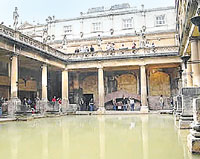
peaceful atmosphere. Bath's history is The Roman Baths, Abbey, Pump Room, the Circus and Royal Crescent are the most visited sites of Bath and define its character. The Roman Baths make a lasting impression on visitors. They were discovered in the year 1880 and are built over the original Roman baths, on the site of a hot spring. There is a museum along with this that has Roman structures and artefacts dating back from 2,000 years. An outdoor terrace in the museum that overlooks the King's Bath leads into the pool, which has original Roman paving. Near the Roman Bath is the Abbey standing high above
surrounding buildings. Bath Abbey is the last major pre-Reformation Tudor
church built in England, started in 1499. It is the third church built on
this area. The Saxons built the first — a small stone church boasting an
important aspect of British history. It is here that in the year 973, Edgar,
the first king of England, was crowned. Later on a Norman abbey was
constructed around the year1100 only to be replaced by the current church.
Located near the Abbey is the famous Pump Room. This site completed in 1790s
is regarded as the social heart of Bath for more than two centuries and hot
spa water is drawn for drinking here. Bath's most striking architecture is the Royal Crescent. Constructed with a 538-foot sweep of pale stone and defined by 114 Ionic columns, this is a giant curve comprising 30 houses built in order. Georgian House is the museum at No. 1 Royal Crescent. This was the first house built in the complex, having most of the original furnishings and authentic decoration. Slightly down the hills is the Circus: a circle of 33 townhouses, the Circus was designed by John Wood the elder in 1750 but was completed by his son, John Wood the younger. Jane Austen being the most famous and celebrated resident of Bath attracts literature worshippers in greater numbers. The Jane Austen Centre offers a snapshot of the Regency period and explores how this magnificent city affected the writer's life and writing. There are tearooms within the museum for enjoying a pot of leaf tea with homemade cake. The Assembly Rooms in Bath are worth visiting. A prime social centre of 18th century, these rooms were opened to public to exhibit paintings, chandeliers and furnishings of that era. However, the appealing aspect of the Assembly Rooms is featured in its lower section in form of the Museum of Costume. It is the largest museum of its kind in the world and displays 400 years' history of clothing design. This includes 200 dressed figures and 30,000 items illustrating changing styles from the 16th century through today. Similarly, the Building Bath Museum is another interesting place to visit. Housed in a beautiful gothic chapel it is the only museum in Bath about Bath and shows how Georgian Bath was developed, built, and lived in. Art and history enthusiasts must visit the Holburne Museum of Art that displays the collection of Sir William Holburne, a sailor who grew up in Bath and spent his long retirement here. The museum hosts many temporary exhibitions throughout the year and has a busy programme of events and activities for all ages. To admire more art visit the Victoria Art Gallery. Alternatively, American Museum tracing American way of life from colonial times to the mid nineteenth century. In Bath, even with shopping there is a history attached. Milsom's street is considered the town's high street and has the significance of having the nation's first department store since 1831 — the Jolly's. Visitors spend a lot of time wandering in the alleyways (called passages) around Milsom's St. and the surrounding area. These passages are cramped with international chain stores as well as local 'real shops' featuring everything from doorknobs to handmade lace, and hand-carved children's toys. Another shopping spot nearby is the Guildhall Market. It is an old covered arcade with 25 small shops and food stalls and is situated adjacent to the Guildhall — built in 1776 as a courthouse originally but now open to public for the Banqueting Room. Interestingly, Bath has only one modern shopping complex — The Podium — a small mall featuring contemporary decor inside. The Pulteney Bridge is the only bridge in Great Britain that has shops lining both sides of the bridge. The other two such bridges in Europe are Ponte Vecchio in Florence and the Rialto in Venice. Jewellery, souvenirs, apparel, antiques, cameras and more are found here. During the Christmas season, Bath offers yet another lasting impression — an outdoor Christmas market. This is located in this vicinity of Bath Abbey and the Roman Bath with 120 traditional chalet stalls. It offers the very best of seasonal shopping, fine food and excellent entertainment. Another unusual site to visit is Sally Lunn's house; whether for afternoon tea or a peek in the museum showing the original kitchen this French lady used over 300 years ago. Sally Lunn's is the oldest house in Bath (c.1483); home of the world famous Sally Lunn Bun, exceptionally light semi-sweet bread that is being baked for the townspeople since Roman times.
|
|
 families were also part of an elaborate imperial system that allowed the
British to rule India. Soon after its establishment in 1851 as a hill station
and sanatorium, Murree became the summer headquarter of the army's Northern
Command in the latter half of the 19th century. In time, many smaller
cantonments were built around the Murree Garrison amongst which Kuldana is
probably the oldest.
families were also part of an elaborate imperial system that allowed the
British to rule India. Soon after its establishment in 1851 as a hill station
and sanatorium, Murree became the summer headquarter of the army's Northern
Command in the latter half of the 19th century. In time, many smaller
cantonments were built around the Murree Garrison amongst which Kuldana is
probably the oldest.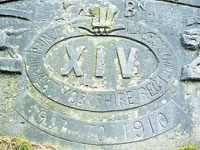
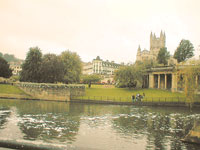 predominantly attached to its thermal springs. These springs are the only
ones of their kind in Britain. Legend has it that the waters cured an exiled
Celtic prince who suffered from leprosy. Later on with the Roman invasion
these hot springs became an attraction due to the Romans' love for long
baths. It was the Romans who dedicated their impressive bath complex to Sulis
Minerva, throwing offerings into the steaming waters. They called the town
Aquae Sulis as it began to grow becoming a home to travellers and merchants
from various parts of the Roman Empire. In the Medieval period, the thermal
springs remained in use though they became dirty and crowded. It was the
onset of the Georgian era that proved to be the most sensational time in
history of Bath as it transformed the city into an architectural phenomenon
and a fashionable resort. Although Bath's fashionable gleam faded during the
Victorian times, the city kept attracting royals, aristocrats and common
holidaymakers. Today, Bath is a World Heritage Site.
predominantly attached to its thermal springs. These springs are the only
ones of their kind in Britain. Legend has it that the waters cured an exiled
Celtic prince who suffered from leprosy. Later on with the Roman invasion
these hot springs became an attraction due to the Romans' love for long
baths. It was the Romans who dedicated their impressive bath complex to Sulis
Minerva, throwing offerings into the steaming waters. They called the town
Aquae Sulis as it began to grow becoming a home to travellers and merchants
from various parts of the Roman Empire. In the Medieval period, the thermal
springs remained in use though they became dirty and crowded. It was the
onset of the Georgian era that proved to be the most sensational time in
history of Bath as it transformed the city into an architectural phenomenon
and a fashionable resort. Although Bath's fashionable gleam faded during the
Victorian times, the city kept attracting royals, aristocrats and common
holidaymakers. Today, Bath is a World Heritage Site.