



|
|
|
|
 |
 |
|
From lawfully
principled to legally confused review
An occasion for more
music Fast
forward
From lawfully principled to legally confused By Adnan Rehmat It has been 18 months since
one of the most memorable and popular movements in Pakistan's How successful, or effective, has the movement been? What changes in the national political fabric has it woven? How lasting will the impact of the movement be? Answers to these can be dared ventured even though the movement itself hasn't either ended or petered out. Rewinding back to the morning of March 9, 2007, few could have guessed that a chain of events was about to unfold that would shake up the Pakistani status quo and change the fates of many of the country's traditional power brokers, including the military, political parties and civil society. That day a crude attempt by
military strongman General Pervez Musharraf, who was then both army It is significant that no judge immediately came to the rescue of the forced removal of the chief justice. It was the swift show of support mounted by the lawyers, quickly backed by most political parties and public backing, that forced the Bench to acknowledge that they could sit on the fence no more, as in the past. The near-universal public support for what was seen as a crude attack on the judiciary by an increasingly strident military was all the urging they needed to restore the chief justice and snub Musharraf even though most of them were essentially hired by his dispensation. The heady images of a
defiant Chaudhry snaking across the country in a dignified silence and The lawyers' movement,
hijacked, borrowed and blunted at various occasions in the time that the
general elections were held and now, goes on for sure but increasingly
threatens to turn into a caricature of itself. Is it about to peter out, or
worse, collapse under the weight of its own expectations, which are dwindling
thanks to the new political parties at the helm? The answer may lie in the
fact that without adapting their movement to include other key players that
shared the same objectives by offering them equal It was a mistake to stick to a zero sum strategy that sought to win at all costs especially when the elections changed the goalposts. The lawyers were too busy fighting in a system framed by a military ruler to notice that once that framework changed, the independence of the judiciary would never come at the cost of a potentially compromised parliament. Especially when the power transfer and transition to a polity that would gradually come under the grip of democrats would itself be under a deal that could be compromised by a judiciary that has traditionally been one-half of the pair that has always sabotaged democracy and strengthened the military establishment. No less than Muneer A Malik,
one of the gallant front-rankers of the lawyers' movement now
The GOOD • This was, for once, a
secular, cause-based movement, arguing for rule of law and • It successfully
challenged a military dictatorship -- ultimately forcing Musharraf's ouster
and • It redefined the civil
society -- forced collective group reaction against the establishment by
media (both conservative and liberal), • It redefined the
national debate on separation and balance of powers -- enlarging the
traditional • It forced the judiciary to defy the military establishment for the first time -- about 60 judges refused to swear a second oath of allegiance (PCO) to a military ruler; up from a maximum of four for the first three bouts of martial law -- hence recording a historic mass defiance to military diktat. The BAD • Stimulated political
polarisation; the two largest political parties are divided over who is the • Threatening political
parties; the movement has been unfortunate in • Setting up a showdown
with parliament; the one-track movement refuses to acknowledge the justified
wariness of the judiciary by the political parties. The judiciary has
traditionally helped military rulers openly, and behind the scenes, to
sabotage parliamentary sovereignty. The Doctrine of Necessity has never been
employed in favour of parliament when the Supreme Court The UGLY • Dividing judges -- in the end not just half the judges lapped up the oath of allegiance to Musharraf, but the half that did not and held out for about a year in defiance in favour of principles have been tempted to take oath of a 'civilian PCO' facilitated by the Naek office. Now division defines both 'posed' Bench and the deposed Bench. • Dividing lawyers -- in the end the lawyers were not invincible after all; unashamedly accepting thinly disguised bribes from a political government and deposing their own colleagues in the Bar offices a la the judges they hoped to restore. -- By Adnan Rehmat
With her Lenticular prints and mixed media works on paper, Farida Batool has dealt with images of Lahore and an individual's relationship with her environment By Quddus Mirza A work of art, especially
if it verges on the outrageous, disgusting or criminal, generates multiple The aftermath of that civic carnage is manifested once again in the art of Farida Batool. In her last exhibition at Rohtas 2 (April 2006), she displayed some works based upon the pictures of that specific day in Lahore. In her latest show "Lahore – My Love" held between Aug 27-Sep 06, 2008, memory of those events was revived and relived. With her Lenticular prints and mixed media works on paper, Batool has dealt with images of Lahore and an individual's relationship with her environment. So, the violent day is not
just remembered by the owners of shops, cars and motorbikes who It appears that Farida is doing the same in her art, by connecting to a larger audience and exploring common concerns. She has constructed her Lenticular prints -- a technique she employs quite imaginatively -- with images of various parts of Lahore, and interjected these with other visuals in order to complete a picture that denoted her content. For example in 'Qadam Qadam Azad' the photographs of children playing with water from a fountain were blended with the armatures of pillars in steel -- structures usually erected for large-scale constructions. Due to the inherent quality of Lenticular, the scene of a kid's play turned into a state of siege (ironically suggested in the title of the work). A similar scenario was depicted in 'Thandi Sarak' (informal name for the Mall Road in the past) with a girl and boy on swings inside a barricaded space. Queues of policemen, with helmets on and batons in hand, formed a border around the two. This particular image referred to a constant conflict between the security personnel and protestors, witnessed by many in the recent past. Another Lenticular print
was composed with the artist's photograph from her childhood with slight There is another side of the story too. It appears that, like several other artists, Batool needed a catastrophe to express her creative capabilities. In a paradoxical way, the grim accounts are useful for the politically conscious artists, because these can be utilised to concoct 'serious' art. Whether genuinely felt or merely following the 'pessimistic' possibilities, the acts of doom tend to bring boom into the art world. In the words of Slavoj Zizek, artists and intellectuals of today participate in the 'silent violence', which means that they are part of a system that generates and witnesses the acts of violence, but they do not get actively involved in changing the situation. However, they are keen and content in meagre (and symbolic) acts of defiance. Quoting Jacques Lacan, he described them as someone interested in 'reality' but oblivious to the 'Real'. Along with Lenticular prints and their clearly formed and cleverly conveyed content, five other works included in the exhibition were mixed media paintings on paper executed in photo collage, acrylic and graphite. Like prints, these works also dealt with the political conditions, primarily the riotous reaction of people denouncing the Danish cartoons. Thus the scorched car, exposed lintels in a burnt and deserted building, and blackened walls and doors in her work reminded of the destruction in the city. However, in terms of formal aspect, these works were not as impressive as her Lenticular prints. The manner of assembling the ready-made image, overlapping it with sweeps of paint and introducing pencil lines, hardly looked as exciting or unexpected as her Lenticular prints. Comparing the two kinds of works, one pondered on the position of an artist as a committed image-maker. Even though the content, by and large, remained the same, the disparity between the two types of works produced by a single artist -- the remarkable sophistication of prints did not match with her mixed media pieces -- brought into fore an important issue: is it the medium that creates the message or is the artist responsible for it? No one could answer it satisfactorily, even though it has been addressed by several post-structuralists including Roland Barthes; as such it contains room for speculation, much like the work of Farida Batool. The ninth barsi of Ustad Sadiq Ali Mando, one of the leading players of the clarinet, was observed at the Alhamra last week with a full session of music By Sarwat Ali Some of the leading
musicians took part in the barsi. Ustad Ghulam Hassan Shaggan was the most This barsi is more than a routine affair because the son of Ustad Sadiq Ali Mando, Ghulam Haider, a music scholar besides being a practicing musician is fully cognisant of the need to keep such institutions going. Many decades ago, he established the Pakistan Classical Music Guild (PCMG), meant to offer a platform both for the established ustads and the young aspiring musicians. All through, since its inception, it has been holding programmes, though it may be conceded without consistency. Usually the lack of funds and not the fazing of desire has been the main cause of these breaks, but despite the absence of resources the presence of Ghulam Haider has ensured that programmes are held. The PCMG continues to serve the purpose for which it was established decades ago. Ustad Sadiq was a very good clarinet player and he approached music within the framework of a definite method. He was educated in music by Mubarak Ali Khan and Fateh Ali Khan, the qawwal duo who took qawwali to a very high point and paved the way for Nusrat Fateh Ali Khan to break new ground with his qawwali in the decades to come. Mubarak Ali and Fateh Ali were properly trained as qawwals and they laid the foundation of the qawwali on raagdari, the exploration of the tonal patterns of the raags and the discovery of the rhythmic divisions. They drew their musical heritage from the family of Behram Khan, the legendary dhrupad vocalist from Jaipur. Their musical build-up was more important than the delivery of the relevant kalam. This definite method they transferred to their shagirds as well; Sadiq Ali Mando being a prime example of that. Clarinet, a western instrument, is supposed to play the staccato note and it was thought that it did not have the capacity to incorporate the microtones, which is the very essence of our music. But in the hands of many of our masters, these instruments were played very differently and almost sounded like our very own. Many other western instruments, too, have been modified in the same manner and they appear to be our own. The list is long and impressive and can begin with the harmonium which has disappeared from the western orchestras but finds a permanent place in our music. Violin, piano and even the guitar are played with the desire to do away with the rigidity of the staccato note. Clarinet's staccato note was mixed with the delight of meends, the glides and the playing of the microtones. The instrument could be played solo with the exploration of the raag and it came out of the shadow of merely being an instrument that formed part of an orchestra. In Punjab, Ustad Shahjahan, Ustad Jahangir and Ustad Aurangzeb were also great clarinet players. They had formed a band and since clarinet was an essential instrument of a band, they started to play raags on them instead of western compositions. These bands were usually engaged on marriage ceremonies and Jahangir, Alamgir and Aurangzeb along with another band led by Master Sohni were the two leading exponents of the instrument. Ghulam Hassan Shaggan has been performing now for more than sixty years and he has a very large repertoire of raags. Usually he sings the more popular ones but come an occasion and he pulls out of his bag a rare achoob raag which keeps even the initiated audience guessing. Despite his age, he is still in control where the faster passages are concerned. His taan, the one that traverses more than three registers is still on track and he saves enough energy to give a demonstration of that during the course of his performance. As always he was accompanied as the second vocalists by his son Qadir Ali. The shagirds of Ghulam Haider also performed well. Zahid Farani, both on the flute, tabla and the vocal, has been keeping the music environment of Islamabad filled with the sound of classical music, Ghulam Shabbir Khan, too, has been singing and teaching for many years now. Jaffer Hussain Khan on the clarinet showed some glimpses of Sadiq Mando Khan while Zohaib Hasan on the sarangi again displayed and demonstrated much promise. Among the lighter genres Habib Ali, Israr Malik, Haji Chaman Ali, Abubakkar Fayyaz, Abdur Rasool, Kaleem Akhter and Nadeem Abbas delighted the crowd with more popular numbers. Alhamra collaborated with the PCMG to organise this programme. It is hoped that this collaboration becomes more active and charged so that more programmes of this nature are held. Pakistan Music Guild has organised some memorable programmes in the past and it should remain a vibrant organisation. Classical Music needs patronage and a discerning one because its purity and pristine quality needs to be handled with care. As long as Ghulam Haider is around, one is hopeful and sanguine about its continuation and there is no reason to suspect that this optimism should not go beyond individuals. Dear
all, I read with some
consternation the news that the head of a London Council had instructed staff I agree with the councillor. I think we Muslims have become overly sanctimonious and even slightly fascist about our practise of religion. What is the point of fasting if we cannot do this in a normal environment? Why should people who are not fasting be made to feel guilty or shifty about this fact? Why can't people who are fasting sit at the same table as non-fasting people, and enjoy their company but simply refrain from eating or drinking? Surely the point of fasting is renewal, reflection and purification, both spiritual and physical? My view is that those of us who are fasting should not advertise this fact but should go about their work as usual instead of acting like exhausted, suffering martyrs. Granted, this is difficult, if you are overly dependent on caffeine or nicotine. Smokers and tea-drinkers have a rough few days because of the withdrawal symptoms. A few years ago, I was reduced to a growling, headache-suffering wreck on the very first fast of Ramzan simply because my consumption of tea and coffee had made me very caffeine dependent. I was so horrified by this that I resolved to cut down on tea consumption (I was drinking endless mugs of tea largely for some sort of comfort). I did cut down and I am happy to report that this time around, the first roza was pretty painless. There is a very key personal aspect to the renewal and reflection of the month of Ramzan that, I think, should not be ruined by fascist social directives which downgrade those people who are not fasting. This is a time for giving and sharing, not for being greedy or overindulgent or intolerant. And what I find most confusing is the slightly mercantile approach that kicks in with the advent of Ramzan: mercantile in terms of gleefully tabulating how much 'sawab' we are earning through our (alleged) good deeds. Does this mean we are fasting, praying and giving zakat merely for personal gains in the hereafter? Or are we doing this in the belief that we are doing good, because that in itself is the aim – to make ourselves better, more compassionate people? Quite apart from the sanctimoniousness, the other irritating thing about our behaviour during this month is our resolve to not agree on anything. The Central Mosque in Regent's Park London announced that Ramzan would begin on the first day of September, but our local mosque – for reasons best known to them – decided that it should begin on the second. This sort of thing is excruciatingly annoying. I went along with the Central Mosque, because I believe decisions like this do need some sort of centralisation. Of course starting Ramzan on different dates means that we will all not be celebrating Eid together either... every year I moan about this, yet otherwise perfectly rational Muslim friends turn around and tell me it is a great thing to have this sort of 'local autonomy'. Personally, I find it unnecessary as well as impractical. I must cite here the example of Turkey. They have dates for Ramzan and Eid all worked out in their calendars beforehand, and they are sensible enough to have a week's holiday for Eid. Given that this is a big celebration in our cultures it makes perfect sense: people travel home to their family base, it takes time as well as money, and it is good to know the exact dates. Also, it is better to have a week off officially rather than three days off officially and three or four days in which people simply don't turn up for work....Moreover it makes this an event and a real celebration – which is as it should be. Ramzan can be instructional for all of us, but the process needs a lot of personal thought and reflection. Becoming even more intolerant and undisciplined during this time, sort of, goes against the spirit of this special month. Best Wishes Umber
Khairi
|
|
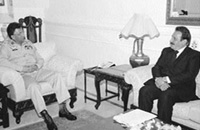 political history began in March 2007. Aimed at defying the country's
incredibly strong and entrenched power establishment, the movement has been
led by the legal fraternity. It has aimed at the larger goal of building a
higher judiciary that would brook neither fear nor favour and would
facilitate the rule of law through enforcement of constitutional guarantees
by an independent judiciary.
political history began in March 2007. Aimed at defying the country's
incredibly strong and entrenched power establishment, the movement has been
led by the legal fraternity. It has aimed at the larger goal of building a
higher judiciary that would brook neither fear nor favour and would
facilitate the rule of law through enforcement of constitutional guarantees
by an independent judiciary.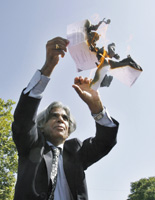 chief and president, to force Iftikhar Chaudhry to resign as the chief
justice failed spectacularly. Even pressure brought to bear on Chaudhry by a
posse of generals did not succeed to break his nerve. Both his 'no' behind
closed doors and open defiance in public and on live television the next day
electrified the nation. The legal fraternity, with experience of backing
political parties in the past in fuelling resistance to military rule,
immediately sprung into action in support of Chaudhry as his first line of
support.
chief and president, to force Iftikhar Chaudhry to resign as the chief
justice failed spectacularly. Even pressure brought to bear on Chaudhry by a
posse of generals did not succeed to break his nerve. Both his 'no' behind
closed doors and open defiance in public and on live television the next day
electrified the nation. The legal fraternity, with experience of backing
political parties in the past in fuelling resistance to military rule,
immediately sprung into action in support of Chaudhry as his first line of
support.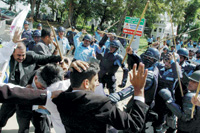 garnering unprecedented adulation for a man who until a few weeks ago was
unknown to a majority seem, now, a long way away. In the interim, Chaudhry
has been restored and sacked again, this time with many of his colleagues,
and despite the return of a popularly elected democratic dispensation,
nowhere nearer back in the saddle to reinforce constitutionalism.
garnering unprecedented adulation for a man who until a few weeks ago was
unknown to a majority seem, now, a long way away. In the interim, Chaudhry
has been restored and sacked again, this time with many of his colleagues,
and despite the return of a popularly elected democratic dispensation,
nowhere nearer back in the saddle to reinforce constitutionalism.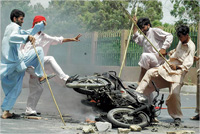 stakes, the legal fraternity finds that its partners kept getting off on
their ports of call as their own parts of the common objectives were achieved
and leaving them to, largely, tread the last long stretch on its own.
stakes, the legal fraternity finds that its partners kept getting off on
their ports of call as their own parts of the common objectives were achieved
and leaving them to, largely, tread the last long stretch on its own. wistfully acknowledges in his new book thus: "In the process of our
struggle we have learnt some invaluable lessons. We have learnt that we have
no monopoly on wisdom and that it is for the political leadership of this
country to navigate the ship of the state to the safety of the harbour. We
are conscious of the dangers ahead and the need to consolidate our gains, to
move forward but with unity of purpose and to tread with caution whilst we
consolidate our gains."
wistfully acknowledges in his new book thus: "In the process of our
struggle we have learnt some invaluable lessons. We have learnt that we have
no monopoly on wisdom and that it is for the political leadership of this
country to navigate the ship of the state to the safety of the harbour. We
are conscious of the dangers ahead and the need to consolidate our gains, to
move forward but with unity of purpose and to tread with caution whilst we
consolidate our gains."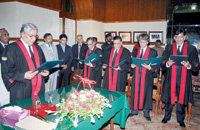 Doubtless
the movement continues, albeit it is bruised by the infighting among the
ranks of the lawyers and division among the deposed judges who have gallantly
stuck to principles but some of whom are abandoning their stance to
pragmatism. What if all the remaining deposed judges decide to rescue their
careers by accepting the Faustian bargain
Doubtless
the movement continues, albeit it is bruised by the infighting among the
ranks of the lawyers and division among the deposed judges who have gallantly
stuck to principles but some of whom are abandoning their stance to
pragmatism. What if all the remaining deposed judges decide to rescue their
careers by accepting the Faustian bargain with Naek? Will Chaudhry hold out until the end and well nigh become the last
one doing so? Or will he give in as well? Will the lawyers' movement then
make the judges the next target of their principles? Whatever happens, there
has been the good, the bad and the ugly sides of this incredibly significant
movement. Wherever the movement goes from here, it has already changed us
all.
with Naek? Will Chaudhry hold out until the end and well nigh become the last
one doing so? Or will he give in as well? Will the lawyers' movement then
make the judges the next target of their principles? Whatever happens, there
has been the good, the bad and the ugly sides of this incredibly significant
movement. Wherever the movement goes from here, it has already changed us
all.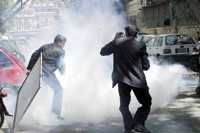 constitutionalism
in a country known for constitutional outlaws, both dictators and democrats.
It made the otherwise boring subject of championing of constitutionalism a
sexy subject! It popularised the principle that injustice rests on the
foundations of arbitrary and dictatorial rule and in order to establish a
just society, the old foundations must be uprooted.
constitutionalism
in a country known for constitutional outlaws, both dictators and democrats.
It made the otherwise boring subject of championing of constitutionalism a
sexy subject! It popularised the principle that injustice rests on the
foundations of arbitrary and dictatorial rule and in order to establish a
just society, the old foundations must be uprooted.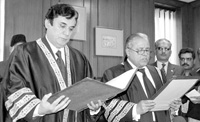 paving the way for an hitherto emaciated political leadership to assert
supremacy of civilian institutions (even though the largest political party
in the country pretends this is not true).
paving the way for an hitherto emaciated political leadership to assert
supremacy of civilian institutions (even though the largest political party
in the country pretends this is not true).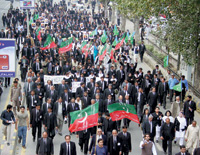 political
parties (nationalist, secular, conservative, centrists and Islamists all
rooting for the same cause and getting the equal treatment by Musharraf's
police!), students and academics, NGOs, women's groups, etc., which fuelled
popular revolt and forced the military's hand.
political
parties (nationalist, secular, conservative, centrists and Islamists all
rooting for the same cause and getting the equal treatment by Musharraf's
police!), students and academics, NGOs, women's groups, etc., which fuelled
popular revolt and forced the military's hand.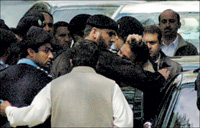 focus from civil-military relationship to historic military-judiciary nexus
('pliant' judges such as Anwarul Haq and Irshad Hasan) and political
party-judiciary nexus ('favourite' judges such as Sajjad Ali Shah for Benazir
Bhutto and Saeeduzzaman Siddiqui for Nawaz Sharif). Incidentally Iftikhar
Chaudhry has been "my judge" for both Benazir and Nawaz. For
Musharraf and (ironically) Zardari it is Hameed Dogar.
focus from civil-military relationship to historic military-judiciary nexus
('pliant' judges such as Anwarul Haq and Irshad Hasan) and political
party-judiciary nexus ('favourite' judges such as Sajjad Ali Shah for Benazir
Bhutto and Saeeduzzaman Siddiqui for Nawaz Sharif). Incidentally Iftikhar
Chaudhry has been "my judge" for both Benazir and Nawaz. For
Musharraf and (ironically) Zardari it is Hameed Dogar.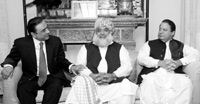 rightful judge while the other political parties are forced to take side of
one of the two mainstream parties. Even judges are constrained to lauding
parties supporting them.
rightful judge while the other political parties are forced to take side of
one of the two mainstream parties. Even judges are constrained to lauding
parties supporting them.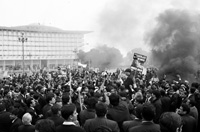 keeping
unthinking company with parties that either boycotted elections or were
trounced and taking potshots at parties with massive public endorsements. The
lawyers even actively canvassed for boycott of elections.
keeping
unthinking company with parties that either boycotted elections or were
trounced and taking potshots at parties with massive public endorsements. The
lawyers even actively canvassed for boycott of elections.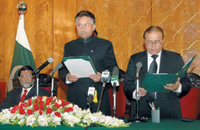 has
sat in judgement over political supremacy.
has
sat in judgement over political supremacy.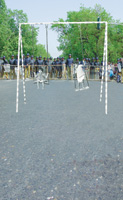 responses, sometimes in the form of art. An example is the recent work of
Farida Batool, an indirect response to the infamous and blasphemous Danish
caricatures printed in Jyllands-Posten in the autumn of 2005 which, when
spread through the internet, infuriated millions of Muslims across the world.
There were demonstrations, protests and proclamations of revenge across the
Islamic world. One still remembers Feb 14, 2006, in Lahore, the day the city
was ransacked by an angry mob, which burnt vehicles, destroyed restaurants,
blazed banks, blocked roads and generated a sense of panic and chaos while
condemning the offensive cartoons.
responses, sometimes in the form of art. An example is the recent work of
Farida Batool, an indirect response to the infamous and blasphemous Danish
caricatures printed in Jyllands-Posten in the autumn of 2005 which, when
spread through the internet, infuriated millions of Muslims across the world.
There were demonstrations, protests and proclamations of revenge across the
Islamic world. One still remembers Feb 14, 2006, in Lahore, the day the city
was ransacked by an angry mob, which burnt vehicles, destroyed restaurants,
blazed banks, blocked roads and generated a sense of panic and chaos while
condemning the offensive cartoons.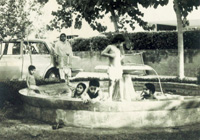 suffered financial and human losses. Farida Batool's work proves that artists
are sensitive human beings. In their works, they are able to associate with
unknown individuals, since what they seek in their work is larger, wider and
stronger than a personal vision or a private preference. They assume
collective responsibility and acquire a role to share other people's
experiences (often miserable) through art.
suffered financial and human losses. Farida Batool's work proves that artists
are sensitive human beings. In their works, they are able to associate with
unknown individuals, since what they seek in their work is larger, wider and
stronger than a personal vision or a private preference. They assume
collective responsibility and acquire a role to share other people's
experiences (often miserable) through art.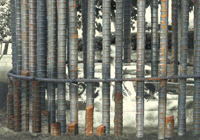 alteration. Batool superimposed a suicide-bomber's jacket on the girl's
frock, which stood before a background of lawn/ yellow field. The strong,
though not so obvious, visual component of terrorism indicated the current
state and destiny of this land – Sohni Dharti as mentioned in the print's
title.
alteration. Batool superimposed a suicide-bomber's jacket on the girl's
frock, which stood before a background of lawn/ yellow field. The strong,
though not so obvious, visual component of terrorism indicated the current
state and destiny of this land – Sohni Dharti as mentioned in the print's
title.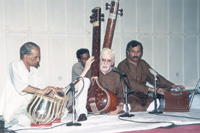 prominent of the lot but many others including some young aspiring musicians
both vocalists and instrumentalists also displayed their talent. As is the
wont, anniversaries are usually excuses to sing, play and perform as the late
ustad is best remembered by converting his memory into an occasion for more
music. This is a very good and understandable tradition which should be kept
alive, though of late basrsis have not been attracting the best musicians and
performers.
prominent of the lot but many others including some young aspiring musicians
both vocalists and instrumentalists also displayed their talent. As is the
wont, anniversaries are usually excuses to sing, play and perform as the late
ustad is best remembered by converting his memory into an occasion for more
music. This is a very good and understandable tradition which should be kept
alive, though of late basrsis have not been attracting the best musicians and
performers. not to eat during council meetings, out of respect for their Muslim
colleagues who were fasting. Apparently, the council provides sandwiches at
meetings and it was thought that eating might offend the Muslim staff and
that there might not be any sandwiches left over for them. A Lib Dem
councillor had opposed the decision on the ground that they were against
being dictated to by any religion.
not to eat during council meetings, out of respect for their Muslim
colleagues who were fasting. Apparently, the council provides sandwiches at
meetings and it was thought that eating might offend the Muslim staff and
that there might not be any sandwiches left over for them. A Lib Dem
councillor had opposed the decision on the ground that they were against
being dictated to by any religion.