



|
|
|
|
 |
 |
   |
campaign Taal
Matol comment Smugglers'
paradise RIPPLE EFFECT
From its humble beginning with one small school and a big dream, CARE has come a long way By Gibran Peshimam The library is large and
silent, stocked with a plethora of books ranging from stories of Peter and
Jane to books on While they were all quite striking, there was something pleasantly unusual about one particular piece of work. It was a card with a delightful version of 'Tweety' (of Sylvester and Tweety cartoon fame) on it. Unusual because, while Tweety may be a regular sight in our urban centres, she makes for a surprising spectacle when one is in a sort of no-man's land, not quite in Lahore, yet not quite in Shiekhupura proper. Having seen Tweety in various forms and shapes, this particular version struck me as being the most original. It may be strange, but, for some reason, throughout most of my trip that was one image that would stick with me. There she was, posing demurely in a yellow dress, almost ready to take a bow for looking so pretty. Who would think she could be so sweetly feminine. It makes me wonder where such creativity and imagination has taken some of these students today. The school in which we
stood is known as CARE-1, located in Iqbal Town, Sheikhupura District, a few
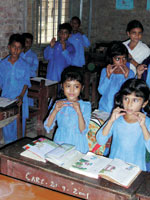
kilometres When a group of concerned citizens began relief work in 1988 to help out the flood-devastated Sheikhupura District, it took one small step that would ultimately lead to an avalanche of results. The response to the setting up of a school, the organisation's first, in Iqbal Town in 1990, would be overwhelming, showing that education did indeed hold high priority even in the poorer areas of our nation. Over 200 students registered on the first day alone. Twenty years on, that first school, CARE-1, which initially consisted of one block made up of 10 rooms, now has over 48 rooms, including that library in which I discovered Tweety, and 1,800 students. The organisation, which would come to be known as CARE, would not only go on to construct nine more schools of its own, but come up with a novel programme that would see it adopt 172 government schools in and around Pakistan's cultural capital, Lahore. Seeing the success of CARE in its efforts to set up and run purpose-built and quality schools, it was Lahore's local government that approached the organisation to see if it could emulate the same sort of success in government schools. Ten schools were given to CARE initially under the adoption programme in 1998. Ten years on, in 2008, we
go in search of one of the first government-owned schools that was adopted by
CARE. When we walked in, in front of us was a sea of girls dressed in their blue and white uniforms jostling hurriedly to form their lines as the morning bell sounded. By the time the principal had made her way in front of the girls, they had managed to congregate themselves into straight, neat blue lines according to their class. It was difficult to get over the sheer number of students. It was astounding. After all, in such an area,
is it possible for so many families to be able to send their daughters to
school? Speaking to the principal later, it was learnt that the school had no less than 2,500 girls in its morning session, which consisted of classes 6-10, and 1,250 in the afternoon shift, which consisted of nursery to class 5. There are about 70 staff members. Of course, this wasn't always the case. The government school was adopted by CARE in 1998. At that time, there were a total of 1,100 students, and 10 staff members. The organisation has been able to transform not only the structure of the school, adding more rooms and facilities, but the very essence of it -- so much so that the residents in the surrounding localities have enough faith in the institution to send their daughters there. In fact, so reputed is the
school now that the administration has to close admissions abruptly because
it cannot The CDG Girls Secondary school is one of the 172 government schools that CARE has adopted, in addition to the 10 schools that it has built itself. 161 of these adopted government schools are located in Lahore, while the rest are spread over Gujranwala, Sargodha and Sheikhupura. The reason behind the adoption programme was that it was felt that government schools were not up to standard in terms of the quality of education being imparted. The number of staff members was too low, the dropout rate too high, the infrastructure was crumbling and there were few if any facilities for students. In the case of the school in which we stood, it was under the administration of CARE that science was introduced as a proper discipline. They had set up computer labs and computer classes. Their focus has been not only on education, but technical education. In the words of the administrator, "we aren't just teaching them Punjabi, we're focusing on imparting practical and technical education, which can serve them well when they grow up; it will be something that they can use." So bad was the condition of the school before CARE got here; there was no drinking water or toilets in the school either. In addition to these efforts, there is the initiative taken in collaboration with the United States Consulate called the Access to English Language programme, an after-school programme for students that helps them not only become fluent in spoken English, but develop comprehensive practicable English skills. To see how successful this effort had been, I met two students who were undergoing the programme I spoke to Fatima Tariq. She, much to my surprise, speaks to me in quite an accent. "The atmosphere is really good; I am really liking it; Sir is very friendly with us...very cooperative." Her English is as fluent as any person studying in a top private school. "I want to be a doctor...more specifically a heart specialist," she tells me. I am happy to report that her father, a shopkeeper, is quite proud of his daughter and supports her in her quest. CARE hasn't stopped here. It ensures that the dreams it helps create in aspiring students can be fulfilled. It has a post-matriculation scholarship programme for deserving and bright students. This programme has had much success. I met with some of the scholars on a trip to Lahore. Shafiq Ullah's story is particularly moving. The 20-year-old is a former CARE student, currently pursuing his BCom at the Punjab College of Commerce. He is venturing into frontiers unknown to his family, among which he is the only member who has passed his matriculation examination thus far. His father, who ran a makai push cart, passed away, which put a lot of pressure on Shafiq Ullah to discontinue his studies and support the family -- especially since he was the eldest. He was supposed to take over his father's profession, selling makai on the streets of Lahore. However, CARE initially provided him with an alternate, more respectable job, teaching at one of their schools, which would also allow him to continue with his BCom. Today as he tells me of his dreams of an MBA and a high paying job, I realise that CARE's efforts have helped him envision and then pursue the impossible, considering his background. CARE scholarship students are at some of the top universities of the country, such as King Edward Medical College and UET Lahore. All they had to do was show that they were deserving. At the end of the interviews, I ran into one student who had graduated from CARE-1. For some reason, Waqas Ali, at 21 years of age, stood out amongst all the interviewees. He did not have the ridiculously high marks in his intermediate and matriculation, but it didn't matter. There was something else about him; a spark that set him apart. He is a fierce and keen debater, elected best debater in an inter-college competition in 2006-7. Waqas comes from the sort of rural background that is used in derogative stereotypes. His mother was murdered by his father's brother over a family blood feud and they moved away from their village. The sharp-witted and quirky boy from Jhugiansialian is the first member of his family to get education, and has fought against all sorts of odds; literally the sort we can only read about or watch in movies. He is currently pursuing his BCom from the Punjab College of Commerce. He plans to go on to pursue Chartered Accountancy. Unfortunately, however, he, like many others, cannot give me any information on the Tweety I saw over at CARE-1 earlier.
By Shoaib Hashmi When, as a kid I read about
the exploits of Marco Polo, I also learnt that during his sojourn in China,
he wanted to And the mind might still have been at it because I noticed something. It must be after years, if not decades, but the other day I actually saw a man using a mashk. That is our word for a goatskin. The skin of a goat is taken off intact, cured and stitched back in the original shape with the four legs tied together to form a handle by which it is slung across one shoulder, and believe it or not till my youth it was the normal container for transporting water! The diminutive of it was mashkeezah which I suppose would be a lambskin, and the man in the neighbourhood who wielded it was called a mashki, or, if you were really educated and polite he was the bahishtee which means man of heaven because it has always been held that quenching a thirst is an act of great piety and sure to take you to heaven. It is something which must have been used for thousands of years unchanged until the end of the twentieth century, and I am not even sure if the methods of curing the leather changed at all during all this time. The ones I remember from my childhood certainly looked as if the way of curing was the same at least from the time of Moses, or earlier, if I am to believe what Hollywood shows in its Biblical epics. Of course until Medieval times, a small goatskin was the usual container for wine in Europe; but it is amazing to think that a goatskin was used here until the twentieth century. But I remember the scene well. The goatskin, of which the neck was left open as the inlet, was filled at one of the 'Municipal Committee' taps at the troughs made for the horses, and then he brought it, dripping a bit, to the house to fill the buckets and containers. Or simply shower it all over the dust in the backyard. Nowadays, in most prosperous neighborhoods, water comes from the taps and the local tube-well. Sometimes in the hot weather the water runs a bit low, and with our usual ingeniousness we have found the remedy. The thing is to set up a small electric water pump -- called a 'donkey' pump for some reason -- in the house, connect it to the main water pipe for the neighbourhood running in the street outside the house, and to suck the whole neighbourhood's supply for your own use and let the neighbours go sit on an egg! I am not sure this is any progress from the leaky goatskin made of half-cured leather! So when the gardener suggested I follow suit I told him to go fly a kite, and think of an alternative because I was not going to join the yahoos. He came up with a small tube-well of my own, a two inch affair which would be sufficient for our needs. I had one put in, at some expense, and ever since it has been raining every third day and the garden is perpetually flooded and my turbine has been sitting there laughing at me. Oh for the days of the mashkee!
Is the PPP playing the role of a democratic force or has it become another power establishment under Zardari? By Jalees Hazir PPP supporters try to hush
up any criticism of their party's government or President Zardari, suggesting
that those On the face of it, the president has been democratically elected and the government enjoys the support of the majority of MNAs. But scratch the surface a bit and an uglier reality stares you in the face. After all, democracy is not only about elections and achieving the magical numbers. It has equally to do with what you do with those numbers. Much water has flown under the bridge since the heady days immediately following the February 18 elections in which the electorate very clearly voted for change. It was natural for the PPP, PML-N and ANP to team up as they represented the opposition at that time, and together they could form solid governments at the Centre as well as in Punjab, Sindh and NWFP, without seeking anyone else's support. This created the perfect opportunity for our political leadership to free itself from petty interests of the independents and smaller parties as well as the shenanigans of the old establishment, so good at the jor-tor politics and at playing one party against the other. Further strengthening the hope for a democratic revival was the fact that while in exile, Benazir Bhutto and Nawaz Sharif had signed the Charter of Democracy (CoD) that spelt out a much-needed consensus on specific goals and rules of engagement for ensuring supremacy of the parliament. This was necessitated by their dismal performance in alternate stints as government and opposition after General Zia's death. So sick were people of their immoral power games and abuse of authority that when General Musharraf took over, there was no public demonstration in support of the democracy they represented. In fact, the public relief was tangible. The CoD was an indication that the two major parties had learnt from their mistakes. Unfortunately, it is as good as dumped today. As a result, we seem to be speeding into the same anti-politicians direction. And the PPP must accept almost the entire blame for it this time. It is interesting that while Asif Zardari had no qualms about going back on more than one signed agreements with Nawaz Sharif, who represents the second largest party in the National Assembly, he showed absolute determination about sticking to verbal assurances given to foreign friends and influential establishment lobbies at home that have no representative value whatsoever. This only highlights how vital policy decisions of the present set-up are dictated more by behind-the-scenes arrangements with power-players rather than transparent democratic compulsions. Whatever spin the present-day PPP stalwarts may give to their villainous role in the Rule of Law movement, it is not difficult to see how the party chose to actively subvert an authentic national movement for people's rights. It is interesting that the workers and leaders of PPP participated in the movement and they do not tire of pointing this out. But they also tell us in the same breath that restoration of judiciary was not a part of the party's election campaign. Even if one were not to challenge this paradox, it is pertinent that the party opted to part ways with its biggest coalition partner rather than accepting their condition for staying in the coalition and doing something that had the support of 86 percent of Pakistanis. The erosion of the democratic consensus, however, had started much earlier with the induction of JUI-F in the federal government under the reconciliation mantra. The same excuse was used to include MQM in the Sindh government and form a government with PML-Q in Balochistan. Reconciliation is a good word but what does it mean in a democratic context? For one, in a system where opposition plays a very important role, it certainly does not mean bringing everybody aboard the government ship. Stuffing the coalition with vestiges of a controversial past was most likely to create problems in cohesive policy formulation for change. But then the PPP leadership seems more interested in pursuing its ambitions for more and more power rather than any democratic ideals that could change the lives of all Pakistanis and not just those lucky jiyalas who manage to get some crumbs of that power in a system based on patronage of largesse. It is unfortunate that PPP, with only 124 seats in the National Assembly, which does not make a simple majority, has chosen to build its strength by developing perverse political relationships based on patronage rather than constructing upon the clear democratic consensus of the February elections. Even before the collapse of the original coalition, there were numerous instances where it acted unilaterally and failed to even inform its coalition partners about important decisions. It decided to impose a Governor in Punjab that was unacceptable to the majority party and its coalition partner PML-N, but gave in to the demands of MQM in Sindh, with which it did not even need to form the provincial government. As the fight for Punjab intensifies, all of it makes more sense, but only in the realm of power politics. The election of Zardari as president and the subsequent somersaults on the issue of parliamentary supremacy and presidential powers has proven to be the last nail in the coffin of PPP's democratic legacy. The jiyalas already have the script for the spins that they must craft around this unjustifiable position and point out the acumen of their new leader at claiming more and more of the power-pie. What they don't see is the birth of a new consciousness in Pakistan where more and more citizens understand that this tried and tested road leads them nowhere. This new consciousness has moved on from the post-Zia politics and has greater expectations from the governments that call themselves democratic. They have understood that political parties are not ordained by the scriptures. Unless the PPP wakes up to this new consciousness, it is set to lose whatever remains of its fast-shrinking support base.
By Ashrafuddin Pirzada The government of Pakistan and Afghanistan signed the Afghan Transit Trade (ATT) agreement in 1965 to facilitate Afghanistan's trade with the rest of the world. As the two neighboring countries share 1610 miles border, known as Durand Line, the ATT is heavily abused by smugglers. Smuggling is carried out on
the Durand line in all seven tribal agencies
since the ATT agreement was signed. The Smuggling is carried out not only through the main border crossing route located at Torkham but is happening right under the nose of Shalman, Ghakhi Sar, Arkhanda, Zaman Sapari and Inzeri check points on the Durand line. There are various unfamiliar routes in the rugged and rough hills in the seven tribal agencies where a large numbers of Khassadars are deployed to control the illegal trade of different products. A recent survey reveals that an organised group of smugglers, middlemen, facilitators and transporters hailing from both countries since decades have continued their illegal trade without any fear or rule of law to date. The imported materials which were not required for consumption in Afghanistan and also were not included in the transit trade list of items were pushed into Pakistani markets, crippling the local industry and manufacturing sector. Products like cosmetics, plastic wares, crockery, electronic products, tyres, automobile spare parts, small arms, blankets, cloth, black tea, Iranian petrol, diesel and carpets were flooded into the markets particularly to the Karkhano market from where these contrabands were sold both at wholesale and retail prices. Similarly from Pakistan, poultry products, diesel, petrol, fertilizers, gas cylinders and other merchandise including flour, livestock, vegetables, meat and salt are also being smuggled to neighbouring countries without paying customs duty to Pakistan's Customs, inflicting billion of rupees' loss to the national exchequer. Besides this, huge amounts of drugs are smuggled to Pakistan from Afghanistan spoiling generations of Pakistan and that of the civilised world at large. According to credible information, items worth Rs40- Rs50 million are being smuggled to Afghanistan each day and it is mostly taking place from Landikotal, Jamrud, Bara and other godowns of tribal agencies through the mentioned check posts and hilly ways of all the seven tribal agencies. It was an amazing scene for the scribe when he witnessed a loaded pick-up with smuggled goods being loaded onboard a big boat in river Kabul at Loe Shalman in Khyber Agency. Smugglers who are earning billions of the black money through illegal trading term it as "a goose that lays golden eggs," saying that smuggling is the only source of income to feed their huge families otherwise what is there to do in the barren and undeveloped terrain of FATA. A conversation with these people revealed that the smuggling money not only goes into their pockets but also into the pockets of officials of the political administration and the customs officials who receive a bigger share. The smugglers pay bribes on each checkpoint and usually pay Rs2000 for petrol, Rs1500 for diesel and Rs1200 for fertilisers. At least five to six hundred small trucks and pick-ups are busy transferring the smuggled goods across the border each day. Customs officials at the Torkham border say that the illegal trade of the banned items, taking place on both sides of the border, is damaging the national kitty of billions of rupees. The officials reveal that forty to fifty thousand liters of petrol and diesel are being smuggled to Afghanistan daily. They also suggested that the government should impose Excise Development Surcharge (EDS) to curb illegal trade and should lift the ban from exporting daily commodities to Afghanistan. Customs clearing agents are also bearing the brunt of the huge amount of smuggling across the Pak-Afghan border. The agents are of the view that they are losing the fight due to the infiltration of business goods converting into illegal trade. Niazuddin Shinwari, a custom clearing agent, appealed to the government to implement Excise Development Surcharge (EDS) in FATA. Custom dues have decreased in the last few years at the Torkham border because of illegal trade in open markets. The implementation of EDS in FATA, says Shinwari, is inevitable for eradication of illegal trade across the border. ANP leader Shah Hussain Shinwari and PPP's FATA information secretary Qazi Fazlullah Shinwari are terming the ongoing smuggling a result of extreme poverty and lack of jobs which is affecting the poor tribal people since the creation of Pakistan. However, Qazi Fazalullah Shinwari says that the illegal trade from both sides is not only affecting the national chequer but also damaging local businesses. Shah Hussain says only one percent of people in FATA are the benefactors of smuggling money. He adds that the US should implement its Reconstruction Opportunity Zone (ROZ) programme for the people of FATA which would provide opportunities of legal trade and business to the tribes people. Shah Hussain places the blame on the political administrations for supporting and backing the groups of smugglers. However, Sajjid Shinwari, a dealer of Tyres and batteries says that businessmen are compelled to transfer daily commodities and other business goods because of huge margins in Afghanistan's new emerging markets.
RIPPLE
EFFECT We are a militaristic
society. There shouldn't be any doubt about that. Period. Look at the amazing
response that The day that this was reported in the media, the prime minister went on record to say that what the army chief said reflected the government's policy on the matter. The prime minister really didn't need to say that because, of course, anything that the army chief says is supposed to reflect government policy. In any case, one can perhaps excuse the prime minister for saying this because of Pakistan's peculiar history, when often the military has not seen eye-to-eye with the elected government of the day. But back to the argument that one is trying to make here -- that the public's response to General Kayani's remark was most enthusiastic. There were even reports (credible or otherwise) that the army chief became hugely popular for what he had said in FATA and that his pictures were in great demand. A day later, this was followed by the prime minister (apart from his statement that this reflected government policy) saying -- or rather trying to explain at length -- that while no nation wanted its borders violated by a foreign country's powers, what was needed was a pragmatic approach, one that relied more on diplomacy rather than military means to settle differences with other countries, especially when your own country and this other country were, prima facie, allies. He also said -- and this apparently was a killer for many people in this land -- that Pakistan couldn't wage war with America. As soon as this statement was made, email inboxes of newspapers were flooded with letters by outraged Pakistanis -- all saying pretty much the same thing along the following lines: that the happiness they had experienced at reading General Kayani's most excellent statement was drowned in the sorrow and disappointment created by the prime minister's 'meek', 'cowardly' and 'completely uncalled-for' remark. Several letter-writers, armchair intellectuals and TV hacks said that the prime minister's words had robbed whatever advantage Pakistan had gained after the army chief's remarks. However, the issue of gains accruing to Islamabad, presumably in the form of a moral advantage arising out of the fact that it had finally decided to stand up to the Yanks, remain unclear given that the next day another missile attack hit North Waziristan. These are the same people who took the prime minister to task (and this writer is hardly a supporter of anyone in this, or the previous, government) when he went to America admonishing his apparent failure to tell the Americans off, given Washington's repeated chiding of Islamabad to fight militants on its side of the border more vigorously. One can only say that what is wrong with these people? It was said then and one will say it now -- if you go abroad on another country's invitation, representing your country in the capacity of chief executive, do you go to fight and act with belligerence or do you go trying to find some kind of common ground, and if that is not possible, to impress upon your hosts, in a peaceful and polite way, that there are some differences of opinion and that your views need to be considered or else the bilateral relationship will crumble. What point will the prime minister make if he says that yes, Pakistan will fight America? Apart from scoring some points because of its populist credentials, it is not even in the least bit believable -- unless one is assuming that some kind of guerilla warfare will be fought against the Americans, in which we will -- just as they are accused of doing -- use some of our non-traditional assets. Even if that were to happen, does the PAF have the wherewithal to establish air superiority compared to that of the US military? Perhaps, the most important argument in favour of understanding what the prime minister said is that countries which are economically and politically weak, and have severe internal strains and fissures, normally do not go about thumping their chests and picking a fight with other countries, especially if the latter are far more economically and militarily stronger. In fact, that explains precisely why America goes about bullying other countries -- because it can, and because its economy can sustain several wars and at the same time withstand a deep recession, without the possibility of the country itself crumbling under its own internal divisions. The same goes for regional powers like India or China, which seek to expand their influence -- though without the kind of chest-thumping that many Pakistanis would want their political and military leaders to indulge in -- across the world. When Pakistan is as powerful -- economically and militarily -- as America then it, too, can (the morality of such actions aside) act as a hegemonic power or at least then a statement to the effect that we will wage war with the US would make some sense. Linked to this discussion, of late, one has also noticed a sudden rise in the number of articles on certain blogs and sections of the print media attributing the problem in FATA, and especially the Pakistani Taliban, as being created by the Americans, Indians, the British and even the Iranians. Without going into the merits and demerits of this issue, it wouldn't make sense for the Americans to spend billions of dollars on Afghanistan and on aiding Pakistan, only to also spend their resources aiding the Tehrik-e-Taliban Pakistan which creates problems for Pakistan, which in turn hampers the ability of the Pakistani military to effectively containing militancy and extremism on its side of the border. These apologists -- and they know on whose behalf they speak -- also claim that the so-called Afghan Taliban and the Pakistani Taliban are two separate and quite dissimilar entities, and that the former have never attacked Pakistan or done anything to harm it while the latter, as their murderous actions against everything Pakistani suggest, must be creations of Pakistan's enemies. (To that, just one question: surely, Mullah Omar and Baitullah Mehsud are not enemies?) When you ask these people that how can America be called an enemy when we are allied with it in the war on terror, the (expected) reply is that since America is playing a double-game, there is no harm if we also do the same. Of course, these people fail to see the murderous ways of these obscurantist bigots, that all of them target socio-economic development, all of them blow up girls schools and colleges, all of them seek to impose their version of faith on others around them -- on the pain of death if need be, that all of them stand and fight the state and its security apparatus, and have no qualms with murdering innocent civilians. Ironic -- an understatement surely -- that no one is outraged when they see Pakistan's own sovereignty being ceded or devoured by these people. The
writer is Editorial Pages Editor of The News. Email:
omarq@cyber.net.pk
|
|
 airplanes and other modern flying machines, which stand neatly on shelves
encased within immaculately clean glass cabinets.
airplanes and other modern flying machines, which stand neatly on shelves
encased within immaculately clean glass cabinets. outside Lahore. The school has a heart-warming history behind it, and is a
sort of monument celebrating the beginning point of an effort so special.
outside Lahore. The school has a heart-warming history behind it, and is a
sort of monument celebrating the beginning point of an effort so special. Located in the winding streets of Lahore's Kot Khwaja Saeed, is the CDG Girls
Secondary School. So confusing and identical are the narrow streets that our
driver himself is unsure of which turns to take; we are lost a few times, but
ultimately able to make it to the school right in time to hear the morning
bell chime. We arrive at an innocuous looking black gate. Some girls continue
to trickle in, lugging their school bags and wrapped in shawls, giving us
untrusting glances. My initial estimates were that the school would contain
some 400-500 students, judging by the surroundings and, to be honest, by the
unassuming black gate.
Located in the winding streets of Lahore's Kot Khwaja Saeed, is the CDG Girls
Secondary School. So confusing and identical are the narrow streets that our
driver himself is unsure of which turns to take; we are lost a few times, but
ultimately able to make it to the school right in time to hear the morning
bell chime. We arrive at an innocuous looking black gate. Some girls continue
to trickle in, lugging their school bags and wrapped in shawls, giving us
untrusting glances. My initial estimates were that the school would contain
some 400-500 students, judging by the surroundings and, to be honest, by the
unassuming black gate.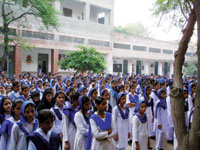
 cater to the massive number of applicants despite the increased number of
buildings and classes.
cater to the massive number of applicants despite the increased number of
buildings and classes.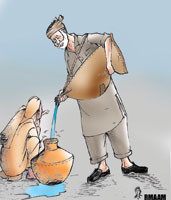 steal some silk-worms and smuggle them back to Europe and he did -- inside a
piece of bamboo stuffed with mulberry leaves or whatever the ruddy things
lived on. And for weeks I thought why he brought them in a bamboo piece, and
then I struck upon the answer. Because that was a time when there were no
'shopper bags' or plastic boxes or containers or in fact containers of any
kind.
steal some silk-worms and smuggle them back to Europe and he did -- inside a
piece of bamboo stuffed with mulberry leaves or whatever the ruddy things
lived on. And for weeks I thought why he brought them in a bamboo piece, and
then I struck upon the answer. Because that was a time when there were no
'shopper bags' or plastic boxes or containers or in fact containers of any
kind.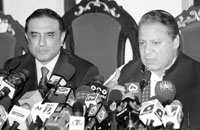 criticising them are playing into the hands of an invisible establishment out
to destabilise a democratic dispensation. The problem is that the government
and our new president have not only failed to earn any democratic points,
they have actively subverted democracy and democratic norms at every
conceivable level. The Zardari-led PPP has thwarted the democratic consensus
that clearly emerged in the February elections and has replaced it with the
traditional power politics which lies at the root of why people mistrust our
political elite.
criticising them are playing into the hands of an invisible establishment out
to destabilise a democratic dispensation. The problem is that the government
and our new president have not only failed to earn any democratic points,
they have actively subverted democracy and democratic norms at every
conceivable level. The Zardari-led PPP has thwarted the democratic consensus
that clearly emerged in the February elections and has replaced it with the
traditional power politics which lies at the root of why people mistrust our
political elite.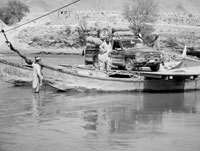 imports of Afghanistan are unloaded at the Karachi sea port and the loaded
containers are transported en-route Khyber Agency to Afghanistan. Some of the
containers are unloaded at warehouses in the Khyber Agency while many are
re-transported illegally from Afghanistan back to the godowns established in
the Khyber Agency by the smugglers and then onwards to the markets throughout
Pakistan.
imports of Afghanistan are unloaded at the Karachi sea port and the loaded
containers are transported en-route Khyber Agency to Afghanistan. Some of the
containers are unloaded at warehouses in the Khyber Agency while many are
re-transported illegally from Afghanistan back to the godowns established in
the Khyber Agency by the smugglers and then onwards to the markets throughout
Pakistan.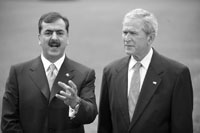 has followed General Ashfaq Parvez Kayani's remark -- a remark which was
sensible in the given circumstances but also expected. After all, when was
the last that the head of the military of any country did not say that his
force would defend the country at all costs, and would seek a quick response
against any violation by a foreign force of its territorial integrity?
has followed General Ashfaq Parvez Kayani's remark -- a remark which was
sensible in the given circumstances but also expected. After all, when was
the last that the head of the military of any country did not say that his
force would defend the country at all costs, and would seek a quick response
against any violation by a foreign force of its territorial integrity?