|
|
| |
instep
profile
Woman on top
As brilliant as she was as Kamla, Ramchand Pakistani shows only
a spark of the dynamo that is Maria Wasti. Instep gets to know one
of the most intelligent actors in the business a bit better
By Saba
Sartaj K
|
| |
 |
| |
|
Everyone's talking about Maria Wasti these days
- well, at least everyone who has seen Ramchand Pakistani. Possibly
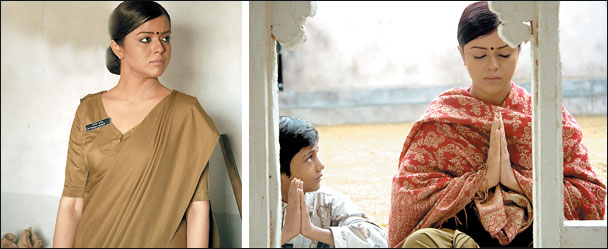
her best performance to date, Maria's turn as Kamla the empathetic
and feisty Brahmin prison subordinate who forms an unlikely bond
with the young Dalit Ramchand has created a hot buzz amongst film
critics and high society alike. Whoever has seen the film will vouch
for the fact that it was Maria's role as that took the cake and
had the audiences glued to their seats. Unfortunately in the film's
promos, Maria Wasti was totally overshadowed by Nandita Das, so
those who haven't seen Ramchand won't realize the crackling performance
Maria Wasti gave. Indeed, her blow away performance made it imperative
for us to catch up with this experimental and ever evolving actor.
Catching hold of Maria was a task and a half in its own considering
her chock a block schedule which is full of acting and production
commitments, nevertheless, one had her pinned down after a couple
of phone calls.
Having arrived at her striking sea front apartment, one at once
realizes that this is one lady who likes it minimal and simple.
A lot of thought has obviously gone into the décor to give
a breezy spacious feel that is rather classy. Sparsely yet tastefully
decorated, it is definitely inspired by Far Eastern aesthetics and
it's obvious that Maria has carried many an object from exotic lands.
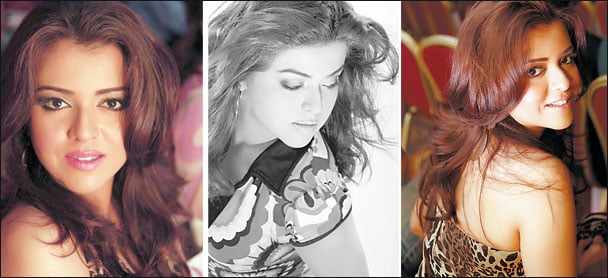
And in this environment there is the owner. Dressed casually yet
elegantly in a long, pink summer dress, her hair falling teasingly
over her shoulders, Maria is breezy and relaxed as she begins to
wax eloquent on the film that has put her in the spotlight.
Remembering Ramchand Pakistani
"Ramchand just happened to me,' she admits. "Mohammad
Ahmed (the script writer) and Mehreen Jabbar are good friends and
I've known them for a long time. One day they called and said they
wanted to meet me. I said sure. My house is always open to friends.
They came over and explained the role to me at length and it sounded
interesting."
But Maria did not say yes immediately.
"I'm essentially a television actor and maybe I can afford
to do bad television or drama and get away with it but I had never
ventured into films and did not want to get involved with something
substandard. I asked Mehreen and Muhammad many questions as to what
I had to do and everything about the role and got it all clear in
my head. I liked the story line and decided to go ahead with it.
Muhammad said he wanted me to play the role of Kamla because he
had kept me in mind while writing it. They totally sold the idea
to me and I realized I was going to be a part of a quality project,
which is why I agreed."
And
a quality project it was. Maria insists that for her Ramchand Pakistani
was more about supporting a good project and friends than it was
about doing a film. Her role in the film is a small one but her
powerful performance has managed to overshadow Nandita Das'. Even
Javed Jabbar, the executive producer of Ramchand confessed that
Kamla was his favorite character in the film. And it is Kamla and
young Ramchand's camaraderie that turns a film that is rather heavy
into a more hopeful experience. It was Maria's Kamla with her toughness
edged with kindness and the affair she was conducting with another
police officer there that Ramchand helped conceal that gave Mehreen
Jabbar's debut a twist that elevated it from just another art house
film about the plight of the downtrodden. Maria was also the glamour
quotient, but did she mind playing second fiddle to Nandita?
"In our country we hardly have any films being made. I want
to support anybody who is trying to make an honest effort,' says
Maria idealistically. "If we don't support it then who will?
If I start thinking 'I don't have five songs and not a prime role
I shouldn't be a part of it', then how will it ever work? Everyone
agreed to be a part of this project for a reason and performed brilliantly
even if they had the smallest of roles. Nauman Aijaz had such a
small role but he also agreed because we all wanted to support it.
We basically did it for that," she adds passionately.
|
| |
 |
|
|
Maria seems happy with the acclaim that the film
on the whole has received and how the end product turned out. Maria
knew the film will turn out great since such a lot of honest effort
went into it.
"I didn't know what the film would look like once it was made
but I just knew no matter how wrong it goes, the film is still going
to be great. I knew I was being a part of something great. You want
to be a part of such a project and want to work with such wonderful
people. They are professional, they are honest, they are punctual
and they take care of their actors. These are the things that make
you want to take up a project and make it a success."
However, she has one reservation about how things unfolded.
Unequal footing
"It was all wonderful but this I have to say. I had made one
thing clear to them from the very beginning, even before I heard
my role," Maria says calmly, "I told them that whoever
is a part of this film, whether its me or some star from abroad,
they should give proper coverage and proper publicity to all of
us, which, sadly they didn't do. And I had predicted this before
I even started the film. I knew this was going to happen - eventually
it was going to be all about the Indian actor." she adds. "The
only thing I told them was that whether you make me do one scene
or twelve, give me and any actor be it from India or France or where
ever, give us proper equal respect. I fulfilled my part of the deal,
but sadly it wasn't the case, it was the other way round,"
she says with a tinge of remorse.
Maria doesn't sound bitter, just aware. And the promos of Ramchand
support what she's saying. When one saw the promos, one got the
feeling that this film was Nandita Das' through and through. But
upon watching the film, one realized that Nandita was only a small
part of a multi layered story out of which it was Maria who made
us laugh and remained in our hearts even after the credits ran.
She was real, she was tough and more importantly, she had oomph
factor in an otherwise raggedy bunch of characters.
Had the film been publicized Maria Wasti's little tete a tetes with
Ramchand or her sitting and watching a Bollywood flick with him,
maybe there could have possibly seen a different reaction to the
film here at home. Let us not forget that Maria Wasti is a huge
television star with a fan following across the country; her fan
base is definitely bigger than that of Nandita Das. Chances are
Ramchand could have appealed a lot more to the masses had this angle
been brought out in the promos instead of a distraught Nandita screaming
out for her son in the scorching heat and vast empty expanse of
the Thar.
|
| |
"I
don't have any regrets," says Maria smiling. "But I'm just
trying to explain the general psyche of people in our country. I wish
we would give our own people as much respect and reverence as we do
to anyone who comes from abroad. We are not creating our own icons.
Superstars like Shahrukh Khan are products; they are created and they
are sold. We don't do that with our stars. We need to build our stars
and make them sellable like the Indians do - both across the border
and even in Hollywood."
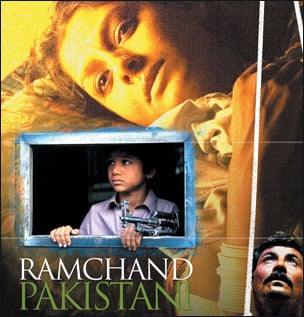
Maria maintains that Ramchand Pakistani is an excellent film but it
wasn't marketed properly.
"They haven't sold the film properly,' she says bluntly. "If
people are saying there is no market for such a film then they are
wrong. We have a huge audience for films here in Pakistan. Ramchand
is a different genre but it definitely has a place and a viewership
The only reason its not drawing a packed house every evening is that
it was not marketed properly." |
 |
| |
|
Thinking big
Maria maintains however that other then these glitches, working
with the Ramchand team was a wonderful experience and that the film
has turned out much better then her expectations.
"I was a very small part of it and had my part of the shoot
entirely in Karachi. It was very easy for me. But for the others,
they all had to go to Thar and go through a lot of difficulties.
They have done a marvelous job. It was well received at international
festivals and has definitely helped bring Pakistani cinema to the
limelight in the international film circuit."
And Maria who is very bright and savvy and professional to the core
understands the international appeal of the intelligently made Ramchand
Pakistani. And it turns out that intelligent cinema is what Maria
has always been interested in.
"I knew I would never be ashamed of Ramchand Pakistani,' says
Maria candidly. "As for the types of films that are normally
made here, I feel I don't have the talent for them. I don't know
what I would do in them. I was even made to sign a film in Lahore
under pressure from friends. One was No Paisa No Problem with Humayoun
Saeed and once I signed it, I knew it was not something I wanted
my name attached to. I didn't know how to get out of it. I had to
run out of the country and stay out for a long time! In the meantime
it got made, it released and majorly flopped. That was a relief!"
Maria laughs as she remembers the times when there was no room for
films like Ramchand Pakistani to be made in Pakistan. And she insists
that television is where she would like to remain unless a brilliant
script comes and inspires her like Ramchand Pakistani did.
"We don't have a film industry. We have a television industry
and I opted for it. Television is eventually going to be the biggest
industry in the world," she states confidently. "All the
Bollywood stars are coming towards television. We are trying to
make it. I will essentially keep on doing what I am doing but anything
that comes my way I will consider it and see how it goes."
Till then Maria is happy with the small screen that transports her
into homes across Pakistan almost every day of the week.
Small screen superstar
Widely acknowledged as a superb actress, even by her peers, Maria
wasti proved her mettle with quality plays like Kallo, Neend and
Boota from Toba Tek Singh. Now, well after a decade of being in
the telly biz, she has also veered into production.
These days she is taking it a bit easy since she has wrapped up
a couple of serials and is looking at new production ideas. She
has recently produced Sunset Boulevard which is based on the book
79 Park Avenue by Harold Robbins and which has big names like Samina
Peerzada, Shakeel and Humayoun Saeed acting in it. Another of her
recently wrapped up productions is Hateli Pay Chand and a couple
of small magazine programmes which also includes one on fashion
with Sunita Marshall as the host.
Maria has also wanted to make documentaries for a long time now
but never actually got around to do it. She is also working on a
programme Zindagi - Saza Ae Maut which is based on the life of those
prisoners who have got the death penalty and shows how the lives
of the families of both the murderer and the murdered have been
affected.
She loves the fact that Shehzad Roy has done something on similar
lines by releasing his latest album in the juvenile jail. According
to her, actors and entertainers have the power to raise these issues
and have a certain influence which they should use to bring about
awareness of certain social issues. "It doesn't take from you,
it only gives you back in the form of indescribable pleasure you
get from doing something good for someone in any little way possible."
Maria is obviously a thinking actor and is going beyond just being
a star. She is looking at television as a tool to make a difference
as well. And she is incredibly savvy about the needs of the industry
today. According to Maria, the main problem we have in the television
industry is the lack of trained people. Everything needs specialization
to improve. The lighting, audio, visuals, everything needs to be
improved and the technical staff needs to be well trained.
For her, it is very serious business and meaningful as well. According
to her, media is the face of the society and whatever we see on
television, it is all inspired by what is happening around us. "The
girl I portray in a drama is around us," she says. "Everything
happens in our society. Whatever you are seeing on television, it's
happening around you. Television is a mirror of our society."
Maria considers herself lucky enough to be a part of the last generation
of PTV actors and feels that PTV was the best possible learning
ground for a newcomer. "These days," she says, "there
is so much going on that no one has the time to learn or teach."
When she was working for PTV, she felt like she was going to university
in a way because there was always so much to learn, so many rules
and regulations and discipline. According to her, professionalism
has finished. There is no respect for time, work or commitment and
since there is such a lot of work everyone is doing, that passion
has disappeared, which is why the quality of dramas has gone down
considerably, though the odd good ones are still out there. And
Maria seems to have taken it upon herself to be true to the spirit
of that time, even as she is ultra savvy about the business modern
media has become. She has carved a place for herself in it, lived
and learned and has come out very much on top.
|
| |
|