



|
|
|
|
 |
 |
  
|
journey Through
the Skardu valley
A Sunday on
the Makran Coast is a thrilling picnic waiting to By Kaiser Tufail With the lone hotel
in Makran having closed down recently due to security concerns, one has to
think twice about With my old Air Force friend Nauman for company, we set course early in the morning and headed via the Northern Bypass towards the industrial estate of Hub. From there, as we drove along the RCD Highway to Uthal, we picked up many features familiar to us from the air during our bombing runs of yesteryears at the Sonmiani Firing Range. We were so busy recollecting old stories that we completely missed the turn to the Makran Coastal Highway. After nearly reaching Bela, we realised our mistake and turned back to Zero Point, 18km south of Uthal, from where the highway starts. The traction of the tyres suddenly smoothened out as we coasted along one of the finest roads in the country. The road widely arcs around the inland sea known as Miani Hor where all sorts of aquatic birds can be seen; it can be visited only in a 4x4 vehicle due to rough terrain. About 90 km from Zero Point is another marvellous geological feature, the famous Chandra Kop mud volcanoes of Makran. Located about six km off-road, the three volcanoes can be visited in a 4x4 vehicle; however, one must be prepared for a very bumpy ride over sand dunes and thick shrubbery. The desolation of the
countryside is evident all along, with hardly any population centres, save
for a few reed huts here and there. There is no evidence of agriculture or
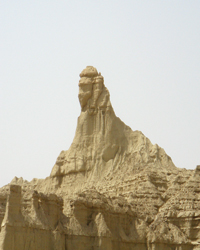
even rudimentary industry, anywhere. The road traffic is We took a tea break at a roadside shack short of the Hingol Bridge that also marks the beginning of Hingol National Park. Nearby, a signboard proclaims — dubiously, I think — the site of the graves of Muhammad bin Qasim’s soldiers, though their design and vintage seem similar to those at the 15th to 18th century Chaukundi Necropolis north of Karachi. Another signboard indicates the road branching off to Nani ka Mandir, a Hindu shrine of great antiquity, about 15 km inland near Aghor. Since there is no bridge over the river and the water level was high for fording it, we decided to leave it for some later adventure. Beyond Hingol River, the road passes through defiles and gullies in the hill range. Odd shapes chiselled by the wind and rain can be seen, the most remarkable of all being a huge sphinx-like figure. Not too different from the famous specimen at Giza in Egypt, it only needs some refinement and finer shaping of facial features to qualify as the Sphinx of Balochistan. Other naturally sculptured shapes include pagoda-like structures, lofty towers and human figures; one of the latter is said to have been named Princess of Hope by none other than Angelina Jolie, while on a flood relief tour a few years back. As we got closer to Ormara,
the huge mass of the promontory jutting out into the sea became visible. We
were Occasionally a woman wrapped in a black chaddar would scamper past, somewhat uncomfortably. We found the locals to be generally good-natured and friendly. Almost everyone spoke Makrani Balochi with a Persian lilt to it, though Urdu is the lingua franca in much of Makran. Unfortunately, literacy rate in the area does not reach two figures for males, while for females it is absolutely zero. A school administered by Pakistan Navy, however, promises to change things in due course. After reaching the Mess we had a quick shower and, hurried to be in time to watch the sunset from atop the hammerhead, which rises to 1,500 ft above sea level. A winding road covering a distance of 17 km takes one to the top, where a small viewing enclosure aptly named Bay Watch offers the most stunning views of the East and West Bays. Unusual for the month of July, we encountered cold winds that lashed the sheer cliffs draped in low clouds. Ospreys struggled to keep balance in delightful aerobatic flight as they scanned the shore for fish and crabs. About 50-odd fishing boats could be seen in the shallow waters off Ormara town. The Jinnah Naval Base stood out as an ultra-modern facility in the clear blue waters of East Bay. The picturesque view did a lot to soothe our tired eyes, much as the feast that followed did to our midsections, a little later! After the long day was done, we drove down the hammerhead in pitch dark, with our headlights picking out several hedgehogs setting off on their nocturnal forays. Next morning we decided to go around the town to check the activities. Plenty of men were busy catching crabs on the West Bay, which is a daily chore for those who cannot afford a fishing boat. Many others have found jobs as labourers at several of the Navy’s construction sites. Poaching of falcons for Arab Sheikhs is rampant, we were told; a sizeable number of shikaris indulge in this illegal falconry trade which earns them handsome amounts. The beautiful Sooty Falcon (Falco concolor), a summer breeder on the Makran Coast and the Peregrine Falcon (Falco peregrinus), a winter visitor to the area, are prized birds, which has been the cause of their declining numbers. The Navy is well-respected in Ormara, especially for its welfare efforts which include free medical care for the locals and subsidised rations purchase. An upcoming 100-bed hospital is certain to extend health care to far-flung areas. In a few years, one expects the first batch of educated youngsters from Ormara enlisting in the Navy, which would be a turning point for the locals, both from the point of view of employment opportunities in this far-flung region, as well as national integration. Having spent a wonderful weekend, we were ready to leave at mid-day. Shortly after driving out of Ormara, we saw two more mud volcanoes about three to five km off-road (approximately 18 km northeast of the town). Since we had to get back to Karachi before sunset, we could only view them from a distance. During the journey, a lot of landscape pictures were taken. We noted an excellent spot at Kund Malir for those who insist on hazarding a camping trip. About 25km west of the Hingol River crossing, the rocky Ras Malan plunges into azure waters, and date palms laden with fruit seem to soar above the huge sand dunes of Kund. This is Arabian Sea in unmatched splendour. It must be noted that mobile phone signals in the area are poor to non-existent; a car breakdown could thus turn into a nightmare, so it would be best to travel in a convoy of two vehicles. A jerry can of extra fuel and a strong towing cable would be a good idea. Needless to emphasise, a stock of delicious snacks and cold beverages could enrich the outing manifold. A Sunday on the Makran Coast is a thrilling picnic waiting to happen. Wise words: don’t wait! kaiser_mach2@yahoo.com
Flight to Skardu is an experience of a lifetime... By Akhtar Mummunka The flights to the
mountain towns of Skardu, Gilgit and Chitral are subject to Insha Allah,
countless prayers by those hoping to fly to these destinations and PIA’s
reputation of “Perhaps-I-Arrive”. We were a group of 16 Thick black monsoon clouds overcast the sky and our flight to Skardu, operated by a Boeing 737, was delayed. The flight to Skardu is an experience of a lifetime, as one flies over the emerald green waters of lake Saif-ul-Maluk, the eternal snows of Nanga Parbat, the glittering glaciers of the Himalayas and the mighty Indus that seems to be slithering like an anaconda through the Skardu valley. The parking bay of the new runway of Skardu Airport is miles away from the airport terminal and one has to wait for ages to receive the baggage. It was at the tiny airport building that our host formally introduced the group members to one another. I had watched Imtiaz Gul as a political analyst on various television talk shows and imagined him to be seriously boring or boringly serious, but to my pleasant surprise, he turned out to be the most lively and entertaining individual in our group. ‘Sehatmand’ and stout Sarwat Majeed was attached to fragile Farieha from Newsline to ensure that the young journalist was not blown away by the strong winds. Skardu was known as Tibet
Khurd (little Tibet) and located on the old route to Tibet and Ladakh. It is
the We were briefed about the vision behind the restoration of the 200-year-old Khaplu Fort by the Agha Khan Cultural Service Pakistan (AKCS-P). The Altit and Baltit Forts in Hunza Valley, Shigar Fort and Residence in Shigar Valley and Khaplu Palace and Residence, are a result of a three-fold strategy: preservation of cultural heritage, socially responsible tourism and economic development, and self-sustaining operations. Khaplu Palace and Residence offers the comfort of a five-star property along with a range of guest services and facilities that include 21 rooms including eight suites in the old palace, Serfa Khar Restaurant and a business centre with state -of-the-art conference facilities. The next morning, we set upon a jeep excursion to Machlu village at the edge of the cold zone. We crossed a suspension bridge over River Shyok and followed its right bank, through potato, maize and wheat fields and orchards of apples and apricots laden with golden fruits. Machlu is a typical Balti village with sun baked clay-and-stone houses clustered on rocky ridges with their wooden balconies hung over deep valleys. The landmark of the village
is Imambargah, with delicate woodcarvings. At the extreme end of the village,
under the shadow of the glittering snows of the Mashabrum peak (7,821 metres),
we came face to face with nature’s Late afternoon, we returned to our hotel to meet PIA’s director marketing. For Iftari, the tables were laid out in a garden, under the canopy of diamond-like bright stars. Fresh juices made out of apricots and cherries plucked from the palace garden were the highlights of the party. When the hungry gang had had its fill, everyone turned to Mirza and bombarded him with complaints about PIA. I think he was aware that running down national institutions was our greatest passtime so he took the complaints with grace. Meanwhile, two very positive marketing proposals resulted out of this session: One, Link Kashgar, in China, to Skardu and Islamabad to attract foreign tourists to Pakistan, who come in large numbers to the Sunday market. And, to perate bi-weekly flights from Lahore to Skardu, during summer, to facilitate families for holidays in these areas. The last night of our tour was spent at the Shigar Palace Residence, set in the scenic Shigar valley. Built on a huge boulder at the foot of a steep rock, Shigar Fort is locally known as Fong Khar (palace on the rock). The 400-year-old fort of the former Raja of Shigar has been transformed into a 13-room heritage guesthouse with the grand audience hall as Balti Museum. Shigar, like its younger brother, Khaplu Fort and Residence, is a superb property that is ideal for family holidays. On the last day of our tour, we headed towards the Skardu airport to fly to Islamabad. Although it was drizzling in Skardu and the jagged peaks guarding the valley were wrapped in clouds and we were soon informed, there were no chances of flight operation. Meanwhile, experienced guide Irfanullah had organised an A/C coaster and we all decided to take the long and arduous but rewarding journey via Karakoram Highway. Out there, one could see the Himalayas, the Karakorams and the Hindukush being cut by river Indus. We stopped for the night at Shangri-La, which will go under water, along with the nearby ancient rock carvings after the construction of the Diamer-Bhasha Dam. If the world could save massive statues, being submerged into Lake Nasser, at Abu Simble in Egypt, why not these historic carvings? |
|
 exploring this fascinating vastness by camping out in the open. I was lucky
to take up the offer from a naval colleague and decided to spend a tranquil
weekend at the Naval Mess at Ormara. The allure of watching the turquoise
waters of gently curving bays, from an exclusive viewpoint perched on the
enchantingly beautiful ‘hammerhead’ was too much of an opportunity to let
pass; and what better way to get there than by driving down the excellent
highway which, at places, overlooks the dazzling Arabian Sea with the
stratified hills of the Coastal Makran Range for a picture-perfect backdrop.
exploring this fascinating vastness by camping out in the open. I was lucky
to take up the offer from a naval colleague and decided to spend a tranquil
weekend at the Naval Mess at Ormara. The allure of watching the turquoise
waters of gently curving bays, from an exclusive viewpoint perched on the
enchantingly beautiful ‘hammerhead’ was too much of an opportunity to let
pass; and what better way to get there than by driving down the excellent
highway which, at places, overlooks the dazzling Arabian Sea with the
stratified hills of the Coastal Makran Range for a picture-perfect backdrop.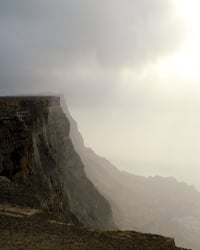 thin, with about one vehicle passing by every 3-4 minutes. Roadside shacks
serve tea and beverages, while some also sell petrol, hand-pumped out of
barrels, as there are no proper petrol stations on the way. About 100 km from
Zero Point, the road starts to run southwest along the base of a hill range
that eventually dips to the edge of the sea. For those not so lucky to manage
a night’s stay in a forces’ Mess at Ormara or beyond, the drive must end
at Hingol River crossing near Aghor (about three-and-half hours from Karachi)
so that a return journey can be completed before nightfall.
thin, with about one vehicle passing by every 3-4 minutes. Roadside shacks
serve tea and beverages, while some also sell petrol, hand-pumped out of
barrels, as there are no proper petrol stations on the way. About 100 km from
Zero Point, the road starts to run southwest along the base of a hill range
that eventually dips to the edge of the sea. For those not so lucky to manage
a night’s stay in a forces’ Mess at Ormara or beyond, the drive must end
at Hingol River crossing near Aghor (about three-and-half hours from Karachi)
so that a return journey can be completed before nightfall.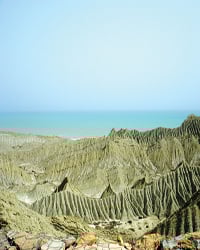 low on fuel so our immediate concern was to find a petrol station in the
town. As we drove through the town’s central street, we saw numerous shops
selling Iranian bootlegged petrol, besides the usual groceries and
vegetables. A shopkeeper’s assurance that it was top grade fuel prompted us
to get a refill; in the event, we did not have any engine issues on the
return leg. The drive through the town had nothing to show but pot-holed
streets and an unkempt look. Iranian-made motorbikes are the principal means
of transportation in the town.
low on fuel so our immediate concern was to find a petrol station in the
town. As we drove through the town’s central street, we saw numerous shops
selling Iranian bootlegged petrol, besides the usual groceries and
vegetables. A shopkeeper’s assurance that it was top grade fuel prompted us
to get a refill; in the event, we did not have any engine issues on the
return leg. The drive through the town had nothing to show but pot-holed
streets and an unkempt look. Iranian-made motorbikes are the principal means
of transportation in the town.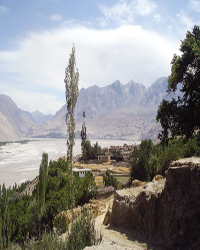 individuals, with a few exceptions, mostly unknown faces, waiting in the
departure lounge of Islamabad Airport hoping to fly to Skardu. Tourism
Promotion Services Serena (TPS) had invited tour operators, travel writers
and journalists to the opening of their new property, Khaplu Palace and
Residence.
individuals, with a few exceptions, mostly unknown faces, waiting in the
departure lounge of Islamabad Airport hoping to fly to Skardu. Tourism
Promotion Services Serena (TPS) had invited tour operators, travel writers
and journalists to the opening of their new property, Khaplu Palace and
Residence.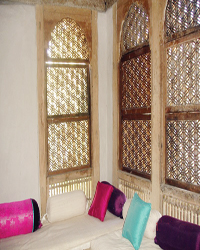 administrative headquarter of Baltistan, which is densely packed with some of
the world’s highest peaks and an enormous field of shifting glaciers. This
is where intrepid mountaineers study expedition maps — many of them
determined to conquer K-2. The airport is midway between Shangri-La Resort on
the right and Skardu town towards the left. On entering Skardu, we stopped at
Hotel Mashabrum for our non-fasting friends, before embarking on our 90
kilometre trail to the Khaplu valley. We crossed a suspension bridge over
River Indus and followed Shyok River upstream. We were now in the land of
hanging bridges, bamboo barriers, high mountains, deep valleys and gushing
winds. After three hours of a fascinating drive, we passed through the
meandering streets of Khaplu town to arrive at an imposing fort set against
the formidable wall of towering peaks. We were handed out pre-allotted room
keys in the reception area, which had been a stable during the time of the
Raja of Khaplu.
administrative headquarter of Baltistan, which is densely packed with some of
the world’s highest peaks and an enormous field of shifting glaciers. This
is where intrepid mountaineers study expedition maps — many of them
determined to conquer K-2. The airport is midway between Shangri-La Resort on
the right and Skardu town towards the left. On entering Skardu, we stopped at
Hotel Mashabrum for our non-fasting friends, before embarking on our 90
kilometre trail to the Khaplu valley. We crossed a suspension bridge over
River Indus and followed Shyok River upstream. We were now in the land of
hanging bridges, bamboo barriers, high mountains, deep valleys and gushing
winds. After three hours of a fascinating drive, we passed through the
meandering streets of Khaplu town to arrive at an imposing fort set against
the formidable wall of towering peaks. We were handed out pre-allotted room
keys in the reception area, which had been a stable during the time of the
Raja of Khaplu.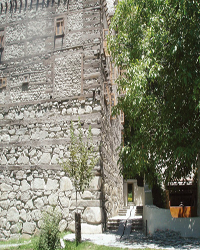 anger. A day earlier, a hill torrent had come down with full fury and washed
away houses, crops, orchards and cattle, turning the village into a mound of
mud. Luckily, there had been no human deaths. Apart from a tented settlement,
one did not see much outside help for these people. They were relying solely
on self-help and living with dignity.
anger. A day earlier, a hill torrent had come down with full fury and washed
away houses, crops, orchards and cattle, turning the village into a mound of
mud. Luckily, there had been no human deaths. Apart from a tented settlement,
one did not see much outside help for these people. They were relying solely
on self-help and living with dignity.