


|
|
|
|
 |
 |
  
|
tribute Seeking the
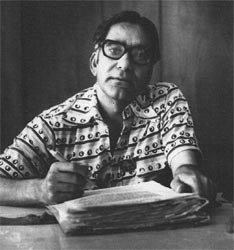
hidden Melody at 78 calamity tribute The unsung hero of PTV Kunwar Aftab was one of the brightest stars in the Golden Era of TV Drama By Arif Waqar It’s been a full year since Kunwar Aftab left this world, but Pakistan Television has yet to pay any tribute to one of its founding fathers. Kunwar was certainly one of the brightest stars in the sky of PTV in the Golden Era of TV Drama. In Karachi he produced the memorable plays based on Manto’s stories: Naya Qanoon, Mummy and Toba Tek Singh (which could not be aired due to political reasons). In Lahore he worked with the young and upcoming writers like Amjad Islam Amjad, Younus Javed, Asghar Nadeem Syed and Arif Waqar. These were the days when writers were learning about the requirements of this new medium, and they could not get a better teacher than Kunwar. Under his superb guidance, Amjad was able to write his early plays like Ya Naseeb Clinic and Khaab Jaagtay Hain. Younus Javed wrote his masterpiece Najaat, and Arif Waqar penned his first ever TV play Sonay ki Chirya. Few people remember today that the famous serials Shahzori and Waris were initially planned and discussed by Kunwar Aftab and later assigned to other producers. Born in a family of
agriculturists in East Punjab on July 28, 1929, Kunwar graduated from Gordon
College Rawalpindi and did his LLB from the Punjab University Law College.
Like most Zamindars, his father wanted him to be a famous lawyer, but when
Kunwar went to London for higher studies, instead of law he switched over to
his favourite subject, film making, by joining The London School of Film
Technique. He returned to Pakistan after four years and produced/directed his first film Jhalak. It was a different film altogether and an entirely innovative experiment 50 years ago. The cine-goers of that time however could not appreciate the idea of Taansen, the famous musician of the Mughal court, time-traveling to the 20th century Lahore. The fantasy was a flop at the box office, but taught Kunwar Aftab a lifelong lesson that film was a people’s medium and could not accommodate high flown intellectualism. One needs to be direct, simple and straightforward to capture the viewers’ imagination. He applied the same rule to the new medium of television when he joined PTV in the mid 1960’s. Throughout his life Kunwar Aftab remained a vociferous opponent of pseudo-intellectualism and fake experimentation. Terms like Symbolic, Suggestive, Undertone, and Subtle Nuance etc…made him furious. “Cut this nonsense, and come to the point” he would say. His association with drama was not through literature and poetry, but directly through visual arts. That is one reason why the literary elite associated with PTV was so unhappy with him. When Kunwar was the General Manager of PTV Karachi centre, many rumours and anecdotes about his inability to appreciate poetry were manufactured and spread on large scale by the neglected poets and writers. According to one such anecdote, one day Kunwar Aftab called the office accountant and reprimanded him for the late payment to the poets whose poems had been used in a music programme. The accountant was a bit surprised because he had already paid all the poets. Kunwar said,” these poets are a pain in the neck; you delay their payment for one day and they’ll call the Headquarters, or write a letter to editor, even bring out a protest rally from the Press Club…Please never delay their payments. “But sir, all the poets have been paid” said the accountant. “No. not all of them, look here” and he showed the accountant a blank space against one name. The accountant smiled and took back the register. He kept silent, out of respect, before the General Manager, but the moment he arrived back at his desk, he burst into laughter because the name Kunwar referred to, was that of Urdu’s famous classical poet Nazir Akbarabadi (1735-1830). When the story reached Kunwar Aftab, he enjoyed the joke and didn’t deny it. He might not know much about Urdu poets and their poetry but he knew a lot about his own job. He was very clear on what makes good television. He would often tell the new comers that good literature doesn’t mean good television. A short story can be an excellent piece of literature but not necessarily good stuff for a dominantly visual medium. The script section of PTV was supposed to contact famous literary figures of the country and convince them to write for the new medium but after much effort when the script editor was successful in eliciting their great ideas in a script form, Kunwar Aftab would just throw it away saying it was too literary. He demanded from the screen-writer a visual translation of all the literary expressions. He would often quote Charles Dickens in this context, who was born long before the film medium was introduced but his approach was so “visual” that most of his stuff could easily be transferred to film. However there are passages in Dickens which are purely non-visual and one should not try to translate them to visual terms. For example when Oliver Twist is born and the birth cry comes out of his tiny lungs, the writer says, “Oliver cried lustily. If he could have known that he was an orphan, left to the tender mercies of church-wardens and overseers, perhaps he would have cried louder.” Now this phrase is so difficult to be interpreted visually that even a maestro like David Lean did not try his hand on it. If you watch the 1948 production of Oliver Twist, you can see this direct quote from the novel written on the screen. Those who have worked with Kunwar will tell you how tough a taskmaster he was. He was a man of mercurial nature — on the run all the time — never rested for a moment himself, nor allowed a moment of peace to his colleagues. He could work for 18 hours at a stretch, which he did during the production of Nishan-e-Haider, which he had to shoot in real army trenches with real arms and ammunition. For Sonay ki Chirya he erected a huge set of Mall Road in the PTV studio Lahore, but when he inter-cut it with the real location, it did not match, so using his film experience, he came up with a novel idea of “fore-projection”—-a modification of back-projection — in which a screen was fixed in the background and the film image of Mall Road was projected on it. This was the first and the last time this technique was used in PTV. TV writer Hameed Kashmiri would proudly call himself a protégé of Kunwar Aftab. When he was writing the play Akhara (the Arena) Kunwar rejected his script four times. Hameed was so fed up that he refused to write a fifth draft. Kunwar took him to his house, spread a matt on the floor, donned a lungote (loin cloth) and thumping his thighs like a wrestler, jumped onto the matt, which was supposed to be an arena. Now he started delivering the dialogue that Hameed had written for the wrestler’s character. Hameed himself realised that the dialogue was unnatural and a wrestler wont speak like that in an arena. So he agreed to write a fifth draft, which finally became a landmark play both for the writer and the actor Munawar Saeed who was playing the Pehalwaan. From a realistic play like Rubi Kis ki Beti Hai to a burlesque like Abhi tuo mai Jawan Hun, he had covered the whole spectrum of the genre. He was equally good at documentary and music. He started the first Pop Show from Karachi, called Sunday kay Sunday and also produced the award-winning documentary on the football industry of Sialkot. This varied experience in different genres also enabled him to be the first Docu-Drama producer of PTV. He chose Munawar Saeed to do the role of Mohammad Ali Johar, in his play Azadi kay Mujrim. The entire drama was based on the documented record of the historic Johar case, obtained from the legal archives of the court. This tradition of Docu-Drama was furthered by Bakhtiyar Ahmed in Karachi, but like many other good traditions, PTV has forsaken this genre too. During the last years of Z.A.Bhutto’s government, a film project, Palestine my Love, was planned through an agreement with Chairman Yasser Arafat. Kunwar Aftab was the director of this feature film and some shooting was done in the deserts of Middle East, but with the fall of the Bhutto government, the project was shelved, the film company dissolved and its physical assets were distributed between the Arab group and PTV. What the Arabs got is still unknown, but PTV, besides other things, acquired a big wooden box full of make-up items like coloured wigs, beards, moustaches, and many types of exotic lotions and creams. The excited PTV employees were trying to read the text on the sealed bottles, cans and packets, but it was all in French. Out of sheer curiosity, Kunwar Aftab pressed the top of a can…and out came a puff of white mist. Kunwar sprayed the silvery stuff on the head of writer-actor Jamil Malik who happened to stand nearby. “Oh, you have suddenly changed into a character actor, Jameel” Kunwar said jokingly. The stuff in that can was actually “blond spray” and it had really changed Jameel into a serious looking grand old man. Kunwar’s prophetic words came true when a young PTV producer got a play specially written for Jameel Malik in that get-up. He played an old medical professor who falls in love with a young and attractive patient (Roohi Bano) in his teaching hospital. The play was called Ghar Banaya Chahiay, an excellent piece of writing, direction acting and make-up, but PTV has lost this memorable play like many other irreplaceable items, and most of its archival footage.
During the launch of his second book in Lahore, Mohammed Hanif said that although there are a lot of differences between A Case of Exploding Mangos and Our Lady of Alice Bhatti, but the two novels have much more common than what he expected or planned. An observation made by many writers about their books, to which Gabriel Garcia Marquez adds in his long interview (Fragrance of Guava) that an author writes only one book, each time in several variations. What Hanif meant was that a creative person has some obsessions, which keep on coming into his/her work, despite the apparent dissimilarity in his/her productions. It seems Waseem Ahmed is also fascinated by certain elements in his art (or life, if one can separate the two). Apparently it is the encounter with a naked body — of a woman, and the problem and perplexity of dealing with this unexpected (but desirable) scenario. A situation that is scarce in our art, and rare in real life, because in our society, we do not see naked or even half draped woman in the public sphere. A female without cloths is neither viewed in actual surroundings nor much in the works of art; so artists painting nude figures are obliged to restrict their works in private galleries, without much publicity or information. Perhaps the only area in our culture, where women can be portrayed as an entity made of flesh and bone and not negating their sexual aspect, is the field of film or the internet. Yet the immediate reaction of a person when confronted with a naked body is to hide it. Conceal the fact of that encounter, or in another sense deny the existence of the nakedness. Hence one can lie about the act of sighting a nude figure, or even if he admits, a person is hesitant in describing particular parts of the body, which are always referred not by their actual names, but by some other terms. Actually this custom of denoting body organs through other words, or words borrowed from another language (English for instance, which makes a certain part less explicit when mentioned in that tongue), is a means to deflect the presence of a reality that is there, and not acknowledged fully or easily. Actually all our discourse
and attitude towards the naked body and its organs is to cover it. Negating
its existence through putting a veil of words, behind which one can sense the
shape but can not see the contours. We try to put a chador on the body to
safely put it away — also from our lustful gazes, intentions and plans.
However every kind of cover fails to serve the purpose, because in a
paradoxical manner it reminds and reasserts the entity it was supposed to
make it disappear. Much like the earlier works of Waseem Ahmed, in which the
artist had picked famous female nudes from Western art history and painted
them under thin layers of transparent cloth, sometimes in the shape of a
burqa, which depicted the detail of their bodies in spite of a white layer of
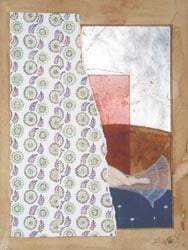
transparent gauze. That body of work was a comment upon the persisting pressure of the pardah on women in our environment and the efforts to subjugate them on the name of faith, convention and honour. Also it was an attempt in appropriation, since the figures from European art were incorporated in his miniature painting. Thus two traditions, which belonged to two different systems of thoughts and cultures merged in his miniature paintings. In a way those works were in continuation of diverse phenomena in which West has been adapted, assimilated, modified and indigenized in our circumstances. Ahmed is trying to extend his theme, through another layer of concealment. In his new works, to be shown from Sept 20th to 29th 2011 at Canvas Gallery Karachi, the artist has introduced the motif of a wrapping paper in/on his miniature. Reverting back to his earlier scheme of image making, of nudes from Western art history draped in transparent robes, now these are further covered by patches of paper. A paper that is so well painted on the surface of miniature, that it gives the illusion of a glued sheet. The effect of a pasted paper is enhanced with the composition in which specific parts are exposed “beneath” the patterned section of the miniature. Probably this addition of designed paper on an already recognisable and resolved image is an attempt to turn everything into traditional, thus acceptable. But this is just one reading, because in reality the work is about the truth of painting, which is not a window in space, nor it is a baggage of great ideas; it is an exercise concerning the flatness of the pictorial space/material. An understanding that is supported by some works in which famous paintings, like Luncheon on the Grass of Edouard Manet and La Baigneuse and La Grande Odalisque by Ingres are painted partially, with frame/border in which same visual continues but in outlines, much like the siah qalam drawing of traditional miniature. So on the surface the new works of Waseem Ahmed may not look much different from his earlier pieces, but in terms of his concerns these indicate a different direction. The question is can Ahmed pursue that direction purposefully and persistently, without following the trodden and much tried path?
Melody
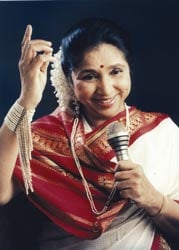
at 78 Asha Bhosle celebrated her seventy eighth birthday last week. Her singing career has spread over seven decades and blissfully she retains the energy and the strength to continue singing till now with the same verve that she introduced to film music many decades ago. Her elder sister Lata Mangeshkar can no longer sing with the facility that made her the leading voice of film music for about five decades after independence. And she has more or less retired, only basking in the ample glory of laurels. But Asha Bhosle is still singing and the physical abilities have not let her down, contrary to the fate of many musicians/ vocalists. Ghulam Ali Khan struggled with his illness for about eight years and Salamat Ali Khan no longer remained the same vocalist after he was stuck down by illness. Mehdi Hasan has not recovered from his stroke for more than ten years now and Abida Parveen is making tentative attempts to stage a comeback after her heart attack last year, but some vocalists are fortunate that their physical strength sees them last longer. It is partially a case of looking after yourself but not entirely so. Many a vocalists have been stricken by bad health while they have been very particular about their health and diet while many others, more reckless have survived to retain their voice and energy till late in life. Asha Bhosle should consider
herself lucky as well but she was unlucky in the sense that she always landed
up being compared to her elder sister Lata Mangeshkar. This tendency to
compare is probably the fate of hereditary musicians. If the comparison is
not with a brother or sister it is with the father or mother and if not them
then it is their cousins and other members of the clan. This comparison is
what drives these vocalists and musicians to edge forward in creating their
individual niche while staying connected to the umbilical chord of their
inherited knowledge. But this Mangeshkar clan is unique having produced two of the top female vocalists with two more vocalists and a composer. The standard undoubtedly held very high by the two elder sisters. for Lata Mangeshkar swept everything in front of her, Asha Bhosle struggled to create an expression that was different to the generic brand which Noor Jehan and later Lata Mangeshkar monopolised and packaged as their very own. And obviously the changing trend offered her the openings than merely singing for characters who were vamps swinging in clubs and bars and playing female sidekicks to villains. There as definitely more body in the sound quality of Asha Bhosle than her sister but the total transparency of voice which Lata carried made her the favourite with composers. The transparency was a quality that went perfect with the needs of a film song meant to be picturised on various heroines. Lata built on her natural transparency to suit the image of the heroin on screen. A negative quality it served film music well. The individual expression of voice proved to be a disqualification for Asha Bhosle and she had to wait decades before being accepted as a truly front rank vocalist. Initially she had to feed on the leftovers of her sister. If a composer was annoyed with Lata he made an overture towards Asha Bhosle, if a composer was rejected by Lata Mangeshkar as a second choice the song was offered to her. If Lata Mangeshkar was not on good terms with a co vocalist Asha was offered to sing duets. It was rare that a composer picked her for the uniqueness of her voice quality and an intonation that was different from the much stylised one of our music. Born in 1933, Bhosle started to sing in 1943, the first number being Chala Chala Nav Bala for the Marathi movie Majha Bal. The music for the film was composed by Datta Dawjekar. She made her Hindi film debut when she sang the song Saawan Aaya for Hansraj Behl in Chunariya (1948).Her first solo Hindi film song was for the movie Raat Ki Raani (1949). In Sangdi (1952), the compositions of Sajjad Hussain, got reasonable recognition. Bimal Roy gave her a chance to sing in Parineeta (1953),Raj Kapoor signed her for Nanhe Munne Bachche withMuhammed Rafi inBoot Polish (1954), which gained popularity. O.P Nayyar gave Asha a break in C I D.(1956) and she first achieved success in Naya Daur (1957) singing his compositions, duets with Rafi likeMaang ke saath tumhara,Saathi haath badhana andUden jab jab zulfein teri, penned by Sahir Ludhianivi It was the first time that she had got to sing all the songs for the lead actress and sang also for Waq, Gumraah, Humraaz, Aadmi Aur Insaan and Dhund. Nayyar's collaboration with Bhosle produced many hits as it lasted till the 1970s. She established herself and received patronage of composers such as S.D. Burman andRavi.and in 1966, Asha's performance in the duets from music director. R.D. Burman's Teesri Manzil won popular acclaim. Aaja Aaja and other songs of the film,O Haseena Zulfonwa and O Mere Sona Re, duets with Rafi, became rage of the day. Asha's collaboration with R D Burman resulted in numerous hits. In 1960s and 1970s, she became the voice of Bollywood's dancer Helen and voiced hits for her like Piya Tu Ab To Aaja O Haseena Zulfon Wali and Yeh Mera Dil.. By the 1980s, Asha Bhosle had been stereotyped as a "cabaret singer" and a "pop crooner". In Umrao Jan, she proved her versatility by singing ghazals like Dil cheez kya ha,i In aankhon ki masti ke, Ye kya jagah hai doston and Justju jiski thi. The ghazals won her the first National Award of her career. A few years later, she won another National Award for the song Mera Kuchh Saamaan for Ijazaat (1987). In 1995, the 62-year-old sung for Urmila Matondkar in the movie Rangeela. Numbers like Tanha Tanha and Rangeela Rer, and composed by A.R. Rehman, who went on to record many more songs with her. She has done playback singing for over 1000 Bollywood movies and recorded many private albums and participated in numerous concerts in India and abroad. Renowned for her voice range and often credited for her versatility, Bhosle's work includes film music, pop, ghazals, traditional, Indian Classical music, folk ,qawwali Rabindro Sageet, Nazrul Geeti. She has sung in Hindi Urdu, Telugu, Marathi, Gujrati, Punjabi, Tamil, Kannada, English, Russian Czech, Nepali, Assmes, Malay, Sinhala and Malyalam. Asha Bhosle stated that she had sung over 12,000 songs, a figure repeated by several other sources. The World Records Academy, an international organisation which certifies world records, recognised her as the "Most Recorded Artist" in the world. In September 2009, India honoured her with theDadabhai Saheb Phalke Awardin 2000 and the Padma Vibhushan in 2008.. Her non film numbers and collaboration with foreign artists too is truly amazing.
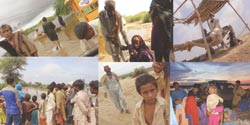
calamity All 23 districts of Sindh have been severely hit by devastating monsoon rains, which not only created floods in many districts, but caused heavy losses of human lives, properties, livestock heads and standing crops. The agriculturally-rich districts have been ruined by rains resulting in destruction of the standing crops of cotton, chilies, paddies and vegetables, displacement of estimated 10 million people and loss of livestock and public infrastructure. Despite the insufficient government response to this human crisis, civil society organisations and local volunteers are striving hard to address the problems of the people. But with limited resources, the NGOs or individual philanthropy cannot play an effective role. “The government even
discouraged the local NGOs initially and government officers were not serious
to do relief work,” said Ms. Naubahar a social worker with Pakistan
Institute of Labour Education and Research (PILER). She said the health
situation in the affected areas is very dangerous and Malaria, skin diseases
and diarrhoea are rampant and no government healthcare facilities are
available for the affected people. The main demand of the affected people is
not food or medicine, but tents because their houses have been destroyed and
they area under the open sky. It was only on September 8, when the President Asif Ali Zardari made an appeal to the United Nations, when he visited his hometown Nawabshah (district Benazirabad), which has also been badly affected by the rains. NGOs and civil society organisations had been demanding the government to make a formal appeal to the United Nations, so that international NGOs could start their relief work. Thus it took a month for the federal government to decide whether it should make an appeal or not. “The workers of the ruling political parties even snatched the relief goods from NGOs,”said Hussain Jarwar, Coordinator of the newly formed network of the NGOs, Sindh Peoples Commission on Disaster Prevention and Management. He said at the Mahshwari relief camp near Kario Ghanwar town the workers of the political parties snatched raw food packets, which were being distributed among Hindu peasants. Discrimination in the relief distribution on the basis of religion is quite rampant but unfortunately majority of affected population belong to low caste Hindus, who are working as farmers on the agriculture lands. “Even the affected people of opposition political parties are denied government relief,” said Ms. Naubahar. The heavy rains, which first hit lower Sindh districts of Badin, Umarkot, Mirupurkhas and Tharparkar on August 10 caused substantial destruction of the crops and katcha or mud houses. Thousands of affected people had to take shelter in government schools or other safer places because all katcha houses were destroyed and vest-deep water was standing in their villages. Majority of them moved to raised places, banks of canals and rail and roads sides, near to their villages. They were not allowed to come in the school camps, because they possessed livestock. But the subsequent rains inundated that area also so they are moving from one place to another. Women and children are the most vulnerable groups of the affected population, which are under threat of malnutrition and diseases. According to a week-old
report of the Provincial Disaster Management Authority (PDMA) over 31
children and 79 women were among the dead. Healthcare conditions in the
flooded areas are very serious, where malaria is rampant due to mosquitoes
and there is fear of spread of Dengue virus. The consecutive heavy spells of the monsoon rains continued till September 14 in almost all districts. Khairpur, Sanghar, Benzirabad, Dadu, Jamshoro, Tando Mohammad Khan and Tando Allahyar were affected by the latter rains, where standing cash crop of cotton has completely been washed way. Even major cities like Karachi, Hyderabad, Mirpurkhas and Sanghar were also inundated due to heavy rains, where knee-deep water is still standing in the streets. Sindh was still trying hard to recover recovered from the destruction of 2010 floods, which mainly hit the Indus River’s right bank districts due to breach in Tori dyke and subsequent breaches in other embankments, the damages of this year’s rains and floods are much more than the previous year. Experts believe the economic and infrastructure losses are four times more than the previous floods. According to rough estimates, the cotton grown on about 200,000 acres of land in these affected districts was completely destroyed by rains, which would reduce the share of Sindh in Pakistan’s yearly production by at least 2 million bales of cotton. Target for the country’s cotton production for the year 2011-12 was 15 million bales and traders and economists believe it is now difficult to achieve this target. Similarly, other crops like chillies and onion have also been destroyed. Kunri in Umarkot district is Asia’s largest red-chillies market, from where chillies are also exported, but the heavy rains and floods coming from saline water canals have destroyed the chilly crop in Umarkot and Mirupurkhas districts. Dadu, Jamshoro and Thatta were hit hard by the previous year’s floods and these districts were again lashed by torrential rains of this year, multiplying the losses and miseries of the people. “The losses of rains are much more than the last year’s floods as millions of people have become homeless and their economy has been ruined,” said Ishaq Mangrio a senior journalist of Hyderabad.” Talking to, Mangrio said a large number of livestock heads has died or facing starvation due to non-availability of fodder in the area. “Just go outside in Badin city’s cattle market, you can see hundreds of people are selling their animals in despair at throw away prices. A buffalo, which normally sells at Rs 100,000 or even more is being sold at Rs 20,000 or Rs 25,000 just because the animal’s health condition has deteriorated because the owner cannot afford to feed it. The profiteers are exploiting the situation and purchasing the animals at discounted rates from the needy owners,” Mangrio added. “Milk price in Badin has
increased from Rs 40 per litre to Rs 80 per litre, which is also not easily
available,” said Sarfraz Ahmed, a local activist of an NGO in Badin. The rains have endangered the ecology and environment of the area, which cannot be repaired so early. The farmers would also not be able to sow next season’s crop because it would take many months to drain out the standing water. No system of draining rain water exists in these areas. The natural passages of old rainy rivers like Paran and Hakro have been encroached upon by influential landlords. Safe drinking water is scarce in the rain/flood affected areas and public health departments’ water filter facilities have come under rain and flood waters. Thus no piped water is available even major cities like Badin. The saline water canal Left Bank Outfall Drain (LBOD), which carries saline and municipal waste water from upper Sindh districts has actually created havoc in Mirpurkhas, Umarkot and Badin districts and breaches in both banks of this canal have further deteriorated the situation. Located at the coastal area of Arabian Sea, Badin receives all the drainage water not only from LBOD but from other similar saline water disposal canals coming from upper areas and in the past the district had suffered floods caused by cyclones and high tides. This year also due to high tide the water from LBOD flew in reverse order, which further inundating vast area of land and destroyed crops and homes. Mithi, the district headquarter of Tharparkar districts received the largest quantity of rains this year, which caused disconnection of road network and many areas of Thar desert are still disconnected from other towns. A large number of flood affected people have moved to Hyderabad, where the district administration has set up a temporary relief camp at Sabzi Mandi (fruits and vegetable market), where last year over 20,000 internally displaced persons (IDPs) were kept for many months. The condition of IPDs in this relief camp is also very serious, where people do not receive any government support. |
|