



|
|
|
|
 |
 |
|
comment comment The dream of
reality I
wish she hadn’t done it
comment Caught in Haqqani Net Rather than conceding their own shortcomings, Americans are looking for excuses and scapegoats, and there could be no better scapegoat than Pakistan By Rahimullah Yusufzai Such is the US obsession
with the so-called Haqqani Network that American officials told the media
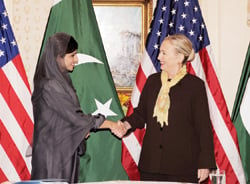
after a recent three and a half hours meeting in New York, between Secretary
of State Hillary Clinton and Pakistan’s Foreign Minister Hina Rabbani Khar,
that Clinton began and ended the session by talking about the Haqqanis and
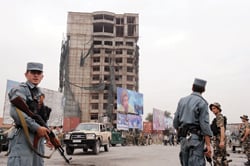
highlighting the threat that they pose to both America and Pakistan. This obsession isn’t new, but it seems to have grown in recent weeks, more so after the successive sophisticated Taliban attacks directed at the US embassy, the Nato headquarters and other important targets in Kabul. As if on cue and under a well-thought out strategy, US officials from the spectrum of the civil and military establishment are speaking in unison about the need for Pakistan to end its ties with the Haqqani Network and go after its sanctuaries in North Waziristan. Suddenly, everyone from Clinton to Admiral Mike Mullen, the outgoing Chairman of Joint Chiefs of Staff, and from new Defence Secretary Leon Panetta to the CIA chief General (Retd) David Petraeus is talking about the Haqqanis and often using unusually blunt language to put pressure on Pakistan to take action against the network. The US ambassador to Pakistan Cameron Munter also got into the act and accused Pakistan of having links to the Haqqanis. So did the US ambassador to Afghanistan Ryan Crocker and everyone else dealing with the AfPak region. It was obvious that the daring Taliban attacks in the centre of Kabul despite the strong presence of US-led Nato forces and stepped-up security organised by the Afghan national army and police had not only embarrassed but also angered the Americans. Rather than conceding their own shortcomings, they began looking for excuses and scapegoats. There could be no better scapegoat than Pakistan, with which the US had developed disagreements in recent months, and the easiest way to pin blame on it was to link the Haqqani Network to the four spectacular attacks in Kabul since June this year. The US tactics appeared to have succeeded as the focus shifted from the inability of the foreign and Afghan forces to defend Kabul against Taliban attacks to Pakistan and the Haqqani Network. Unlike the past, the
Haqqanis didn’t take credit for any of these attacks in Kabul. Perhaps they
weren’t involved or had realised that making claims of responsibility for
the attacks, particularly the ones targeting the US embassy and Nato
headquarters, would have consequences. Besides, the central Afghan Taliban
leadership doesn’t want different Taliban groups such as the Haqqanis to
independently make such claims. The Taliban want to be seen as a united
organisation run by the Mulla Muhammad Omar-led shura in which the Haqqani
Network is represented by Sirajuddin Haqqani, a young man in his early 30s
who has replaced his elderly and seriously ill father Maulvi Jalaluddin
Haqqani as the leader of the group. As if to reinforce this point, Sirajuddin
Haqqani even gave a rare interview recently to reiterate his group’s
loyalty to the Taliban movement and Mulla Omar and make it clear that the
Haqqanis would not do any deal or join the Afghan peace process separately. However, the consequences that the Haqqanis appear to have foreseen are already beginning to take shape. The US military authorities are now publicly hurling threats of acting unilaterally to target the Haqqani Network in Pakistan if Islamabad doesn’t do the needful. The US has already undertaken unilateral military action in Pakistan on quite a few occasions by sending their gunship helicopters and Special Forces to South Waziristan and North Waziristan in a bid to take out militants and more famously to Abbottabad on May 2 this year to kill Osama bin Laden. Pakistan’s displeasure and protests haven’t stood in the way of the US in the past and won’t make any difference in the future. It won’t be a big deal if
the US undertook more such military missions and specifically targeted the
Haqqanis as Pakistan is unlikely to confront the American commandoes despite
publicly warning that it won’t tolerate such incursions and “boots on the
ground” again. However, any such US raid in North Waziristan or in other
tribal areas of Pakistan is unlikely to achieve much because there aren’t
any clearly identifiable Haqqani Network targets that could be attacked
except the family’s compound in Danday Darpakhel village near Miranshah
where mostly women and children have been living for years. Moreover, the
Haqqani commanders and fighters are unlikely to stay put in North Waziristan
and offer an easy target to the US military. In fact, there have been reports
that Haqqani fighters who may have been in North Waziristan have already
relocated to Afghanistan and certain other tribal and other areas in
Pakistan. Another option for the US would be to further increase its drone strikes in North Waziristan against the Haqqanis or Afghan and Pakistani militants aligned to them. In a way, this option has already been exercised as the missiles attacks by the CIA-operated Unmanned Aerial Vehicles (UAVs) in Pakistan’s tribal areas have already registered a big increase since President Barack Obama’s election. More such strikes would mean the death of a greater number of ordinary militants and also civilians instead of commanders and fighters on the wanted list. In turn the rise in civilian casualties would have political fallout and lead to even more strained relations with Pakistan and further radicalisation of the Pakistani tribesmen and increase in anti-US sentiment. In past drone strikes in North Waziristan, the US managed to kill Mohammad Haqqani, the teenaged son of Maulvi Jalaluddin Haqqani in 2010 and an unspecified number of Afghans aligned with the Haqqanis. Another of his son, Omar Haqqani, who was in his 20s, was killed in 2009 fighting Nato and Afghan forces in the family’s native Khost province in Afghanistan. In two other drone attacks on the Haqqanis’ village Danday Darpakhel in North Waziristan, the elder Haqqani’s sister and some other relations including women and children were also killed. It also needs to be mentioned that at least twice in the past the Haqqanis’ living quarters, mosque and madrassa in North Waziristan were searched in joint raids conducted by Pakistani and US soldiers without achieving anything. Any future raid on the village by the US forces would most likely yield similar result. There have been other
consequences also, primarily for Pakistan. A US Senate committee while
approving $1 billion in aid to support counter-insurgency operations by
Pakistan’s military voted to make this and any economic aid conditional to It seems the US may not gain much in terms of taking unilateral military action against the Haqqanis in North Waziristan or putting pressure on Pakistan to take action against the group. The US hasn’t achieved anything significant by employing the military option against the mainstream Taliban or the Haqqanis in Afghanistan during the past 10 years and has been forced by circumstances to consider dialogue and political settlement with its foes. That is what Pakistan has been proposing to the US by offering to bring the Taliban to the negotiation table. However, it seems Pakistan’s offer has few takers at this stage and instead it is being asked by the US to sever its links to the Taliban, particularly to the Haqqanis, and assist in diminishing their strength. It is obvious that Pakistan’s relations with the US would be the biggest casualty if it refused to fulfil the American demand.
The advance in technology has reduced the differences and distinctions in music between those — who create music and those involved with its production. The recording technology and the post-production processes has made those who actually sit on the computer, manipulate, add, delete, play around with volumes and frequencies, control distortions, as the real arbiters of music rather than those who actually are involved in its playing and singing. But now it appears that the next wave of breakthroughs in technology is being done with more sensitivity to the particularities of music. As it is the variations in musical expression across the globe are so peculiar and diverse that to lay it hostage to one level of technological breakthroughs is like accepting the end of invention and innovation. In Pakistan many of the
musical forms have been dying or are dead and many of the traditional
instruments too are extinct or their players have passed away. This process
in our country was hastened as no safeguards were provided to preserve these
forms and instruments. But even in countries where this was done the process
of computerised music has put everything on its head. The issue is larger
than mere promotion and preservation. It has to be addressed in the context
of a technological breakthrough, which is not at the expense of wiping the
peculiarities of culture and rich diversity but which should be employed in
the service of higher artistic values. The instrument has been the vehicle of human artistic expression. It has been inconceivable to separate the bansuri from Hari Prasad Chaurasiya, sitar from Vilayat Khan, tabla from Shaukat Hussain and Shahnai from Bismillah Khan. Now all kinds of instruments can be played on the computerised keyboard. The link between the man and his musical instrument has been severed as well. Some of the leading scientists have been working with the musicians in the more advanced countries to end the boring similarity of sound and seemingly mere mechanical production that appears to be lifeless. Bjork, the Icelandic singer has not shied away from exploring musical innovations and one such innovation has been the Gravity Harps. Invented by Andy Cavatorta, a graduate of the MIT, it does not make sound effects but is more like an instrument in the sense that it has a more expressive range. Cavatorta was initially captivated by the inability to play the same note with exactness in a string instrument twice and has always compared an instrument’s expression to that of the human voice, which has emotional dimensions that defies reduction to just pitch, volume and timbre. It is a view shared by Dr Lippold Haken, designer of the Continuum Fingerboard, a keyboard that gives the player the continuous expressive control in three dimensions — pitch, volume and modulation. His aim is to create an instrument that isn’t instantly playable but requires practice to let the player’s fingers shape the details of the sound. In the past three decades digital technology has had profound effect on instruments and what musicians expect of them. Analogue synthesizers have largely been superceded by computers and controllers that use MIDI (musical instrument digital interface) to send digital messages about various parameters to the amplifiers. The Continuum represents something of a compromise between the MIDI sequencing and expressive playing. Magnetic censors register finger pressure, allowing for subtle vibrato techniques and other internal sounds that are then converted into MIDI data. Other digital innovations have resulted in equally exotic instruments. Using small blocks or pucks controls another device designed by a research team at the Barcelona Pompeu Fabra University, Reactable. Once placed on the instruments surface, the pucks, each representing a function such as an effect, sample or beat — interact to generate seemingly endless musical possibilities. The Reactable looks at first sight like the control panel of an alien spaceship with its translucent luminous surface and hieroglyphic blocks but is instead a highly intuitive variation on the analogue synthesizer. Ken Moore, a goggle designer is in the process of inventing motion sensing equipment to create an instrument capable of creating sound by mapping a player’s movement. The march of technology is unstoppable and it should not be questioned either. What is crucial is the use that we can put technology to, though it may be conceded that the advance in technology does bring in a certain sameness from which it is very difficult to breakout of. This sameness is not restricted to music only but is being experienced in architecture, (all modern cities look alike irrespective of where they are) in design and in languages. A large number of languages becoming obsolete are being replaced by the language, which is primarily used in the computer — English. Hundreds of different languages are on the verge of extinction because these cannot become part of the contemporary world of economic and social transactions. Now software can compose music and design buildings according to the broad guidelines that are fed. The great compositions have in music come about not through idiosyncratic technologies but through musicians working with culturally embedded instruments. It is not yet clear whether digital technologies will produce an instrument around which musicians coalesce and innovate or they will remain the preserve of the computer geek. Perhaps this fear is unjustified if one looks at the cohabitation of humans with galloping technological inventions. The first real alarm was raised by the Romantics who foresaw the enslavement of the humans by their machines but the equation between the mind and its product, that is technology, has not remained static but has been propelled by its dynamic character. The happy turn of events in the latest batch of innovations is that the particularities of music and culture are being recognised and placed at the disposal of humans once again.
The
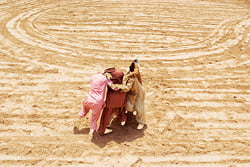
dream of reality Jean Paul Sartre writing on the war denotes an interesting aspect about the reality of photography. According to him, we always believe that camera records the real world, but in fact it shows only one — select — part of it. This part often ignores the larger meaning. Sartre comments on the picture of a German soldier from the occupying forces in Paris. This man was photographed standing in front of an old book stall at the river Seine, leafing through old books and magazines. In the picture he was shown alone, immersed in the world of books but, Sartre explains, the soldier was not alone; he must have been surrounded by a number of Parisians who may have all sorts of expressions and reactions to his presence, which the camera failed to represent. So what we see is a partial and cropped reality. , which can be a contradictory state/statement. Basir Mahmood’s work also focuses on that aspect of reality which is hidden yet has its effect upon what is viewed through the lens or the eyes of an image maker. In his three channel video installation ‘I won’t Leave you till I Die’ (the line which also serves as the title of his second solo exhibition at Grey Noise, being held from Sept 17-Oct 22, 2011), what is absent assumes more importance than what is present. What we see on each small screen is the image of single man engaged in an incomprehensible struggle. But only when combined, mentally, these characters seem engaged in a combat with each other. So one witnesses a movement of hands, arms and limbs; initially all appear concocted but, once connected, the narrative starts to unfold. In every video screen, a different person is moving, twisting, bending and stretching but instead of an opponent, it is just white space which surrounds him that he is fighting against. On the surface, the video
represents a simple story about three men caught in a fight. But Basir has
elevated an ordinary incident on the street by splitting the usual view into
three independent visuals. Thus the empty space that engulfs the man, who is
constantly in a battle with nothingness, acquires multiple meanings. It
represents an enemy who is invisible (perhaps alluding to the current state
of our society, which is at war with an opponent who is unseen — and would
like to be so, on religious grounds!). Apart from its political connotation,
the work invokes a personal element too. It suggests that any struggle with
outside is, in fact, an internal conflict, compelling a person to deal with
his private demons that are only perceived by him alone, and cannot be
accessed by another individual, no matter how close he or she is. The
psychological battle with his imaginary enemies is just like having dreams,
which nobody else can know unless told; and the told version cannot replace
the dream experienced by the person in the first place. Hence Basir’s video
offers a range of readings that relate to the present situation as well as to
the permanent state of being. What he achieves through minimal means and apparently less effort probably conveys more than what the artist has intended. But this is the story of art — that it usually communicates concepts beyond its creator’s control, initial desire and original plans. A work of art usually assumes its own character and sometime fails to signify what the maker has aimed for. May be it is this independent and untamed nature of art or of art making that engages people, who are not satisfied by what they have produced just a few hours before, or fifty years ago. An example of this phenomenon can be found in a number of his other works from the recent exhibition. For instance in appliqué works, called The Goat and Islamic Icon, Mahmood tries a different technique in present day art, yet the works do not suggest more than the experiment with a new method, which is not only domesticated through the choice of imagery (at least in one panel, the skinned animal) but also by dabbing the whole surface in white, a colour that does not belong to traditional chromatic order used to create these pieces of craft. His other works, the digital print dealing with different stages of water, from cloud to rain droplets (in Sky was Blue and Cloudless) to, Fruit for All Land Belongs to no one, in which the image of men on a barren land, with some parts of human being missing, seem like exercises in ideas that may have fascinated the artist (who graduated in 2010 from Beaconhouse National University), but the initial infatuation with the imagery or concept do not filter through works, at least not to a usual visitor. In another body of work, again a triptych ‘We’ve been Ruled by Many’, the artist’s intended theme as well as the meaning of an art work, independently, seem to be reaching to a comfortable level. Here three figures are photographed sleeping, but the artist has introduced a different setting at the background of each man. Vast spaces with clouds high in the sky, canals, greenery and snow capped mountains, arguably attract the viewer, since he in an instant finds out the unrealistic relationship between the two components of the work. The models are sleeping on bed sheets (which the artist has transformed into lavish and touristy scenery) printed with the views of classic beauty attached to nature, so in that sense he has indicated the two layers of dream, overlapped in the work. The inner body of dream within the head of the person sleeping, while the bed sheet revealing the archetypical beautiful scenes, signifies the collective dream/desire that we associate with an ideal landscape — of mountain, meadows, trees, snow and clear water. Perhaps in this work along with ‘I won’t Leave you Till I Die’ the artist has managed to deal with issues through an ordinary vocabulary, which is simple but still elegant, whereas in other works on display, the simplicity soon turns into banal — a trait that one hopes does not turn into a temperament.
Dear All, About a decade ago the
columnist Allison Pearson wrote a novel called ‘I Don’t Know How She Does
It’ about a working This has now been made into a film by Sarah Jessica Parker who has turned a funny, touching, socially relevant book into a lightweight ‘chick flick’. I have to say the film, which I believe does little good either to the cause of working mothers or good moviemaking, sorely disappointed me. Since the story has been taken out of its British context and been transposed into an American setting (Boston), some kitschiness was to be expected, but I didn’t really think it would be turned into a cross between such TV shows as ‘Sex and The City’ and ‘Diary of a Wimpy Kid’.... SJP is pretty nauseating as
the gutsy perpetually exhausted character Kate Reddy, her performance consist
mainly earnest Despite having a good cast (Greg Kinnear, Kelsey Grammar, Pierce Brosnan), this film is as flat as a mediocre TV show. So much so that I suspect that is precisely what Sarah Jessica Parker has tried to do: make this film to launch a new sitcom on American TV. Oddly enough several women in the British press have written quite favourably about the film and I suspect that it is largely because it brings the whole issue of the work-life balance into the limelight. Too bad that it had to go through this dreadful film which is so very flat and which extols the inexpressible joys of motherhood in a saccharine manner rather than focussing on the bittersweet comedy that being a working mother mostly is. My advice: just read the book
Umber
Khairi |
|

 Islamabad’s willingness to cooperate with Washington in fighting militant
groups including the Haqqanis. It remains to be seen if this would strengthen
US hands to persuade Pakistan to do Washington’s bidding. A number of
American analysts have been complaining that the US doesn’t have enough
leverage with Pakistan despite allocating about $20 billion as military and
economic aid for Pakistan over the last decade. It is being argued that US
aid could become crucial for Pakistan next year following its decision not to
seek a new International Monetary Fund (IMF) loan after having received the
$11 billion that it negotiated in 2008 to boost its struggling economy.
Islamabad’s willingness to cooperate with Washington in fighting militant
groups including the Haqqanis. It remains to be seen if this would strengthen
US hands to persuade Pakistan to do Washington’s bidding. A number of
American analysts have been complaining that the US doesn’t have enough
leverage with Pakistan despite allocating about $20 billion as military and
economic aid for Pakistan over the last decade. It is being argued that US
aid could become crucial for Pakistan next year following its decision not to
seek a new International Monetary Fund (IMF) loan after having received the
$11 billion that it negotiated in 2008 to boost its struggling economy.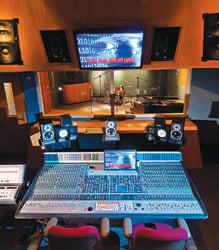
 mother trying to manage a career while at the same time managing a husband,
two children and a household administration — all in the face of negative
attitudes towards working mothers in both society and the workplace.
mother trying to manage a career while at the same time managing a husband,
two children and a household administration — all in the face of negative
attitudes towards working mothers in both society and the workplace. promises and cutesy little-girl mannerisms. Yuk. She really took all the
feistiness out of our Kate.
promises and cutesy little-girl mannerisms. Yuk. She really took all the
feistiness out of our Kate.