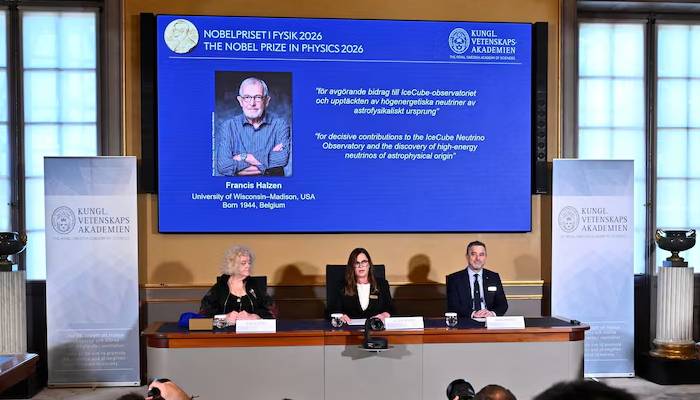
Francis Halzen won the Nobel Prize in physics for his contributions to the IceCube Neutrino Observatory and his discovery of high-energy neutrinos of astrophysical origin.
According to Reuters, the Belgian-American won the 2026 Nobel Prize in Physics on Tuesday, October 6, for his work creating an Antarctic observatory of ice to detect high-energy neutrinos.
The 82-year-old realised that pristine ice at the South Pole could be used to track such neutrinos, sometimes known as "ghost particles" for the way they pass through the Earth without a trace, only interacting with matter extremely rarely.
Eva Olsson, of the Royal Swedish Academy of Sciences, told a press conference, “The messengers bring information from the cosmos. They open the door to distant galaxies and tell us about the processes of exploding stars."
How Francis Halzen's hunt for ghost particles?
Halzen led work on the IceCube neutrino observatory, which made the first detection of high-energy extraterrestrial neutrinos in 2013, soon after it was switched on, The Guardian reported.
To build the observatory, scientists, technicians and engineers embedded thousands of basketball-sized light detectors into a cubic kilometre of ice to detect faint flashes of light that can result when neutrinos from space crash into atomic nuclei.
What are Neutrinos?
Neutrinos are mysterious particles that are as elusive as they are ubiquitous. They pass through almost everything they encounter, from people to planets.
Every second, billions of neutrinos from the sun pass unnoticed through the body. But every now and then, a neutrino will interact with the nucleus of an atom in a collision that can be picked up by a sensitive detector.
Halzen realised that brief flickers of light from neutrino collisions could be detected in clear, glacial ice and in 1988 put forward a plan to convert a chunk of the south pole into a neutrino observatory.
The detector uses Earth to shield against the background noise of cosmic rays, and has downwards-facing light sensors to detect neutrinos passing through the planet from the northern hemisphere.
Apart from a hostile environment for the team, the site benefited from being far from sources of interference and the risk of vibrations from earthquakes.
After the first detection of high-energy extraterrestrial neutrinos in 2013, scientists working on IceCube identified the first cosmic source of neutrinos 3.7bn years away.
The observatory has paved the way for a new kind of astronomy. Until now, researchers have learned about the cosmos from light, other electromagnetic radiation, and gravitational waves. Neutrinos are considered messengers from the cosmos and provide fresh clues as to how the universe evolved.
Halzen, who received the news while travelling in Italy, said he was working on a new proposal and hoped that winning the prize would help in getting it approved.