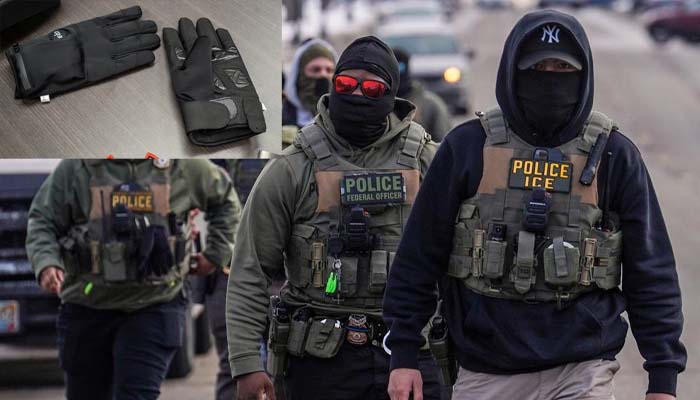
US President Donald Trump administration is planning to spend tens of millions of dollars to equip federal immigration agents with gloves capable of delivering electric shocks.
According to Al Jazeera, in a notice posted earlier this week, the Department of Homeland Security has estimated it will invest between $10m and $20m in such gloves by the end of March 2027.
The devices are known as the CT-G5 G.L.O.V.E., an acronym that stands for “Generate Low Output Voltage Emitter," currently used by some jails and police departments.
Their manufacturer, Compliant Technologies, says the gloves are used to “quickly distract with small uncomfortable electrical pulses” when applied to a person’s skin. The Department of Homeland Security indicated they would be used for “distraction and de-escalation.”
The Department of Homeland Security, ICE’s parent agency, stated, “ICE is constantly assessing the needs of our officers in the field to ensure they have the tools and equipment necessary to safely arrest and remove criminal illegal aliens from our country.”
“Every decision is made with careful consideration and appropriately reviewed to ensure that any technology ICE utilizes is consistent with all applicable law enforcement policies and standards,” it added.
A user manual states the gloves can deliver a maximum of 380 volts, which “inhibits/distracts the subject from performing coordinated muscle movement.”
Electric shock gloves for ICE spark concerns
The planned purchase has already sparked a backlash among rights advocates, who fear the gloves will be used to harm protesters and immigrants in the department’s custody.
New York Attorney General Letitia James said at a news conference Wednesday, August 12, “We are outraged,” warning that CE officers who misuse the gloves in her state could face criminal and civil consequences, The Associated Press reported.
Moreover, former ICE leader and law professor warned that the gloves could be misused.
John Sandweg told MS NOW, “It’s too easy for this to get misused, against a population that doesn’t pose a threat.”
Michael Mannheimer, a law professor said, “One concern I would have is if ICE agents have this at their immediate disposal, will they use it more than they should? Will they jump over lesser force that could be appropriate and successful to attain compliance and instead use this first?”
It is worth noting the manufacturer warns the devices should not be used against some populations that ICE agents routinely encounter: the elderly, small children, pregnant women and the severely handicapped.
The device’s user manual also warns it should not be used in response to verbal defiance, or for punishment, torture or horseplay.