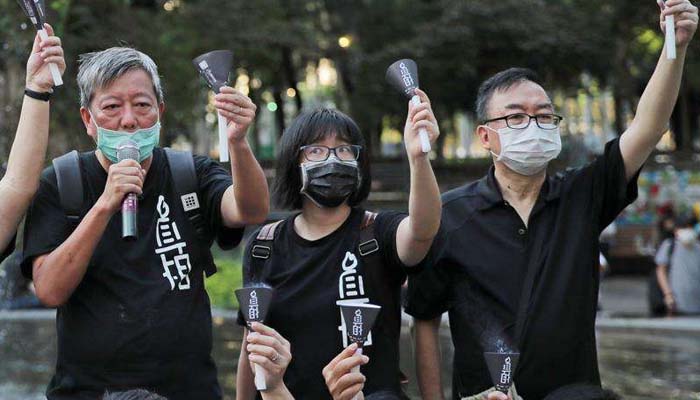
Tiananmen vigil leaders Lee Cheuk-yan and Chow Hang-tung have been found guilty in Hong Kong.
The court in Hong Kong on Friday morning, August 21, found two key organizers behind the large-scale event to remember the 1989 Tiananmen Square crackdown guilty of breaking national security law, CNN reported.
The 69-year-old Lee Cheuk-yan and 41-year-old Chow Hang-tung pleaded not guilty of inciting subversion.
The judge will decide the sentence later, but they could get up to 10 years in prison under the China-introduced law.
As per a summary of Friday, Lee and Chow “incited other persons to organize, plan, commit, or participate in acts by unlawful means with a view to subverting the state power.”
A third activist, veteran pro-democracy lawmaker Albert Ho, had previously pleaded guilty and will be sentenced later.
The case and verdict were marked as the latest example of Hong Kong’s pro-democracy movement being shut down under the national security law.
Prosecutors in Lee and Chow's trial insisted the case was not political and focused on what they saw as a call to incite the overthrowing of China's ruling party, pointing to their former alliance's goal of "ending one-party rule."
Lee and Chow, a barrister who defended herself, said it was about promoting democracy.
According to NBC News, Lee Cheuk-yan and Chow Hang-tung, former leaders of the Hong Kong Alliance in Support of Patriotic Democratic Movements of China, were charged in 2021 with inciting subversion under the national security law.
For three decades, the candlelight vigil organized by the alliance was the only large-scale public commemoration of the Tiananmen Square crackdown on Chinese territory, drawing tens of thousands of people annually.
The event was banned in 2020 during the first year of the Covid-19 pandemic, weeks before Beijing imposed the security law on Hong Kong to quell the 2019 massive anti-government protests.
Observers say their trial symbolizes the erosion of freedom of expression in the former British colony, which returned to Chinese rule in 1997.