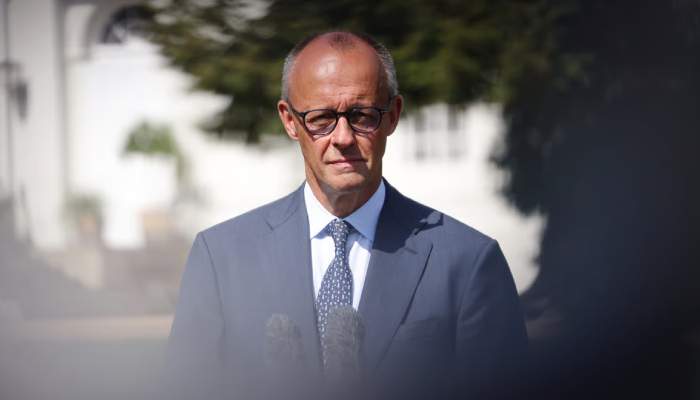
Germany’s embattled chancellor, Friedrich Merz, has vowed to stay in office and fight for future-proofing economic changes despite heavy losses for his conservatives in two state elections, one to the far right and the other to a leftwing party.
Preliminary results indicated Merz’s Christian Democratic Union (CDU) tallied just over the 5% threshold to enter the state parliament in the coastal region of Mecklenburg-Western Pomerania, its worst-ever state score, which he called a “disaster”.
The anti-immigration, Kremlin-friendly Alternative für Deutschland (AfD) party extended a streak of strong showings by coming in first in the former communist region with nearly 38%, more than doubling its previous score.
In the capital, Berlin, one of Germany’s 16 federal states, the far-left Linke looked on course to win with about 25% of the vote, ahead of the incumbent CDU by a five-point margin. The AfD made headway there too, with a clear double-digit result.
The deeply unpopular Merz has been fighting for his political survival after a humiliating series of setbacks with voters this year.
Speculation about his ability to hold on as chancellor reached fever pitch after Saxony-Anhalt state’s AfD chapter routed the CDU with a record 44% for the party in an election two weeks ago.
The Mecklenburg-Western Pomerania result marked the third time the AfD has emerged as the strongest party in a region, although the party seemed likely to remain shut out of power in the state because of a “firewall” of non-cooperation agreed by the other main parties.
In a rare speech on a state election night, Merz admitted the CDU had been bitterly deprived of “tailwinds from Berlin” in both of Sunday’s races. But he said he would remain chancellor and party chair and continue a reform drive on fronts including taxes, healthcare, pensions and reducing bureaucracy.
Merz said the German economy was facing “profound upheaval”, while public discourse had become “harsher and more irreconcilable.”