_updates.jpg)
Tung Chee-hwa, Hong Kong's first chief executive, who said that the people of the region "will be master" of their own destiny in his first speech in 1997, has been laid to rest in a state funeral on Sunday, September 20.
Tung Chee-hwa's death
Tung, who took office in 1997 after Hong Kong handed over from the British colonial rule to China, died on September 9 at the age of 89.
The cause of his death at the time of the announcement was not revealed.
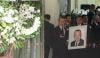
Andrew Tung Lieh-cheung, son of the late shipping magnate was seen carrying a portrait of his father at the Hong Kong Funeral Home in the North Point district, where bouquets of white flowers lined the entrance.
His wife Betty Tung Chiu Hung-ping was seen being supported by family members as she left the memorial, according to local media.
Hong Kong Chief Executive John Lee was among the pallbearers carrying Tung's casket, which was draped with a Chinese flag.
Shi Taifeng, Politburo member and head of the Communist Party's Organisation Department, which oversees personnel decisions, delivered an eulogy, lauding Tung as an "outstanding contributor to 'one country, two systems'" and a "close friend of the Communist Party of China", Xinhua reported.
Tung's successors Donald Tsang, C.Y. Leung and Carrie Lam also paid their respects.
Tung Chee-hwa plays a controversial role in Hong Kong's history
Elected in 1996 by a Beijing-backed selection committee, Tung became Hong Kong's first chief executive under the "one country, two systems" framework and navigated the region through the Asian financial crisis that hit in 1997.
In 2003, Tung tried to push through a security law seen as restricting Hong Kong's freedoms, triggering widespread protests.
Article 23 was ultimately adopted in 2024 by a pro-Beijing legislature.
Tung was also criticised for the government's response to the SARS epidemic in 2003.
He stepped down as chief executive in 2005 and that same year became vice chairman of top advisory body, the Chinese People's Political Consultative Conference. He later accompanied Xi Jinping on visits to the US in 2012 and 2015.
He became an outspoken critic of Hong Kong's pro-democracy protests that flared up in 2019.