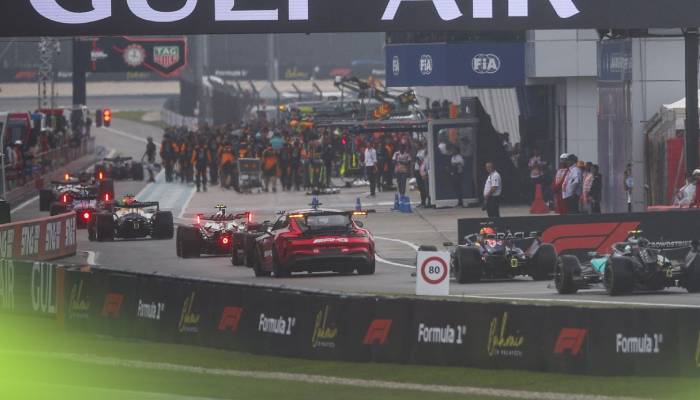
The FIA has revealed the cause of the power loss issues that delayed the start of the Bahrain Grand Prix in Malaysia.
According to TSN, after last weekend’s farcical formation lap at the Bahrain Grand Prix in Malaysia, the FIA will introduce new wet-weather engine software in time for the United States Grand Prix later this month.
The Bahrain Grand Prix, which was hosted at Malaysia’s Sepang circuit, was the first wet race under F1’s new power unit regulations in 2026 and revealed a considerable oversight in the FIA software that polices the deployment of electric power on each car.
Described as “totally unacceptable” and “horrible” by drivers, a bug in the software supplied to all teams by the FIA resulted in multiple cars losing power as they followed the Safety Car at slow speeds on the formation lap.
What happened at Bahrain Grand Prix?
The bug resulted in multiple cars losing drive coming out of the slow Turn 9 corner as the software prevented the use of electric power at a point where the internal combustion engine was struggling at low revs to spool the turbo and regain full power.
Some drivers were able to return to a normal speed once the system reset itself, while others, such as Lewis Hamilton, had to pull to the side of the track to restart their power unit.
“The review concluded that some cars running on low engine RPM [Revolutions Per Minute] in certain circuit sectors where a 250kW [kilowatt] power reduction was applied experienced a loss of power beyond the original intent and that could not be recovered in those sectors,” an FIA statement said ahead of this weekend’s Singapore Grand Prix.
Once the issue was detected, the start of the race was suspended for a second time as the FIA investigated the bug.
Within five minutes of the suspension of the race, the FIA had released updated software to all teams to address the problem.
What will FIA do next?
Although the FIA countered suggestions the software had not been tested at all prior to Sunday’s race, its investigation recommended additional testing be granted in the future.
“The review also recommended that measures would be implemented for testing of the software, recognising that opportunities for testing are limited, to make it robust as possible,” the statement added.
“The FIA would like to address comments suggesting that the software had not been tested prior to its deployment. Before implementation, teams and Power Unit manufacturers conducted simulation exercises to validate the software package, which was subsequently tested in full-scale running during Free Practice 1 sessions at both the Belgian Grand Prix and the Dutch Grand Prix,” it added.
The FIA , together with the teams and Power Unit Manufacturers (PUMs), will continue to strengthen Power Unit software testing and verification capabilities, enhancing the overall validation process through independent assessment and collaborative feedback, including input from the supplier of the standardised Electronics Control Unit (ECU).