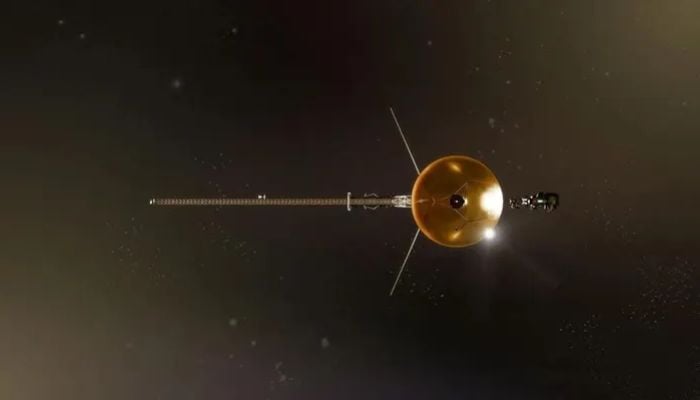
On November 18, 2026, NASA’s Voyager 1 officially became the first human-made object to reach a distance of one light-day from Earth. At 10:16 UTC, the iconic spacecraft crossed the 16.1-billion-mile (25.9-billion-kilometer) mark.
A light-day is the distance a beam of light travels in 24 hours, meaning radio signals sent from Earth now take a full day to reach the probe.
Nearly five decades in space
Launched on September 5, 1977, Voyager 1 has been flying through space for over 49 years. Originally built to study Jupiter and Saturn, the probe kept going and entered interstellar space in August 2012.
Traveling at roughly 38,000 miles per hour relative to the Sun, it continues to venture deeper into the cosmos in the direction of the constellation Ophiuchus.
Still sending data home
Despite its extreme age and dwindling plutonium power supply, Voyager 1 is still active. To conserve energy – including turning off its low-energy charged particle instrument in April 2026 – NASA engineers now run only two science instruments: the magnetometer and the plasma wave subsystem.
Using the giant dishes of NASA’s Deep Space Network, scientists continue to receive vital data about the harsh environment beyond our solar system, proving that humanity’s farthest explorer is far from finished.