England is seeing higher-than-usual numbers of scabies infections this winter.
Health officials have warned that the conditions, caused by tiny mites called Sarcoptes scabiei that burrow into the skin, spread easily through close contact and can trigger intense itching and discomfort.
According to the latest report from the Royal College of General Practitioners' Research and Surveillance Centre, scabies has been spreading more than expected in England with the number of cases rising during autumn and winter.
Although mites are almost invisible to the naked eye, they can still cause strong allergic reaction in the body due to their saliva, eggs and waste which results in intense itching and skin irritation.
If left untreated, scabies can persist for months or even years as the mites continue to reproduce skin.
They can also survive on items such as bed sheets, clothing and towels.
What are the symptoms of scabies?
Scabies symptoms usually do not appear immediately and can take three to six weeks after the first infection to show, although people who had scabies before may notice symptoms within few days.
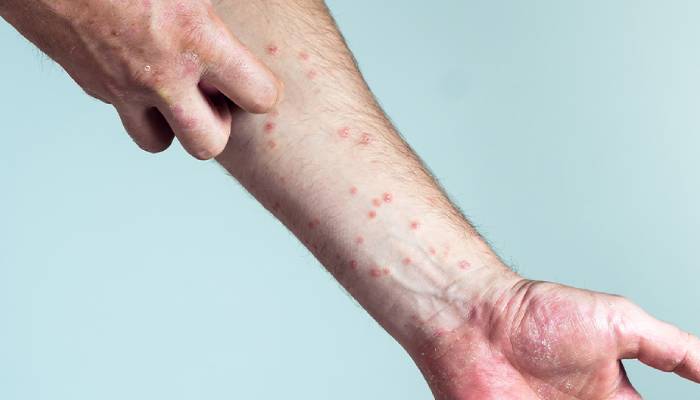
Common signs include severe itching that often worsens at night along with small bumps, blisters or thin burrow-like lines on areas such as hands, wrists, elbows, nipple, genitals and waist.
In more serious cases, the skin can become thick, rough and scaly while in children and older adults, symptoms may also appear on the scalp, face or soles of the feet.
How is scabies treated?
Scabies can be treated effectively by using special medicated creams and lotions known as scabicides and with good hygiene.
To prevent reinfection, bedding, clothes or towels should be washed at higher temperatures then tumble-dried or ironed.
Items that cannot be washed should be sealed in a bag for at least three days, as the mites will die without contact with human skin.