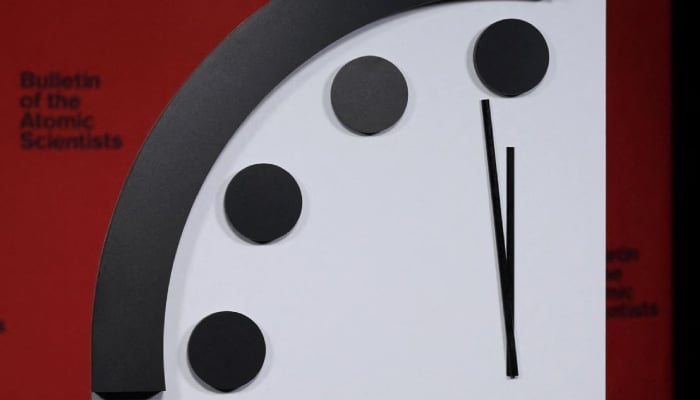
As the name suggests, the Doomsday Clock is a symbolic tool where time is moved closer to and further away from midnight to indicate the likelihood of a man-made catastrophe, which could cause the end of the world.
The experts in charge of moving the Doomsday Clock weigh several factors, including the possibility of nuclear war or a catastrophic climate change event, and then make their decision of whether to keep things where they are or shift the second hand closer to midnight.
Last year, the clock was set to 89 seconds to midnight, the closest it had ever been to hitting the haunting marker.
What if the Doomsday Clock reaches midnight?
If the clock strikes midnight, it would indicate that a nuclear attack or a destructive natural disaster has occurred, which could wipe out humanity.
The Doomsday Clock: 2026 update
On Tuesday, January 27, the Doomsday Clock was moved to 85 seconds to midnight, with world-leading scientists citing dangers of global war, climate change, and artificial intelligence as reasons for their decision.
The ominous clock is now the closest to midnight since its introduction in 1947. It is updated each year by the Bulletin of the Atomic Scientists, which determines how close humanity is to self-annihilation.
The Bulletin of the Atomic Scientists explains the change
The Bulletin of the Atomic Scientists' experts described 2025 as a "bleak" year for the Doomsday Clock, as factors such as climate change and the threat of wars become more prominent for the human race.
Citing a worldwide "failure of leadership", Alexandra Bell, president and CEO, Bulletin of the Atomic Scientists, noted, "The Doomsday Clock's message cannot be clearer."
He added, "Catastrophic risks are on the rise, cooperation is on the decline, and we are running out of time. Change is both necessary and possible, but the global community must demand swift action from their leaders."
Backstory of the Doomsday Clock
In 1947, The Bulletin of the Atomic Scientists became a magazine, and its first cover was of a clock designed by artist Martyl Langsdorf.
The image was hailed as the Doomsday Clock, set to measure how close humanity is to its end.
While initially the clock was made to estimate a nuclear apocalypse, in recent years other facts, such as climate change, have also been included.
Following the development of hydrogen bombs, by 1953, the clock was set to two minutes to midnight, and it reached three minutes in 1984 during the Cold War.
At the end of the Cold War in 1991 and the START treaty between the US and Russia, the clock moved back to 17 minutes to midnight, the furthest it was to the catastrophe.
In 2020, the clock was set at 100 seconds to midnight, and it has only moved closer to midnight.
How does the Doomsday Clock work?
Each year, the members of the Science and Security Board are asked to ponder on two questions:
1. Is humanity safer or at greater risk this year than last year?
2. Is humanity safer or at greater risk compared with the 79 years the clock has been set?
Their answers set the clock for the coming year.