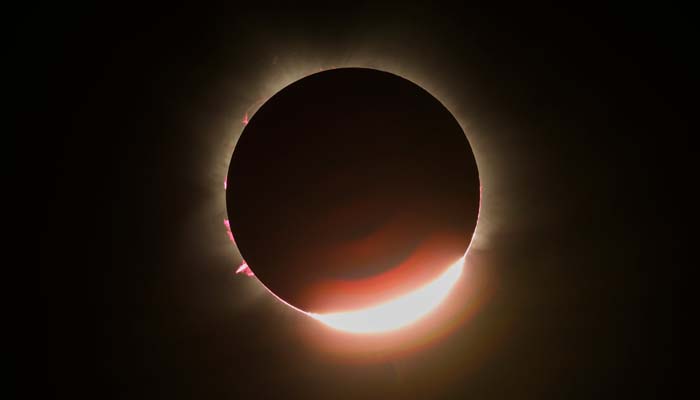
A total solar eclipse is set to happen next month, but not everyone in the world will be able to see it.
A total solar eclipse will soon take place across Greenland, Iceland, northern Russia, Spain, a part of Portugal and the Atlantic Ocean, according to NASA.
While Americans would have to travel to the locations listed above to experience the total solar eclipse, areas of the U.S., from Alaska to North Carolina, will be able to experience a partial solar eclipse, along with Canada, Europe and northwestern Africa.
The night after the eclipse will also offer an extra-special treat, as the Perseid meteor shower will peak during the new moon, the optimal time for viewing. The Perseid is "considered the best meteor shower of the year," according to NASA.
A total solar eclipse usually only happens about once every 18 months, per Time and Date. The last total solar eclipse was on April 8, 2024.
Here's what to know about the upcoming event.
When is the total solar eclipse?
The total solar eclipse will take place on Aug. 12, at around 11:34 a.m. ET, according to Date and Time.
US will see a 'bite' taken out of the sun and see a partial solar eclipse
During the solar eclipse, areas of the U.S. and southern Canada in line to view the event will look as if a "bite" was taken out of the sun, and the moon will appear to cover only a tiny portion of the sun from North America's perspective, according to NASA.
What is total solar eclipse?
A solar eclipse occurs when the moon moves between the sun and Earth and casts a shadow on Earth that either fully or partially blocks the sun's face, according to NASA.
When the sun is completely blocked by the moon, it is known as the period of totality. During this time, the sky darkens, and viewers can remove their eclipse glasses to view our planet's moon blocking our star.
However, only a small part of the Earth, called the path of totality, will get to experience a total solar eclipse. Because it is not on the path, the U.S. will only experience a partial solar eclipse, where only a portion of the sun will be covered, but we will not see it completely blacked out.