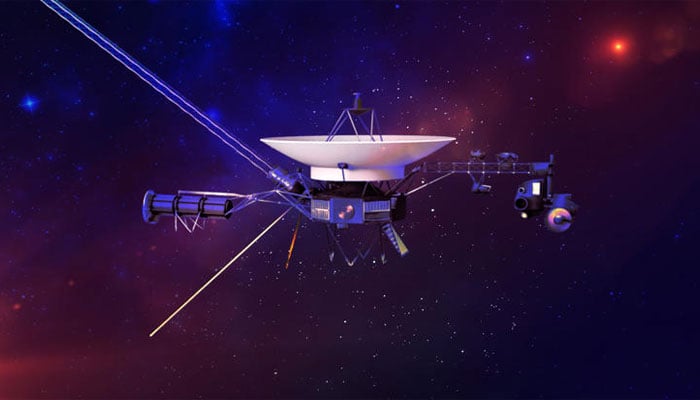
In a significant development, NASA's Voyager 1 is approaching to accomplish a major milestone, emphasising the scale of space nearly 50 years following its departure from Earth.
Several reports suggested the spacecraft will be the first ever to reach a distance of one light-day from our planet, a staggering 16 billion miles away, by November 2026.
At this distance, any command sent to Voyager 1 will take an entire 12 hours to reach the probe at the speed of light, with 24 hours required for a response.
Voyager project manager at NASA’s Jet Propulsion Laboratory Suzy Dodd stated, “If I send a command and say, ‘good morning, Voyager 1,’ at 8 a.m. on a Monday, I will receive Voyager 1’s response on Wednesday morning at around 8 a.m.”
To maintain communication with Earth, the probe transmits data at the speed of 160 bits per second, which is equal to the speed of dial-up internet.
Ms. Dodd explained, “The distance from Earth means signals take much longer to arrive, and their strength diminishes along the way,”
“It takes multiple antenna arrays to collect that signal,” Dodd added.
This slow data rate means the team will only receive limited information regarding the spacecraft, and quick fixes remain impossible.
However, both Voyagers were built to look after themselves.
Ms Dodd further stated, "If they get something going wrong, they can put themselves in a safe state so that they can wait until we're able to talk to the spacecraft and figure out what the problem is and resolve that issue."
For years, the team has been making difficult choices to extend the longevity of these spacecraft, switching off engineering systems and instruments to save power.
Notably, the mission started in the late 70s, when Saturn, Neptune, Jupiter, and Uranus occurred to line up in a way that happens only once every 175 years.
Due to that alignment, the spacecraft visited every planet, receiving "slingshot" momentum from gravitational pulls.