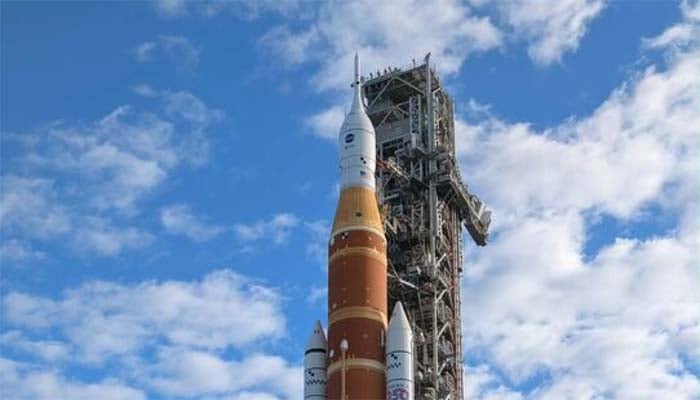
In a significant milestone, NASA’s Artemis II Space Launch System (SLS) rocket and Orion spacecraft have launched at Launch Pad 39B at the Kennedy Space Center in Florida.
The launch comes ahead of the agency’s first crewed Artemis mission, which will be the first crewed mission to the Moon since Apollo 17 touched the ground in December 1972.
The towering orange-and-white rocket successfully reached the pad at 6:42 p.m. EST on Saturday, January 17, following the completion of a nearly 12-hour journey from the Vehicle Assembly Building. Earlier in the day, NASA’s crawler-transporter 2 started the slow four-mile launch, carrying the fully stacked SLS and Orion at a top speed of just 0.82 miles every hour.
The rocket was carried by a massively bigger crawler-transporter, travelling at a top speed of 0.82 mph (1.3 km/h).
Nasa said the rocket will be prepared over the next few days for what it calls a "wet dress rehearsal" - a test for fuel operations and countdown procedures.
After exiting the Vehicle Assembly Building, the rocket paused briefly to let teams reposition the crew access arm that will offer astronauts and closeout crews access to the Orion spacecraft on launch day.
Engineers will prepare the vehicle for a wet dress rehearsal in the near future, a critical test that is particularly designed to validate fueling operations and countdown procedures.
Targeted for no later than February 2, the rehearsal will involve loading the rocket with super-cold propellants, conducting a countdown, and safely draining the fuel.
Extra rehearsals are likely to be conducted if required, and NASA could launch the vehicle back to the assembly building for more work.
It is worth noting that Artemis II will carry NASA astronauts Reid Wiseman, Victor Glover and Christina Koch, along with Canadian Space Agency astronaut Jeremy Hansen, on a roughly 10-day mission around the Moon.
Kock stated, “Astronauts are the calmest people on launch day. And I think... it feels that way because we're just so ready to fulfil the mission that we came here to do, that we've trained to do."
Hansen hopes that the mission would become a great inspiration for the world.
"The Moon is something that I've taken for granted. I've looked at it my whole life, but then you just glance at it and glance away," he said.
"But now I've been staring at it a lot more, and I think others will be joining us and staring at the Moon a lot more as there will be humans flying around the far side and that is just good for humanity."
The launch marks a major step forward towards future crewed lunar landings and eventual missions to Mars.