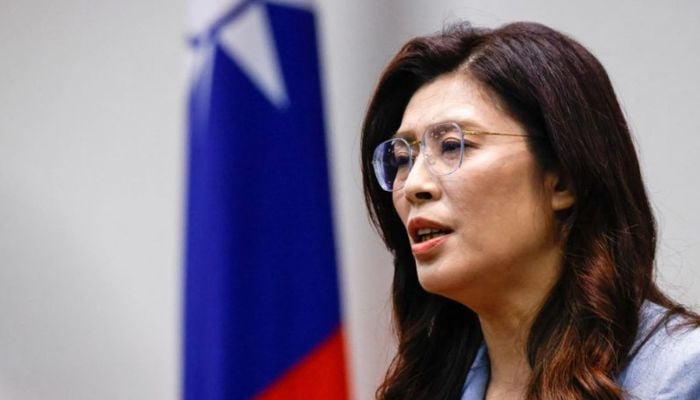
Taiwanese opposition leader Cheng Li-wun pledged for reconciliation and unity with China on Wednesday.
She aimed to channel the spirit of her party's founder, Sun Yat-sen, and seek reconciliation with China, offering praise at his tomb for the country's achievements following the communist revolution.
Cheng, chairwoman of the Kuomintang (KMT), Taiwan's largest opposition party, is in China at a time of increased Chinese military pressure on Taiwan.
It reveals that Beijing views it as its own territory, and the opposition-dominated parliament stalls a government plan for $40 billion in extra defense spending.
Founder of the Republic of China:
While Taiwan is a multi-party democracy, China's communist party brooks no dissent to its rule.
China refuses to speak to Taiwan President Lai Ching-te, saying he is a "separatist," as Lai says only Taiwan's people can decide their future, as neither government formally recognizes the other.
Cheng says she is on a mission of peace and that while she supports defence spending, it has to be balanced with dialogue.
"I think this is very important for peaceful exchanges between the two sides of the Taiwan Strait."
Taiwan officials wary:
Wu Cheng, a spokesperson for Taiwan's ruling Democratic Progressive Party, said if the KMT really wanted stability across the strait, it should stop blocking defence spending in parliament.
"Peace has never come from the charity of dictators; it must be safeguarded by Taiwan's own strength," he said in a statement.
Lai's government has said Cheng should also tell Chinese officials, including President Xi Jinping should she meet him, to stop China's regular military harassment of the island and respect the Taiwanese people's right to choose their own future.
Speaking to reporters at parliament in Taipei earlier on Wednesday, Taiwan National Security Bureau Director-General Tsai Ming-yen said he couldn't comment on what political parties do but added China uses a carrot-and-stick approach.
'China uses military intimidation and harassment to create an atmosphere of rising military danger and instability across the Taiwan Strait,' said Tsai.
"This is intended to make Taiwan's society and public feel the psychological pressure and anxiety of a possible conflict," Tsai added.
"It aims to divide Taiwanese society internally, boosting the visibility of pro-China positions. It can also further obstruct efforts to push forward U.S. arms procurement deals."