Buried way underneath Antarctica’s ice, researchers have found an enormous, continent-sized network of basins we never knew were there until now.
According to Live Science, scientists have discovered a giant, fan-shaped structure that connects several well-known basins deep beneath the East Antarctic Ice Sheet, and it may have formed in the breakup of the ancient supercontinent Gondwana.
The feature is the product of a tectonic process known as distributed rotational extension, in which Earth's crust deforms outward from a fixed, central point, like fingers spreading out on a human hand.
The gaps between the "fingers" in East Antarctica are triangular basins that were previously described but not recorded as belonging to a single system, researchers reported in a new study.
First author Egidio Armadillo told Live Science in an email, "Rotational extension is known from other tectonic settings, but recognizing a feature of this scale, hidden beneath the East Antarctic Ice Sheet, is quite remarkable.”
"If our interpretation is correct, this may be one of the largest and clearest examples of distributed rotational extension yet recognized in continental crust," added the associate professor and researcher in the Applied Geophysics Laboratory at the University of Genoa in Italy.
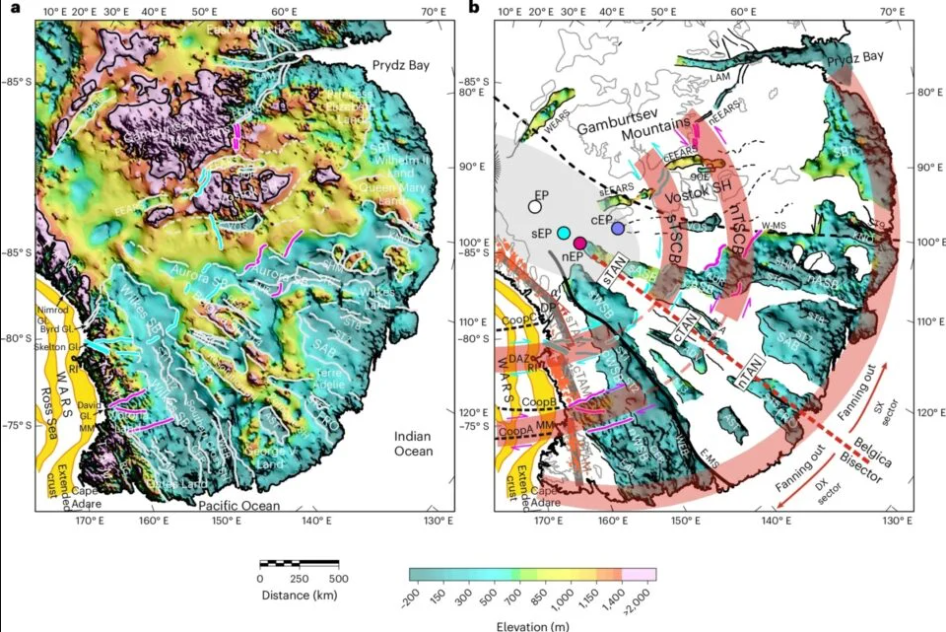
The discovery began with the simple observation that many buried basins in East Antarctica seem to radiate from the same place.
The results, published on June 3 in the journal Nature Geoscience, support the idea that some of East Antarctica's best-known features, including the Wilkes and Aurora basins and the basin that hosts Lake Vostok, the largest known subglacial lake on Earth, were formed by distributed rotational extension. But it's unclear exactly when this happened.