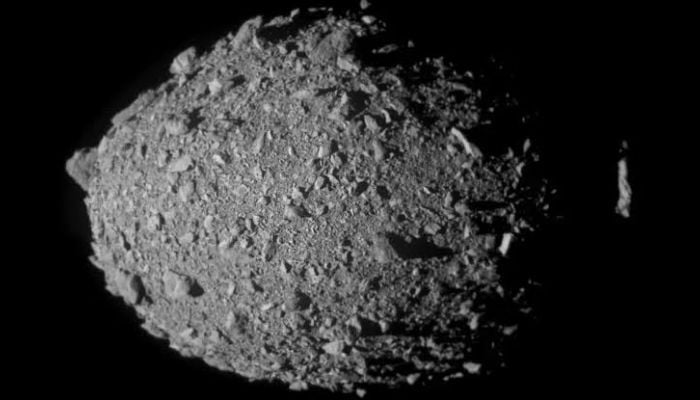
New close-up images from the European Space Agency’s Hera spacecraft reveal the dramatic aftermath of NASA’s historic planetary defense test.
Four years after NASA deliberately crashed its DART probe into a space rock, the newly arrived Hera spacecraft captured photos showing a crater the size of a sports stadium flattened across the asteroid’s face.
A historic space crash
In September 2022, NASA slammed its half-ton DART spacecraft into Dimorphos – a small moonlet orbiting a larger asteroid named Didymos – at over 13,000 miles per hour.
Neither space rock posed a threat to Earth, making them safe targets to test whether a kinetic impact could nudge a dangerous asteroid off a collision course.
Ground telescopes later confirmed the crash shortened Dimorphos’s orbit by 33 minutes, far exceeding scientists’ expectations.
What new photos reveal
Arriving at the asteroid pair in November 2026, the car-sized Hera probe snapped high-resolution images from less than 20 miles away.
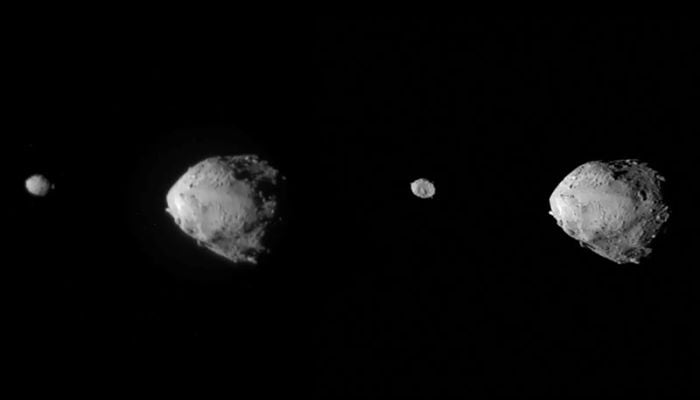
Scientists discovered the impact completely reshaped one side of Dimorphos, leaving a massive crater spanning its entire width and sending the rock tumbling wildly in its orbit.
Earlier studies in 2026 also confirmed the crash slightly shifted the entire binary system’s path around the Sun.
Protecting Earth’s future
Next, Hera will move closer and deploy two tiny cube satellites to scan Dimorphos’s interior with radar. By measuring the asteroid’s exact mass and internal structure, researchers will learn how to reliably deflect any real killer asteroid discovered heading toward Earth in the future.