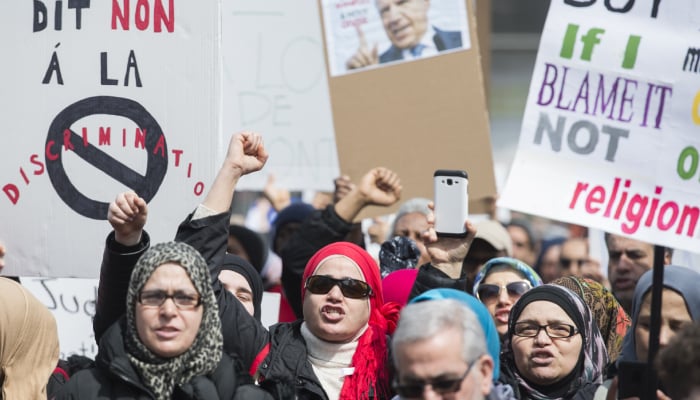
Canada's top court has largely upheld a Quebec law banning public sector workers from wearing religious symbols, including the hijab and the cross.
The law, known as Bill 21, faced legal challenges from a range of groups, including female Muslim, Sikh and Catholic teachers, who argued it violated their fundamental rights.
Quebec passed the law in 2019 under a unique fixture of Canada's constitution called the "notwithstanding clause" - a legal loophole that allows governments to override certain rights, like freedom of religion.
The Supreme Court's decision is one of the most closely watched in Canadian history, with an impact that will be felt both in Quebec and across the country.
Civil liberty groups in Quebec have criticised Bill 21, saying it disproportionately affects Muslim women who wear the hijab, arguing that it has excluded them from key areas of public life in the province.
The Supreme Court was asked to weigh in on a number of questions, including on the constitutionality of Bill 21, whether Quebec's use of the notwithstanding clause was appropriate, and whether there are limits to its use.
On Friday, the top court confirmed the validity of Bill 21, but ruled that the law infringes on democratic rights by banning Quebec's elected officials from wearing a face covering for religious reasons.
The court also ruled that a Canadian court has the power to declare whether a law is consistent with the Canadian Charter of Rights and Freedoms even if the notwithstanding clause is invoked, but that they would not do so in this case.