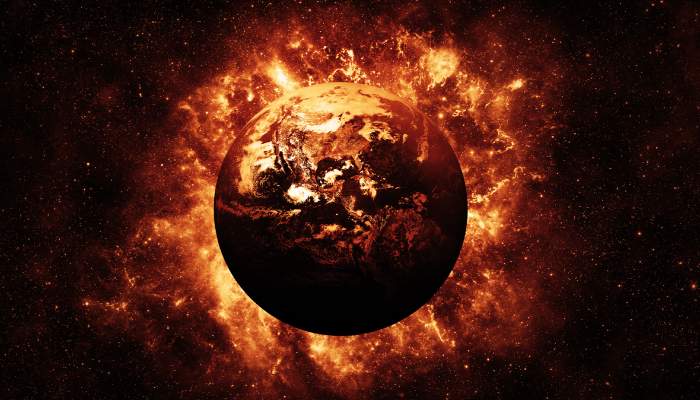
Although the end of the Earth is often imagined as the impact of an asteroid or the moment when the Sun engulfs the planet.
But the real risk, according to various studies, is that the atmosphere will become unsuitable for complex life long before the planet physically disappears, Marca reported.
This process would be driven by the natural evolution of the Sun, which becomes hotter as it ages. It is not a perceptible change on a human scale, but it is cumulative on scales of billions of years.
According to a NASA scientific review, Earth could become uninhabitable for complex life forms in just over 1 billion years.
In an even more distant horizon, the Sun will eventually expand and become a red giant in about 5 billion years.
However, problems could begin much sooner due to a chain reaction: increasing Earth's temperature increases water evaporation, and water vapor in turn intensifies warming, favoring a runaway greenhouse process.
A study published in Nature Geoscience, led by Kazumi Ozaki (Toho University) and Christopher Reinhard (Georgia Institute of Technology), simulated the planet's future using climate and chemical models. After some 400,000 simulations, they concluded that the oxygen-rich atmosphere could last around another 1.1 billion years.
The most relevant result is the order of the changes: the model suggests that significant oxygen loss could occur before Earth loses much of its water to space.
In practice, the air could become unbreathable before the planet is completely dehydrated.