
The U.S. Navy is aggressively pushing to modernize its fleet with laser weapons, though officials acknowledge that a full-scale “laser fleet” remains a long-term goal.
Currently, the Navy has integrated directed energy systems, such as the Optical Dazzling Interdictor (ODIN) and the High Energy Laser with Integrated Optical-dazzler and Surveillance (HELIOS), onto several destroyers.
These systems are already being used in real-world operations to disable enemy drone sensors.
However, Chief of Naval Operations Adm. Daryl Caudle recently emphasized that the service must prioritize funding for “compact, high-density energy storage and thermal management systems” to truly scale this capability.
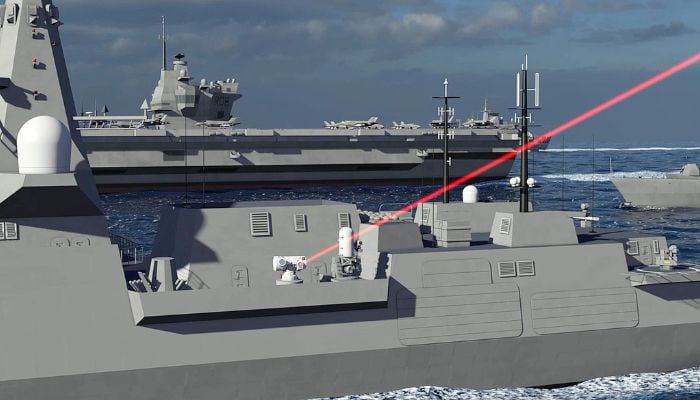
Caudle noted that true high-energy laser defense for missiles cannot simply be “engineered around existing hulls,” but must be built into future warships from the “keel up.”
To bridge the gap, the Navy is pursuing containerized laser systems which allow the service to “adapt capability faster than traditional acquisition timelines.”
While a fully realized laser-armed battleship may not arrive until the 2030s, the Navy is moving quickly to train sailors and refine the technology.
As one official put it, the goal is to deliver combat power “at the speed of relevance – not the speed of platform-centric acquisition.”