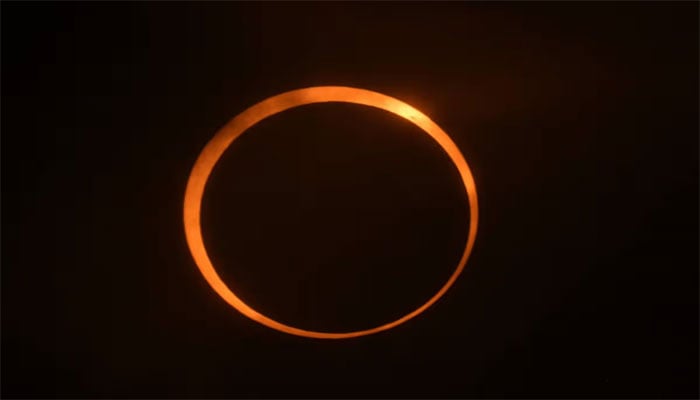
A rare celestial event “ring of fire” annular solar eclipse will spread through Antarctica on Tuesday, February 17, 2026, as the center of the sun is briefly blocked by up to 96% by the same new moon that ushers in two major cultural events.
The event has set up a stage for Lunar New Year (also called Chinese New Year) celebrations.
Notably, the new crescent moon on February 18 will mark the beginning of the Islamic month of Ramadan.
What is ‘Ring Of Fire’ annular solar eclipse?
Total solar eclipses occur when the sun and moon can appear in a similar size in Earth’s sky; the sun is 400 times larger than the moon, but also 400 times farther away. However, it doesn’t happen every time.
Since the moon orbits the Earth in a slight ellipse, it’s sometimes at a great distance, so its apparent size is smaller in contrast to the sun’s.
Who witnessed “Ring of Fire”?
As mentioned earlier, while the “ring of fire” remains confined to Antarctica, a partial solar eclipse will be visible across much of the continent, southeastern Africa and select parts of South America.
Upcoming celestial event
Skygazers all across the globe can look west-southwest after sunset on February 18 for a crescent moon, called “Ramadan Moon,”, with Venus glowing closer to the horizon.
In the following evenings, the waxing crescent will join Saturn and Mercury in a subtle “planet parade,” offering an excellent display.
However, on March 3, a total lunar eclipse is set to appear across North America. Visible before dawn across the US (though best seen in western states), the full worm moon will become a reddish-pinkish-copper color for 58 minutes as it passes through Earth’s central shadow.